
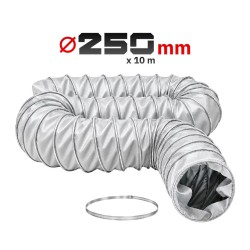
TAPE-250-zestaw
Toolsa Flexible Heater Ducting ⌀250 mm × 10 m with Hose Clamp (TA-DV20 | TA-DV30)
- Toolsa TA-DV20 | TA-DV30
- 250 mm
- 10 m
zł1,131.60 920,00 zł net At your place on Thursday
Accessories for Toolsa TA-DV indirect diesel heaters form two separate systems, each fitted to a different outlet on the machine. One distributes warm air through the heated space, the other takes flue gas out of the building.
5 products
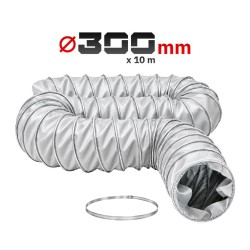
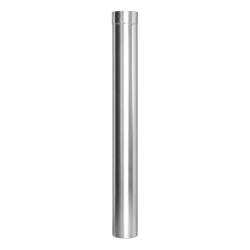
Heat distribution. Flexible ducting fitted to the warm-air outlet carries the airflow to the far end of a hall, into a marquee or to one chosen zone on site. The TA-DV20 and TA-DV30 take the 250 mm flexible ducting set, the TA-DV50 takes the 300 mm ducting set. Both ducts are 10 m long, and each set includes a hose clamp that holds the duct on the outlet.
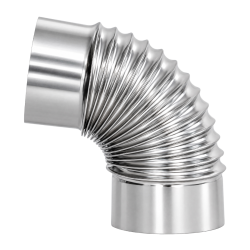
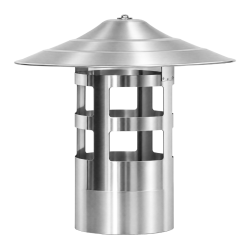
Flue gas extraction. The 110 mm flue is made up of a 1 m flue pipe, a 90° flue elbow of 114 mm that turns the flue towards an opening in a wall or window, and a flue rain cap that keeps rain and snow out of the outlet. The same three parts serve the TA-DV20, TA-DV30 and TA-DV50.
Ducting is never connected to the flue outlet — the heater's manual states which outlet is which. The heaters themselves are in oil-fired air heaters, with the full range in air heaters.
A heater without ducting warms mainly what stands in front of it. The airflow disperses within a few metres, so it is too hot beside the machine while nothing changes at the other end of the space. A 10 m duct carries that airflow intact to where it is wanted.
The heater usually stands near the door, where it can be refuelled, while the work happens further in. Ducting separates the two: the machine stays by the entrance and the heat reaches the working positions. In a hall 8 m high, heating only the working zone uses many times less fuel than heating the whole volume.
With a marquee the heater stands outside — for safety, noise and fuel odour — and heat enters only through ducting, via an inlet in the side wall. For drying, a duct terminated at the chosen point directs the whole airflow at a wet wall or fresh screed instead of blowing into open space. A 250 or 300 mm diameter carries the airflow without excessive resistance, provided the route has no sharp kinks.
The duct slides over the warm-air outlet spigot, and a hose clamp tightens its end so that it does not slip off during operation or when the heater is moved. The clamp is not sold on its own: it comes with the ducting, both in the 250 mm ducting set for the TA-DV20 and TA-DV30 and in the 300 mm ducting set for the TA-DV50.
TA-DV units are indirect heaters: diesel burns in a sealed combustion chamber, only heated air enters the space, and flue gas leaves through a separate spigot. The flue takes it from that spigot to the outside — without one, the gas stays in the room where people are working.
Flue gas leaves the heater through a 110 mm flue pipe, 1 m long. Where the flue has to change direction — towards an opening in a wall or a window, for example — a 90° flue elbow of 114 mm is used. At the outlet, outside the building, the flue is finished with a 110 mm flue rain cap that keeps out rain and snow. The parts are sold separately, so a damaged one can be replaced without buying the rest.
Ducting of 250 or 300 mm connects only to the warm-air outlet, the 110 mm flue only to the flue spigot. The difference in diameter helps to tell them apart, but the heater's manual decides, not the look of the connector: carbon monoxide has no smell and cannot be detected without an alarm. Direct-fired heaters such as the TA-D175 (51 kW) and TA-D215 (63 kW) have no flue — they release combustion products into the heated space, so they run only where air exchange is assured, and ducting does not change that.
| Heater | Flexible ducting with clamp (set) | Flue pipe | Flue elbow | Rain cap |
|---|---|---|---|---|
| TA-DV20 (20 kW, up to 320 m³) | ⌀250 mm × 10 m + clamp | ⌀110 mm × 1 m | 90°, ⌀114 mm | ⌀110 mm |
| TA-DV30 (30 kW, up to 480 m³) | ⌀250 mm × 10 m + clamp | ⌀110 mm × 1 m | 90°, ⌀114 mm | ⌀110 mm |
| TA-DV50 (50 kW, up to 800 m³) | ⌀300 mm × 10 m + clamp | ⌀110 mm × 1 m | 90°, ⌀114 mm | ⌀110 mm |
Ducting is matched to the outlet spigot, not to the length of the run. Ducting narrower than the outlet throttles the flow: the fan works against higher resistance and heat exchanger temperature rises — on a heater with thermal cut-out that ends in a shutdown, at worst in a shorter exchanger life. Wider ducting will not stay on the connection. The flue is shared across the series: moving from a TA-DV20 to a TA-DV50 means changing only the 250 mm ducting set for the 300 mm one, which comes with its own clamp.
An indirect heater burns fuel in a sealed combustion chamber and releases flue gas through a separate spigot, so it runs with a flue that takes that gas out of the building. In the Toolsa range this applies to the TA-DV20 (20 kW), TA-DV30 (30 kW) and TA-DV50 (50 kW), and the same 110 mm flue fits all of them. Without a flue connected, the gas from the spigot stays in the room. Direct-fired heaters such as the TA-D175 (51 kW) and TA-D215 (63 kW) have no flue and may only run where air exchange is assured.
The flue for Toolsa TA-DV heaters consists of three parts sold separately. A 110 mm flue pipe, 1 m long, carries flue gas away from the heater spigot. A 90° flue elbow with a 114 mm diameter turns the flue through a right angle where it has to exit through an opening in a wall or a window. The flue ends in a 110 mm rain cap that shields the outlet from the weather. The same parts fit the TA-DV20, TA-DV30 and TA-DV50, so the flue stays unchanged when moving to another model in the series.
Ducting and a flue are two separate systems connected to different outlets on the heater. Ducting, a flexible hose of 250 mm (TA-DV20, TA-DV30) or 300 mm (TA-DV50) and 10 m long, distributes heated air. The 110 mm flue with its 114 mm elbow takes flue gas outside. Ducting is not suitable for flue gas, and a flue is not suitable for warm air. Mixing them up is dangerous because carbon monoxide has no smell and cannot be detected without an alarm, so check the purpose of each outlet in the heater's manual rather than judging by the look of the connector.
Ducting diameter has to match the heater's warm-air outlet: in the Toolsa range 250 mm fits the TA-DV20 and TA-DV30, and 300 mm fits the TA-DV50. It is not chosen by route length or room size. Ducting narrower than the outlet throttles the flow, raising heat exchanger temperature until a machine with thermal cut-out shuts itself down. Wider ducting will not stay on the spigot. With a heater of another make, measure the outlet rather than assuming compatibility from appearance.
A hose clamp secures flexible ducting to the heater's warm-air outlet so that the duct does not slip off during operation, when the heater is moved or when someone pulls on it by accident. Toolsa sells the clamp only as part of a ducting set: 250 mm for the TA-DV20 and TA-DV30, or 300 mm for the TA-DV50, each 10 m long. It is part of the warm-air system, together with the duct. The connection to the spigot takes the most strain, especially where ducting is often removed and refitted.
Toolsa ducts are 10 m each, a length suited to a typical hall or marquee. Practical reach depends less on length than on route resistance: every sharp bend costs more than several metres of duct laid straight. Joining several lengths into one run raises resistance and lowers outlet temperature, and on a heater with thermal cut-out it can cause repeated shutdowns. Where heat has to travel further than 10 m, moving the heater makes more sense than adding ducting.
Surplus ducting should not be coiled tightly: a coiled section presents noticeably higher resistance and heats up more than one laid out, because the heat has no way to escape. Where the route is shorter than 10 m, the surplus is run in a wide curve along a wall. Cutting a 250 or 300 mm duct removes the factory-formed end used to secure it to the spigot, so it is a last resort and calls for a new connection to be made.
The duct surface reaches a temperature close to that of the air inside, so it must not be laid directly on heat-sensitive materials or rested against building sheeting, insulation boards or marquee fabric. A 250 or 300 mm duct can run freely across a concrete floor, provided it does not block movement and nobody drives over it. Where it passes through a marquee wall, use the purpose-made inlet rather than an opening cut on site.
The connection to the heater wears first: the end of the 250 or 300 mm duct and the hose clamp take the strain when the heater is repositioned, and they are what fails when the duct is pulled rather than moved. The second weak point is kinking: the duct loses its seal where it is folded in the same place each time it is packed away after work. Storing it loosely coiled, without crushing and without heavy items on top, extends its life more than any maintenance procedure.
The heaters these accessories fit are in oil-fired air heaters. Mains-powered units, which need no flue at all, are in electric air heaters, and the complete range of heating equipment is in air heaters.
Essential cookies keep your cart and login working — the shop will not run without them. The rest let us measure traffic and target our ads, and we switch them on only with your consent. You can change your choice at any time using the “Cookie settings” link in the footer. Cookie policy
Essential
Cart, login, form security and remembering this choice. The shop will not work without them, so they need no consent.
Toolsa
Analytics
We count page views and checkout paths to find what is broken in the shop. We look at the data in aggregate.
Google Analytics · Microsoft Clarity
Marketing
We show our ads outside the shop and check which of them lead to a purchase. Phone callback requests land here too.
Google Ads · OptinMonster · Zadarma