
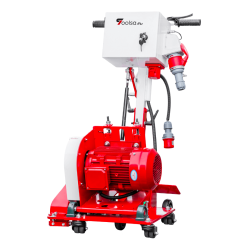
THM130M400
Toolsa THM130 M Floor Heating Scarifier, Manual Feed (4 Kw | 400 V)
- 77 kg
- 4 kW
- Manualny
zł8,608.77 6 999,00 zł net At your place on Thursday
An underfloor heating milling machine cuts a groove for the pipe into a finished slab — it does not plane the floor, it channels into it. That is how underfloor heating goes into an existing building without breaking up the screed and without raising the floor level.
1 product
It is a different machine from a concrete scarifier, even though both are called milling machines: the scarifier works the whole surface 3–8 mm deep, this one goes down to 25 mm in one narrow band. In the UK it is also known as a floor chaser or groove cutter.
The Toolsa THM130 M runs a 130 mm cutter with a 22.2 mm bore, cuts a 16 or 17.3 mm groove and carries a 4 kW cutting motor on 400 V plus its own 0.44 kW drive. The cutting wheels themselves are in underfloor heating cutters.
In a new building, underfloor heating is laid on the slab and covered with screed. In an existing building that route means either breaking up the floor or raising it by several centimetres — which means cutting doors down, reworking thresholds and living with a step between rooms. Milling avoids both: the pipe goes into the floor rather than on top of it.
The groove has to take the pipe, so its width follows the pipe diameter rather than preference. The THM130 M cuts 16 mm or 17.3 mm — two sizes covering the PEX and PERT pipe used in underfloor heating. A groove narrower than the pipe forces a second pass alongside the first and leaves a ragged edge; a groove clearly wider than needed means more repair mortar and more spoil carried out of the building.
The machine goes down to 25 mm, set by a lever with a locking pin, so a depth once dialled in holds for the whole run. The arithmetic is simple: with a 16 mm pipe sunk to full depth, about 9 mm is left above it for repair mortar. It is also why you need to know where the reinforcement and the existing services run before you start — 25 mm is a real depth, not a surface score.
Both are milling machines with diamond tooling, and they do opposite things. The underfloor machine cuts one narrow, deep channel in a single band. The scarifier strips a wide, shallow layer off the whole floor to open it up for a new coating. Swapping one for the other ends either in a groove that cannot be cut, or a floor torn up where it was meant to stay intact.
| Machine | What it does | Width | Depth | Tooling | Drive |
|---|---|---|---|---|---|
| THM130 M | groove for the pipe | 16 or 17.3 mm | to 25 mm | 130 × 17 mm cutter | 4 kW, 400 V |
| TSC-150 | surface planing | 200 mm | to 3 mm | drum: 68 cutters on 4 shafts | 2.2 kW, 230 V |
| TSC-250 Auto Drive | surface planing | 250 mm | 0–8 mm | drum: 90 cutters on 6 shafts | 7.5 kW, 400 V, self-propelled |
The tooling difference matters more than the figures. The underfloor machine works with one wheel on a spindle, like a floor saw. The scarifier carries a drum on which dozens of cutters hang loose on shafts and strike the concrete under centrifugal force. The full surface-machine range is in concrete scarifiers, and the drums themselves in scarifier drums.
The cutting motor is 4 kW and runs on 400 V at 50 Hz; there is no single-phase version, and that is not an omission. Cutting 25 mm into concrete draws a torque a 230 V circuit will not hold without the speed dropping, and speed dropping inside a narrow groove ends with the wheel jamming. Confirm there is a three-phase socket or a generator on site before the machine goes out — a flat under refurbishment very often has neither.
A separate 0.44 kW drive moves the machine at a constant speed instead of it being pushed. That has a direct effect on the result: uneven operator pressure gives a groove that is deeper in places and shallower in others, and pipe laid in that channel floats up where the channel is shallow. The front wheels swivel and let the machine turn almost on the spot, which decides how many of the loop bends can be cut by machine rather than finished by hand.
The machine can work to roughly 10 cm from a wall. The rest of the perimeter band — along with the runs to the manifold and the crossings at thresholds — is finished with hand tools. That is not a fault of this machine but a fixed part of planning: lay the loops so the machine runs long straight stretches and the hand work is kept to what genuinely has to stay hand work. At 77 kg, getting it upstairs without a lift is a two-person job.
Dry milling of concrete releases respirable silica dust, and in a closed flat there is nowhere for it to disperse — after a few metres you cannot see your own groove. An industrial vacuum takes the spoil at source and is the condition for steering the machine along a line rather than from memory. Models matched to floor machines are in vacuum cleaners for grinders and scarifiers.
The THM130 M takes a 130 mm wheel with a 22.2 mm bore — those two figures have to match or the tool will not mount at all. The second variable is concrete hardness, which does not decide whether the cutter fits but how fast it wears and how fast it cuts. Our 130 × 17 mm range covers concrete from soft and abrasive to extra hard; picking the grade is covered under underfloor heating cutters.
It cuts a groove into an existing concrete floor, and the underfloor heating pipe is laid into that groove. The installation therefore goes into the building without breaking up the screed and without raising the floor level, so doors do not have to be trimmed and thresholds do not have to be reworked. The Toolsa THM130 M cuts a groove 16 or 17.3 mm wide to a depth of 25 mm, driving a 130 mm diamond wheel. It weighs 77 kg, carries a 4 kW cutting motor on 400 V and a 0.44 kW drive, so it advances itself and holds a constant depth along the run.
In the direction of the work. An underfloor machine uses one wheel to cut a narrow, deep channel — 16 or 17.3 mm wide at 25 mm deep. A concrete scarifier carries a drum with dozens of cutters on shafts and strips a wide, shallow layer off the whole surface: the TSC-150 works a 200 mm band 3 mm deep, the TSC-250 Auto Drive a 250 mm band at 0–8 mm. The first makes a channel for a pipe, the second opens a floor for a new coating. No adjustment turns one into the other.
Down to 25 mm, set mechanically with a lever and locking pin, so a depth once dialled in holds for the whole run. With a 16 mm pipe sunk to full depth, roughly 9 mm is left above the pipe for repair mortar. This is a real depth rather than a surface score, which is why the position of reinforcement and of existing electrical and water services has to be known before cutting starts. On thin screeds the rule is to check the screed thickness before setting maximum depth.
The one that matches the pipe. The THM130 M cuts 16 mm or 17.3 mm, two sizes covering the PEX and PERT pipe used in underfloor heating. A groove narrower than the pipe forces a second pass alongside the first and leaves a ragged edge the pipe will not sit straight in. A groove clearly wider than needed means more repair mortar and more spoil to carry out, and over a large floor area both show up in the cost. Width comes from the wheel fitted, not from a machine setting.
The THM130 M will not — the cutting motor is 4 kW and runs only on 400 V at 50 Hz. Cutting 25 mm into concrete draws a torque a single-phase circuit cannot hold without the speed dropping, and dropping speed inside a narrow groove ends with the wheel jamming. In practice this means confirming a three-phase socket or arranging a generator before the machine goes to site, because a flat under refurbishment very often has no three-phase supply brought into it.
Not entirely. The machine reaches to about 10 cm from a wall, and that perimeter band is finished with hand tools, as are the runs to the manifold and the crossings at thresholds. The swivelling front wheels let the machine turn almost on the spot, so most of the loop bends can still be cut by machine. When setting out the loops it pays to give the machine long straight runs and to accept hand work only where it genuinely cannot be avoided.
Enough that it is the main constraint on working indoors. Dry milling of concrete releases respirable silica dust and a closed flat gives it nowhere to disperse — after a few metres the operator can no longer see the groove and steers from memory, which later shows in how the pipe runs. An industrial vacuum connected to the machine takes the spoil at source. Without extraction what is left is stop-start work, full respiratory protection and a poorer result.
It is sometimes called a floor chaser, but a wall chaser is a different tool. A wall chaser is usually a hand-held machine with two blades, used to cut channels for electrical cable in walls — worked at arm height and over short runs. An underfloor heating machine is a wheeled machine of 77 kg, guided across the floor, with its own powered feed and a 130 mm wheel, built for many metres of pipe channel. If you need a machine for the floor rather than the wall, this is the right category.
The cutting wheels for this machine are in underfloor heating cutters. Machines that work the whole floor surface are in concrete scarifiers, with their wear parts in scarifier drums. Dust extraction, without which indoor work is not practical, is in vacuum cleaners for grinders and scarifiers.
Essential cookies keep your cart and login working — the shop will not run without them. The rest let us measure traffic and target our ads, and we switch them on only with your consent. You can change your choice at any time using the “Cookie settings” link in the footer. Cookie policy
Essential
Cart, login, form security and remembering this choice. The shop will not work without them, so they need no consent.
Toolsa
Analytics
We count page views and checkout paths to find what is broken in the shop. We look at the data in aggregate.
Google Analytics · Microsoft Clarity
Marketing
We show our ads outside the shop and check which of them lead to a purchase. Phone callback requests land here too.
Google Ads · OptinMonster · Zadarma