Accessories

Diamond Core Drill Bits

3 products

A diamond core bit does not drill — it abrades a ring around the core. Diamond crystals set in segments on the face of the barrel remove material across the wall thickness, while the middle stays whole and comes out as a disc. That is why the hole is smooth and exactly on diameter, without the cracking percussion leaves.

3 products

Manufacturer, not a middleman Toolsa machines are ours — we know them from the design side, not from a catalogue.
Service and parts on site Wearing parts stay in our warehouse — the machine does not wait for a delivery from abroad.
Dispatch with a real date Every item shows the delivery day, not “24–48 h”.
Matched to your site Tell us the layer and the area — we will match the machine and the tooling. +48 732 081 091

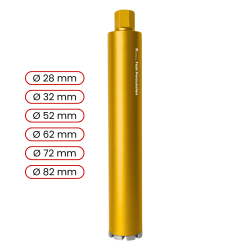
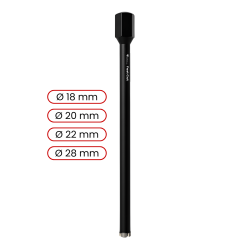
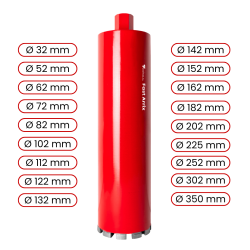
Three series cover three ways of working. Fast Arrix spans 32–350 mm and is built for hard and reinforced concrete. Fast Percussion (28–82 mm) is built for machines with micro-impact. Fast Cut (18–28 mm) handles small service penetrations.

All carry a 1¼"-7UNC thread and 450 mm of working length, so they fit any machine with that mounting — the standard across every one of our core drills, from the hand-held DD 18 to the rig-mounted DD 33.

Read moreShow less

The machines are in hand-held core drills and complete core drills, and the wider context of drilling is in core drills.

Three series, three ways of working

Fast Arrix — hard concrete and reinforcement

The widest series: eighteen diameters from 32 to 350 mm, built for hard and reinforced concrete. Rebar in the hole changes the nature of the work — steel polishes the crystals instead of fracturing them — so a bit for reinforced concrete needs a bond that keeps releasing them despite that polishing. That, not price, is what separates it from a plain concrete bit.

Fast Percussion — for machines with micro-impact

Six diameters, 28–82 mm, for work with micro-impact. Axial blows added to rotation load the segment differently from abrasion alone, so the bit has to take it structurally. Fitting an ordinary bit to a percussion machine ends in segments breaking away — which is why this is a separate series rather than the same bit with a different label.

Fast Cut — small service penetrations

Four diameters, 18–28 mm: anchors, bars, ducts for single cables. At these sizes peripheral speed at a given rpm is low, so you work in the machine's top gear — the opposite of bits above a hundred millimetres.

Diameters and specifications

Series For Diameters Working length Thread
Fast Arrix hard and reinforced concrete 32 · 52 · 62 · 72 · 82 · 102 · 112 · 122 · 132 · 142 · 152 · 162 · 182 · 202 · 225 · 252 · 302 · 350 mm 450 mm 1¼"-7UNC
Fast Percussion micro-impact drilling 28 · 32 · 52 · 62 · 72 · 82 mm 450 mm 1¼"-7UNC
Fast Cut small penetrations 18 · 20 · 22 · 28 mm 450 mm 1¼"-7UNC

450 mm of working length is how deep a bit reaches without an extension — enough for a wall or slab of ordinary thickness, but not a foundation wall. Beyond that it is not the bit that limits you but the stand's carriage travel, covered in core drill stands.

Diameter sets the gear, not the other way round

Segment peripheral speed has to stay in the band where diamond abrades instead of glazing. Because at constant rpm peripheral speed rises in proportion to diameter, every bit has its own gear.

In practice: Fast Cut 18–28 mm runs in top gear, diameters of a few tens of millimetres in the middle one, and Fast Arrix 302 and 350 mm in bottom gear only — on the DD 33 that is 400 rpm. The machines state this outright by quoting three maximum diameters, one per gear.

The effect of the wrong gear is immediate and misleading: the bit stops cutting although the segments still have height. That is not wear but glazing — and it comes back with every switch to the right ratio.

Reinforcement: what happens when the bit meets a bar

Diamond cuts steel too, so rebar does not stop the drilling. It does change the rate of wear: steel polishes the crystals rather than fracturing them, so the segment blunts faster and the bond has to be yielding enough to release those blunted crystals and expose the next. That is precisely what the reinforced-concrete series is for.

The sign of hitting a bar is a drop in progress at unchanged pressure, and a change in the sound of the cut. The right response is a steady, moderate feed — pushing harder overheats the segment and accelerates the polishing, while backing off lengthens contact time with the steel.

The practical consequence when pricing: a penetration through reinforced concrete consumes a bit many times faster than the same hole in plain concrete. That is not a fault of the tool but a material cost to allow for in advance.

How to choose a bit

Check whether the machine has percussion

That is the first question, because it decides the series. Machines with micro-impact — the DB 16 and DDB 26P — need Fast Percussion bits. An ordinary bit on a percussion machine does not work faster; it breaks segments away.

Then material, not diameter

In reinforced concrete the right answer is Fast Arrix, whose bond copes with polishing by steel. For small service penetrations in unreinforced material, Fast Cut is enough. Diameter comes last — it is the easiest figure to establish and the least decisive for success.

Compare diameter with machine and stand range

A ⌀ 350 mm bit requires the DD 33 and the DS 400 stand — no smaller rig will take it whatever the thread. Machine ranges are in complete core drills and stand ranges in core drill stands.

Work out the depth of the penetration

450 mm of working length covers walls and slabs of ordinary thickness. Deeper elements mean an extension or drilling from both sides — and then success depends on squareness, which is to say on the stiffness of the stand.

Questions and answers

How does a diamond core bit work?

It does not drill but abrades a ring around the core. Diamond crystals set in segments on the face of the barrel remove material across the wall thickness, while the middle stays whole and comes out as a disc. That is why the hole has an exact diameter and smooth walls, without the cracking left by percussion drilling. These bits have 450 mm of working length and a 1¼"-7UNC thread, common to the whole core drill range.

What separates the three series?

The way of working each is built for. Fast Arrix, in eighteen diameters from 32 to 350 mm, is for hard and reinforced concrete — its bond copes with rebar polishing the crystals. Fast Percussion, 28–82 mm, withstands the axial blows of micro-impact machines. Fast Cut, 18–28 mm, handles small service penetrations, which are drilled in the machine's top gear.

Does a percussion bit differ from an ordinary one?

It does, and they must not be confused. Micro-impact adds axial blows to rotation, loading the segment differently from abrasion alone, and the bit has to take that structurally. An ordinary bit on a percussion machine does not work faster — its segments break away. That is why Fast Percussion is a separate product rather than the same bit with a different label. The percussion machines in this range are the DB 16 and DDB 26P.

Which gear suits which diameter?

The larger the bit, the lower the gear. Segment peripheral speed rises in proportion to diameter and has to stay in the band where diamond abrades rather than glazes. Bits of 18–28 mm run in top gear, diameters of a few tens of millimetres in the middle, and 302 and 350 mm in bottom gear only — on the DD 33 that is 400 rpm. The machines quote three maximum diameters, one per gear.

Can a diamond bit drill reinforced concrete?

Yes — diamond cuts steel as well, so rebar does not stop the work. It changes wear, though: steel polishes the crystals instead of fracturing them, so the segment blunts faster and needs a bond that will release those blunted crystals. That is what the Fast Arrix series is for. When pricing, assume a penetration through reinforced concrete consumes a bit many times faster than the same hole in plain concrete.

What should you do when the bit hits a bar?

Hold a steady, moderate feed. The sign is a drop in progress at unchanged pressure and a change in the sound of the cut. Pushing harder overheats the segment and accelerates the polishing of the crystals; backing off lengthens contact time with the steel and has the same effect. On a stand, an even feed is easier to hold than by hand, because it is metered on a handwheel rather than by arm strength.

Do these bits fit every Toolsa core drill?

As far as mounting goes, yes: all three series carry a 1¼"-7UNC thread, and that is the external thread on every one of our core drills, from the hand-held DD 18 to the rig-mounted DD 33. The limit is the range of the machine and stand instead — a ⌀ 350 mm bit needs the DD 33 and the DS 400 stand, and no smaller rig will take it despite the matching thread.

What is the maximum hole depth?

Working length on all three series is 450 mm, and that is what limits depth without an extension. It covers a wall or slab of ordinary thickness. For deeper elements the limit is no longer the bit but the stand's carriage travel — 600 mm on the DS 250 and 1650 mm on the DS 400. When drilling from both sides, success depends on squareness, which is to say on how rigidly the stand is fixed.

Related categories

Machines for hand-held work are in hand-held core drills, and motors and rigs in complete core drills. The ranges and stiffness of supporting structures are covered in core drill stands. When and how to drill is explained in the parent category, core drills.