
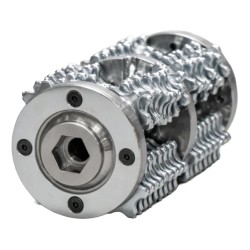
TSC-150-BEBEN
Complete Cutter Drum for Toolsa TSC-150 Concrete Scarifier (200 mm)
- Toolsa TSC-150
- 200 mm
- 223 mm
zł2,214.00 1 800,00 zł net At your place on Thursday
The drum is the only part of a concrete scarifier that wears out in normal use. Cutters sitting loose on their shafts are thrown outwards as the drum turns and strike the surface — they do all the work, while the engine, housing and chassis run for years. A drum is a consumable, in the same sense as a blade in a floor saw.
3 products
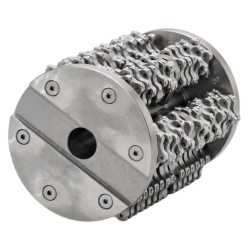
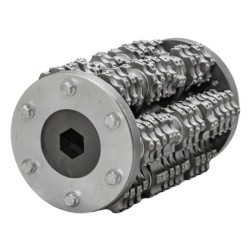
The range covers complete drums for three machines: TSC-150, TSC-200 and TSC-250. Each arrives assembled with its shafts and cutters, ready to fit — nothing has to be sourced separately and no cutters need transferring from the old set.
The point that matters most when ordering: drums are not interchangeable between machines, even at the same working width. The drums for the TSC-150 and TSC-200 are both 200 mm wide, yet differ in the number of shafts (4 against 6) and their diameter (12 against 15 mm). Selection therefore follows the machine model, never the cutting width.
The machines themselves are in concrete scarifiers, and cutting wheels for underfloor-heating machines are in underfloor heating cutters.
A drum is a set of parallel shafts spanning two end plates. Each shaft carries a stack of loose cutters that swing outwards under centrifugal force and hammer the surface. The concrete is broken away rather than ground off — which is why a scarifier removes coatings and laitance that a grinder will not touch, and why it leaves that characteristic ridged texture behind it.
One consequence of this design is that three things wear at once, at different rates. Fastest are the cutters themselves, which take the impact. Then the shafts, worn from the inside by the cutters spinning on them — a shaft can fracture before the cutters have lost their shape. Last the end plates, if the machine has been run with an incomplete drum and allowed to vibrate.
This is why drums are sold complete. Topping up individual cutters in a part-worn set leaves the drum out of balance, and that imbalance passes straight into the bearings and the frame — an economy that usually costs more than the price difference it saved.
Working width is not enough to order by, and this is the commonest mistake made with these parts. The table shows why: the first two drums share a width of 200 mm and still cannot be swapped.
| Drum for | Width | Shafts | Shaft diameter | Cutters |
|---|---|---|---|---|
| TSC-150 | 200 mm | 4 | 12 mm | 68 |
| TSC-200 | 200 mm | 6 | 15 mm | 72 |
| TSC-250 | 250 mm | 6 | 18 mm | 90 |
The difference between a four-shaft and a six-shaft drum is not simply a count of parts. More shafts mean more impacts per revolution, so an evener texture and slower wear on any single cutter — but also greater resistance and a higher power demand. A six-shaft drum therefore belongs to a more powerful machine, not merely to a larger one.
Shaft diameter rises with machine size — 12, 15, then 18 mm — because it has to carry more torque and survive heavier blows. An undersized shaft in a more powerful machine does not wear out faster so much as break.
A worn drum does not fail outright; it loses performance gradually, in a way easily blamed on the machine or the concrete. There are four signs worth knowing before a scarifier goes to a workshop for no reason.
The machine takes off less material at the same depth setting. Cutters with rounded edges skate over the surface instead of breaking it. The operator compensates with a deeper setting and slower travel, which loads the engine and accelerates wear everywhere else.
The finish comes out uneven. Bands of differing depth mean the cutters have worn unevenly, or that some have seized on their shaft and stopped rotating.
Vibration appears where there was none. This is the serious one, because it usually means the drum has lost balance — missing cutters, or a fractured shaft. Running on in that state transfers the load into the bearings and the frame, so the machine is stopped immediately.
Cutters slide along the shaft. End float means the shaft has worn down in section. The cutters may still look serviceable, but the assembly is finished.
Nothing destroys cutters faster than working too deep. A scarifier takes material off in layers, and several shallow passes give a better result than one deep one — set too aggressively, the cutters stop breaking the surface and start jamming into it, which snaps them off.
The second factor is reinforcement and anything else harder than concrete: bars in an exposed slab, anchors, remains of fixings. Striking steel breaks a cutter instantly, and at full speed can take several at once.
The third, and least obvious, is running dry in heavy dust. Dust packs between cutter and shaft and works like a grinding paste, accelerating wear on the shaft from the inside. Dust extraction extends drum life quite apart from being required because of the silica in concrete dust — vacuum cleaners for grinders and scarifiers are basic equipment here, not an accessory.
The drums are not interchangeable, although both have a working width of 200 mm. The TSC-150 assembly has 4 shafts of 12 mm diameter carrying 68 cutters; the TSC-200 assembly has 6 shafts of 15 mm carrying 72. The mounting spacing and axle diameter therefore differ, and one will not go where the other came out. Order by machine model rather than by cutting width — the width describes the mark left on the floor, not the fixing inside the machine.
Drum life is counted in square metres removed rather than in running hours, and the spread is very wide. Depth of pass gives the reference point: a scarifier takes 1–8 mm in one pass depending on the model, and a set holds 68 to 90 cutters, which wear the faster the deeper they are driven. Three things decide it: the hardness of the concrete, the depth taken in one pass, and whether there is any steel in the material. The same drum on a soft screed taken shallow will outlast one worked hard on an industrial slab many times over. Rather than planning replacement by the calendar, watch for the symptoms: less material removed at an unchanged setting, uneven texture, and vibration that was not there before.
Technically yes, economically seldom. Cutters in a used set are worn to a similar degree, so adding a few new ones to 68 or 90 old ones leaves the drum out of balance — the new cutters bite deeper, the old ones less, and the difference in mass sets up vibration. Replacing cutters also does nothing about the second, less visible form of wear: the shafts worn from the inside. That is why these drums are supplied complete, with shafts and cutters ready to fit.
They are two different tools for two different machines. A drum works in a concrete scarifier and breaks up the surface across its full 200 or 250 mm, taking a layer off the slab. A 130 × 17 mm cutting wheel works in an underfloor heating machine and cuts a narrow, deep channel for heating pipe. The first works a plane, the second cuts a chase — they are in no way interchangeable, nor comparable in price.
Stop the machine at once and inspect the drum before it goes back to work. Vibration that was not there before generally means lost balance: missing cutters, a fractured shaft, or cutters seized on the shaft and no longer turning. Running on transfers the load into the bearings and the frame, so a quarter of an hour's delay turns a drum replacement into a machine repair. Check the count while you are there: a drum should hold 68, 72 or 90 cutters depending on model, and even a few missing is enough to throw it out of balance. While the drum is off, check the cutters for end float — if they slide along the shaft, the assembly is worn out regardless of how the cutters themselves look.
The machines these drums fit are in concrete scarifiers. Cutting wheels for chasing underfloor heating pipe are in underfloor heating cutters, and the dust extraction that keeps a drum alive longer is in vacuum cleaners for grinders and scarifiers.
Essential cookies keep your cart and login working — the shop will not run without them. The rest let us measure traffic and target our ads, and we switch them on only with your consent. You can change your choice at any time using the “Cookie settings” link in the footer. Cookie policy
Essential
Cart, login, form security and remembering this choice. The shop will not work without them, so they need no consent.
Toolsa
Analytics
We count page views and checkout paths to find what is broken in the shop. We look at the data in aggregate.
Google Analytics · Microsoft Clarity
Marketing
We show our ads outside the shop and check which of them lead to a purchase. Phone callback requests land here too.
Google Ads · OptinMonster · Zadarma