
90TA97H
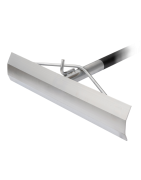
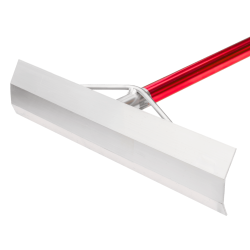
Toolsa Red Aluminium Concrete Rake (508 x 105 x 1530 Mm)
- 508 mm
- Aluminium
zł183.27 149,00 zł net At your place on Monday
Concrete hand tools work in an order set by what happens to the mix after it is poured. Concrete changes consistency over its first few hours, and every operation has a window in which it can be done — a tool used too early draws water to the surface, one used too late will no longer enter the material. The kit is therefore assembled around successive stages of the pour, not around a single task.
38 products
Pick a type, and more filters will show up.
In practice the sequence never varies. First spreading and distributing the mix, which is the work of concrete rakes. Then screeding to level with a screed bar or straightedge. Next initial floating, which closes the surface and brings up the fat — the job of bull floats. Only then come edges, joints and final finishing with hand trowels. Last of all, where the slab has to be non-slip, comes texturing with fresno brooms.
The second criterion is the working material. Magnesium does not stick to wet concrete and leaves the surface open, so it belongs to the early stages. Aluminium is stiffer and cheaper, and suits screeding and raking. High-carbon steel and Blue Steel close the surface at the final stage, while stainless steel works on joints and edges, where a smooth profile and resistance to moisture matter most.
The range covers complete tools and replacement blades alike, along with poles, brackets and adapters for building a tool to your own reach. The blade wears out long before the pole does, so replacing the working part alone is usually cheaper than buying a complete tool.
Every tool in this group shares one constraint: a window of time. Concrete sets and changes consistency after the pour, and each operation has a moment at which it can be carried out. A tool used too soon draws water to the surface and weakens the top layer; used too late it will not enter the material at all. The order below follows from that, not from habit.
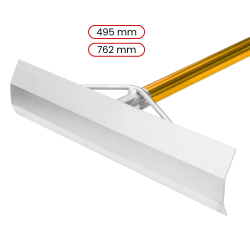
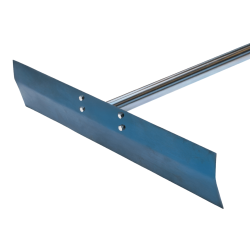
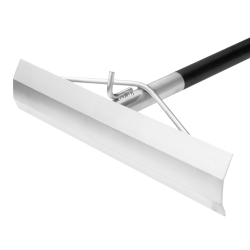
Concrete discharged from the truck lands in one place and has to be distributed across the pour. That is the work of concrete rakes — tools with a working width of 500 or 508 mm on a pole of about 1 530 mm. Tined versions spread while letting the mix pass between the tines, which makes even distribution easier; plain-edged versions work as a pull bar. Speed is what counts at this stage — the concrete does not wait.
Screeding sets the finished level of the slab. It is done with a bar resting on rails, or with a straightedge worked across the surface in a sawing motion. The range covers magnesium screed bars of 2 000, 2 500 and 3 000 mm with double handles, aluminium straightedges with a built-in spirit level, and the Bump Cutter at 3 000 and 3 500 mm for cutting down local high spots. On larger areas this stage passes to vibratory screeds, which compact the mix at the same time.
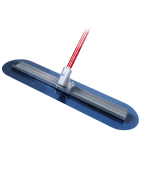
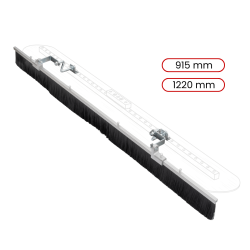
This is the moment that decides how the slab lasts. A bull float closes the surface immediately after screeding, pushes the aggregate below the mortar layer and evens out minor irregularities. It is worked on a long pole, drawing the blade across the fresh concrete. Standard widths are 915, 1 220 and 1 524 mm; a wider blade means fewer passes but is harder to control near edges.
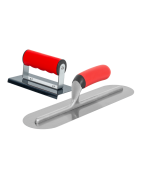
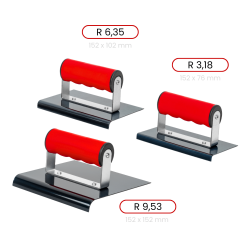
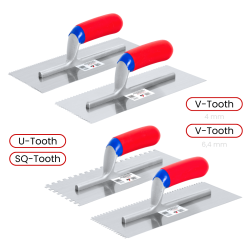
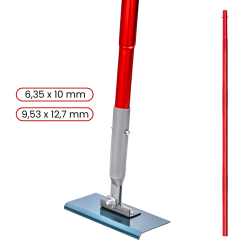
Before the concrete hardens, edges are formed and contraction joints cut. An edge rounded with an edger will not spall later under load, and a joint cut with a groover guides the shrinkage crack to where it is meant to appear instead of letting it run through the middle of the slab. Both tools are in hand trowels, in hand-held and walking versions — the latter allowing the work to be done without stepping onto the fresh surface.
The last smoothing is done with a steel trowel, once the concrete has set enough to carry the weight of the tool without taking marks. Steel closes the pores and produces a smooth surface — and a more slippery one, which is why not every slab is taken to this stage. On large areas the work passes to power trowels, and hand tools remain for the places a machine cannot reach.
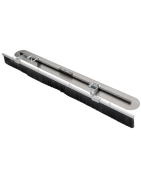
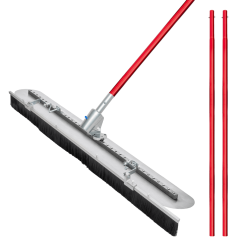
External slabs, ramps, paths and driveways need texture. It is applied last, by drawing a broom or texturing bar across the surface. How deep the texture comes out depends on timing — the earlier, the more pronounced. This stage cannot be undone: a texture once applied can only be removed by grinding.
The same float made from magnesium and from aluminium behaves differently, and the reason is not build quality but how each material behaves against wet concrete.
| Material | Stage | What it gives | Limitation |
|---|---|---|---|
| Magnesium | early, concrete still wet | will not stick, leaves pores open | soft, wears faster |
| Aluminium | screeding, raking | stiffness over long lengths | can drag on wet concrete |
| High-carbon steel | final finishing | closes the surface, holds an edge | must be dried after use |
| Blue Steel | finishing, corners | greater blade flexibility | as above; corrodes if stored damp |
| Stainless steel | joints, edges | clean profile, moisture resistant | higher price |
The working rule is simple: the earlier the stage, the lighter and less adhesive the material. Magnesium at the start, steel at the end. Reversing that order is the commonest cause of a surface closed too early with water trapped beneath it — which shows up as the top layer flaking after the first winter.
Most tools in this group consist of three independent parts: the working blade, a bracket and a pole. What wears is the blade — poles and brackets last for years. The range therefore covers both complete tools and replacement blades, for instance a bull float blade on its own, or a fresno broom blade of 1 220 mm.
Connecting parts complete the picture: a ⌀45 mm handle pole 1 830 mm long, fitting both floats and vibratory screeds, and a bracket with angle adjustment that allows the blade to be tilted mid-pass — without it, a tool at long reach starts to dig with one edge. There is also a carry case for bull floats, which matters for steel blades, since they do not tolerate being stored damp.
The order of stages is fixed; the intervals between them are not. What sets the pace is how fast water evaporates from the surface, and that depends on four things at once: air temperature, slab temperature, relative humidity and wind. Of these, wind is the most underrated — under weak sun but a stiff breeze the surface dries faster than on a still, hot day.
The practical sign of having missed the window is plastic shrinkage cracking: short, irregular cracks appearing before the concrete has set, where water leaves the surface faster than bleed water rises from below. Nothing at the finishing stage will cure it — only protective measures help, meaning shade, windbreaks and fogging. In summer the whole cycle from screeding to finishing can compress into the time that in spring allows two or three hours.
Cold works the other way. Below 5 °C setting slows enough that final trowelling is a long wait, and below freezing the process stops. In winter that means one thing: concreting is planned together with heating the building, because in an unheated unit the window does not lengthen so much as cease to exist — see air heaters.
For tool selection the conclusion is that in hot weather the kit has to be complete before the pour, not assembled during it. A missing edger or a blade with the wrong bracket then costs not a trip to the merchant but a section of slab finished out of time.
Hand tools are no substitute for compaction equipment. Raking and screeding place the mix but do not drive air out of it — on thicker slabs that is the work of concrete vibrators, and on floors of vibratory screeds. Floating alone over uncompacted concrete gives a surface that looks right and breaks up within months.
Nor do they replace power trowels on large areas. Finishing a hall measured in hundreds of square metres by hand is physically possible but will not fit inside the concrete's window — by the time the gang reaches the far end, the start has gone too hard. Hand tools then work alongside the machine: at walls, columns and in corners where a power trowel cannot reach.
And they will not repair an earlier mistake. A mix that is too wet, rails set badly or compaction skipped altogether produce defects that surface work cannot remove — at best it hides them until handover.
A minimum kit covers four stages. A rake of 500–508 mm to spread the mix, a screed bar of 2 000–3 000 mm worked off rails to bring it to level, a bull float of 915 or 1 220 mm on a pole for initial floating, and an edger plus a groover for edges and joints. A fifth item — a steel trowel for final finishing — is needed only where the surface has to be smooth; an external slab usually stops at a broomed texture. Above a few dozen square metres, compaction equipment joins that list, because hand tools place concrete but do not compact it.
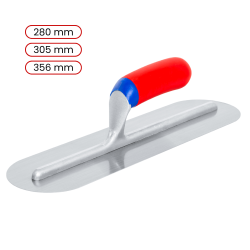
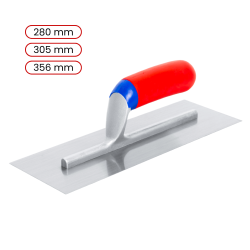
The difference is how each behaves against wet concrete, and therefore when each is used. The dimensions show it: magnesium floats are long and wide, for example 508 × 79,4 mm, because they have to cover ground; steel finishing trowels run 280, 305 or 356 × 114 mm, because they work by pressure rather than reach. Magnesium does not stick to a fresh mix and leaves the surface open, so surplus water can still evaporate — which is why it works early, straight after screeding. Steel closes the pores and gives a smooth finish, but used too soon it traps water below the surface, and that ends in the top layer flaking after the first winter. Magnesium is also lighter and wears faster; steel is heavier and more durable, but has to be wiped and dried after use.
A bull float is a wide blade on a long pole, used immediately after the concrete has been screeded to level — the first smoothing tool of the pour. Drawing the blade across the fresh surface pushes aggregate down, evens out minor irregularities and brings a layer of mortar to the top. Typical widths are 915, 1 220 and 1 524 mm. The work is done from the edge of the slab without stepping onto the concrete, which is the second reason — after sheer coverage — that the blade sits on a pole.
Contraction joints are cut with a groover once the concrete will hold the shape of the cut but has not yet hardened — that is, after initial floating, in the same phase as edge forming. The purpose is singular: shrinkage will happen whatever anyone does, and the cut decides where the crack appears. Without a joint the crack runs through the middle of the slab at a random point. Two figures govern whether it works: the cut should reach about a quarter of the slab depth, and joint spacing should not exceed roughly 30 times that depth — on a 150 mm slab that gives bays of around 4,5 m. The alternative is saw cutting after the concrete has set, with a floor saw — a cleaner joint, but it has to be made before the slab starts cracking on its own.
Brooming is the standard: a broom of 915 or 1 220 mm is drawn across the fresh, floated surface, usually at right angles to the direction of traffic or the fall. Groove depth depends on timing — the earlier, the more pronounced — so a trial is made on one section before the whole area is worked. A grooving bar can be used instead of a broom, giving regular flutes rather than the irregular texture of bristles. The operation is irreversible: removing a texture means grinding.
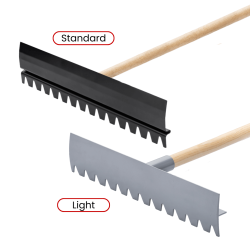
Concrete rakes are usually aluminium, with tines spaced so the mix passes between them as it is spread — the tool is meant to distribute, not to push the whole mass. Asphalt rakes are made from magnesium and come with sharp or blunt tines: sharp ones break up material that has started to clump, blunt ones spread without disturbing the layer. There is also a practical difference in temperature, since asphalt is laid hot and the tool material has to take that contact without distorting. Working widths in both groups are similar, roughly 500 to 915 mm.
Start from the width of the pour, since the point of a pole is to finish the slab without walking on fresh concrete. A single 1 830 mm pole covers a strip about two metres in from the edge; wider slabs need two or three sections joined. There is a practical ceiling to that, though: the longer the pole, the harder it is to hold the blade at a constant angle, and a few degrees of tilt has the float digging with one edge instead of smoothing across its width. At long reach a bracket with angle adjustment solves this, letting the blade be corrected mid-pass. The same ⌀45 mm pole fits floats and vibratory screeds, so it need only be bought once.
Replacing the blade alone makes sense whenever the pole and bracket are still sound, which is often — the blade works in concrete and wears out far sooner than a pole that only transmits movement. Bull float blades are stocked separately in aluminium, magnesium and manganese steel, along with a 1 220 mm fresno broom blade and a 203 mm aluminium grooving bar. The condition is matching the fixing — a bracket has to suit the specific blade type, so when buying a blade on its own, check what fixing the existing tool uses.
One rule covers every material: wash the mortar off before it sets — in practice 2 to 3 hours from finishing work, and less in hot weather. Concrete left to harden on a blade can only be removed mechanically, and that ruins the working face — a scored tool leaves marks on the slab every time it is used afterwards. Steel blades additionally need wiping dry, since they corrode in contact with moisture; magnesium and aluminium are more forgiving there, though magnesium is soft and does not take being dropped onto hard ground. Storing long blades flat and unloaded keeps them from taking a permanent bend, which cannot be straightened out later.
Tools for spreading concrete and asphalt are in concrete rakes. Floats for the initial pass, together with replacement blades, poles and brackets, are in bull floats. Steel and magnesium trowels, edgers and groovers are in hand trowels, and brooms and grooving bars for non-slip texture are in fresno brooms.
Essential cookies keep your cart and login working — the shop will not run without them. The rest let us measure traffic and target our ads, and we switch them on only with your consent. You can change your choice at any time using the “Cookie settings” link in the footer. Cookie policy
Essential
Cart, login, form security and remembering this choice. The shop will not work without them, so they need no consent.
Toolsa
Analytics
We count page views and checkout paths to find what is broken in the shop. We look at the data in aggregate.
Google Analytics · Microsoft Clarity
Marketing
We show our ads outside the shop and check which of them lead to a purchase. Phone callback requests land here too.
Google Ads · OptinMonster · Zadarma