
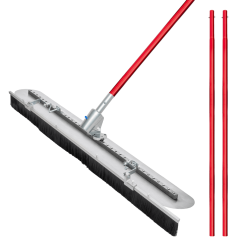
More options FB-1220
Toolsa Complete Fresno Broom with Brush (915 | 1220 mm)
- 915 x 127 mm | 1220 x 127 mm
- Profil Fresno Broom ze szczotką | Rura do listwy (3 szt.) | Uchwyt do łat
zł1,722.00 1 400,00 zł net At your place on Monday
Brooming is the last stage of finishing a slab and the only one that cannot be undone. Drawing a broom across a fresh, floated surface leaves shallow grooves that give the concrete grip — without them an external slab turns slippery in the wet, and on a gradient it becomes genuinely unsafe.
5 products
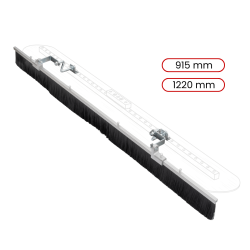
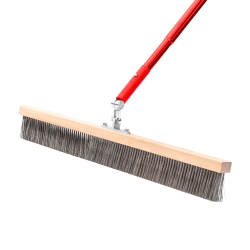
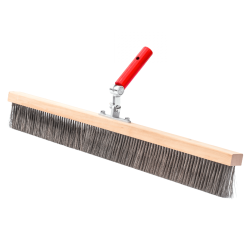
There are two ways to texture. A broom leaves an irregular pattern that depends on the bristles and the pressure applied — our models come in 915 and 1 220 mm, in stainless steel or with bristles set in an aluminium stock. A grooving bar leaves regular flutes of repeatable depth and spacing: the blade is 203 mm, and the complete tool 1 067 mm.
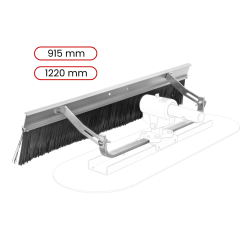
A group of their own are the Fresno Broom tools — a finishing blade with a broom in one, 1 220 mm long. A single pass closes the surface and textures it at once, saving an entire separate pass on large areas. There is also a U-type adapter for fitting a broom to a bull float or Big Blue Float you already own.
How deep the texture comes out depends not on the tool but on timing — the sooner after floating, the more pronounced. The full order of stages is in concrete hand tools.
A surface trowelled smooth with steel is hard, easy to keep clean and exceptionally slippery once wet. Indoors that does not matter. Outside — on a driveway, a path, a ramp or a garage approach — it turns the slab into something nobody can walk on safely after rain, or drive up in the wet.
Brooming solves this in the simplest way available: the grooves increase the contact area for footwear and tyres, and at the same time give water somewhere to run instead of forming a continuous film. The operation costs nothing beyond a single pass with a tool, and it is done while the slab is being worked anyway.
Texture has a second, less obvious use: it hides small imperfections in the finishing. A smooth surface shows every trowel mark and every change of shade; a broomed one shows practically none. Over large external areas that is an argument in itself.
Both tools create grip, but they leave quite different marks and belong to different surfaces.
| Tool | Texture | Width | Where it suits |
|---|---|---|---|
| stainless steel broom | irregular, fine | 915 mm | paths, patios, driveways |
| Fresno Broom | irregular, with finishing | 1 220 mm | large external areas |
| grooving bar, complete | regular flutes | 1 067 mm | ramps, slopes, gradients |
| grooving blade | regular flutes | 203 mm | replacement in an existing bar |
A broom gives an irregular, effectively random texture whose depth follows the pressure applied and the state of the concrete. It is enough for most applications and is what you find on paths and patios.
A grooving bar leaves parallel flutes at repeatable spacing and depth. It is used where grip has to be certain and verifiable: on ramps, wheelchair slopes and steep approaches. The flutes are then run at right angles to the direction of travel, so a wheel bears against successive edges instead of sliding along them.
This is the critical point in brooming, and the only one that cannot be corrected afterwards. How deep the texture comes out does not follow from how hard the tool is pressed, but from how long ago the concrete was floated.
Brooming too early, while the surface is still soft, leaves deep, ragged grooves and drags aggregate to the top. Brooming too late, once the concrete has begun to harden, leaves almost no mark at all, or merely scratches the surface. The right moment lies between the two and does not last long — the less so the warmer it is and the harder the wind blows.
Hence the practice is always the same: try a section, look at the result, and only then work the whole area. If the texture comes out too deep, wait another quarter of an hour; if too shallow, it needed starting earlier, and that cannot be recovered without grinding.
The second rule is direction. Grooves run at right angles to pedestrian traffic or to the fall, so that water drains along them rather than standing across them. On a slope that means brooming across the gradient, not down it.
As with the other pole tools, what wears is the working part, not the tube. The range covers complete tools ready to work, the stainless steel broom head 915 mm for replacement, a grooving blade 203 mm and a Fresno broom blade 1 220 mm.
The U-type adapter deserves separate mention. It lets a broom be fitted to a bull float or Big Blue Float already in the kit, instead of buying a second complete tool with its own pole. For a gang that already owns tubes and brackets, it is the cheapest way to add brooming.
The complete stainless broom ships with a 1,8 m handle on a 35 mm tube. For greater reach the tubes are joined — the same principle as with bull floats, where the standard is ⌀45 mm at 1 830 mm.
Immediately after initial floating, once the surface has closed but before it starts to harden. The window is short and gets shorter in heat and wind — the same conditions that speed up evaporation cut the time available for texturing. Groove depth follows that moment rather than the pressure applied: too early gives a ragged texture with aggregate dragged up, too late barely a scratch. In practice 20 to 60 minutes pass between floating and brooming, and less in hot weather. That is why a section is tried first and the whole area worked only after the result has been looked at.
A texturing broom differs from a sweeping brush in three ways that matter: stiffer bristles, a working width of 915 or 1 220 mm, and a pole fixing that lets the head be drawn flat without lifting one edge. A household broom used on concrete gives an uneven texture, because the bristles bend at different rates and the head gathers mortar instead of grooving it. On a small area it may pass; across a driveway the difference is visible from the first pass.
At right angles to pedestrian traffic or to the fall of the ground. Two things follow from that: a foot or a tyre bears against successive groove edges rather than sliding along them, and water has somewhere to drain. On a ramp or a driveway it means brooming across the slope. On a path, across the line of walking. At a working width of 915 or 1 220 mm one pass covers a full strip, so the direction is settled once and held across the whole area. Running the grooves parallel to the fall achieves the opposite of what was intended — they turn into channels feeding water under the feet.
A broom leaves an irregular texture whose depth depends on pressure and on the state of the surface. A grooving bar leaves parallel flutes at repeatable spacing and depth, because a rigid blade shapes them rather than bristles. The choice follows the requirement: a path or patio is fine with a broom, while a ramp or wheelchair slope is better with a bar, since the grip is then predictable and identical across the whole area. Our complete bar is 1 067 mm, and the replacement blade 203 mm.
It is a tool combining a finishing blade with a broom on one handle, 1 220 mm long. One pass closes the surface and textures it at the same time, rather than requiring two separate passes with different tools. On large external areas that saves appreciable time, and it also solves the problem of hitting the window: floating and brooming follow each other immediately, so the concrete cannot harden in between.
Not at the finishing stage — the concrete has closed, and floating it again only smears the texture without removing it. The grooves are usually under 2 mm deep but reach into a layer that has already set. The only route left is grinding after the slab has set, which means a separate machine, dust extraction and a cost out of all proportion to the brooming itself. Hence the rule at this stage: trying a section first costs a few minutes, and is cheaper than grinding tens of square metres afterwards.
The preceding stage, initial floating, is covered by bull floats, and edges and joints by hand trowels. The full order of work on a slab is in concrete hand tools.
Essential cookies keep your cart and login working — the shop will not run without them. The rest let us measure traffic and target our ads, and we switch them on only with your consent. You can change your choice at any time using the “Cookie settings” link in the footer. Cookie policy
Essential
Cart, login, form security and remembering this choice. The shop will not work without them, so they need no consent.
Toolsa
Analytics
We count page views and checkout paths to find what is broken in the shop. We look at the data in aggregate.
Google Analytics · Microsoft Clarity
Marketing
We show our ads outside the shop and check which of them lead to a purchase. Phone callback requests land here too.
Google Ads · OptinMonster · Zadarma