
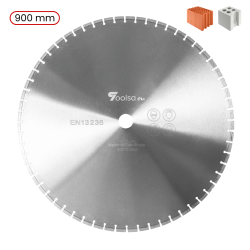
TARW900
Toolsa R&W 900 Diamond Blade for Porotherm and Sand-Lime Blocks
- Porotherm i Silikat
- 60 mm
- 900 mm
zł2,089.77 1 699,00 zł net At your place on Tuesday
A diamond blade does not cut with an edge — it abrades. Diamond crystals sit in a metal bond, and that bond has to wear at exactly the rate of the material being cut: too slowly and blunted crystals stay buried, so the blade stops taking; too quickly and they drop out before they have done any work. That is why bond is matched to material, not to the machine.
4 products
Hence four jobs in this range. Asphalt 350 and 400 for asphalt, HC 350 for block paving and kerbs, R&W 650, 700 and 900 for Porotherm, sand-lime block and building blocks, and for concrete — Soff-Cut 6" in green and hard versions plus Fresh Green Concrete 350.
The bore decides what fits: 25.4 mm on the 350–400 mm blades, 60 mm with reducing rings to 30 and 25.4 mm on the table-saw blades, and the triangular Soff-Cut arbor on the early entry blades.
The machines these blades go on are in floor saws. Early entry also needs the skid plate, which is available with the blade as a kit.
A segment is a sinter: diamond crystals dispersed through a metal bond. Cutting works because a crystal at the surface tears material away, blunts, and the bond around it then wears enough to release it and expose the next one. The blade sharpens itself — provided the bond wears at a rate that suits what it is cutting.
Soft, abrasive material such as asphalt or green concrete strips the bond rapidly on its own, so the bond has to be hard, or the segment disappears within a few metres. Hard, non-abrasive material such as mature concrete or granite setts barely wears the bond at all, so it has to be soft in order to keep exposing crystals. Same principle, inverted.
The practical consequence: an asphalt blade used on concrete stops cutting within minutes because the segment glazes over, and a concrete blade used on asphalt wears out faster than it can pay for itself. This is not about quality or "universal" blades — it is how a sinter behaves.
| Blade | Material | Diameter | Bore | Segment (w × h) | Segments |
|---|---|---|---|---|---|
| Asphalt 350 | asphalt | 350 mm | 25.4 mm | 3.3 × 10 mm | 21 |
| Asphalt 400 | asphalt | 400 mm | 25.4 mm | 3.3 × 10 mm | 24 |
| HC 350 | block paving, kerbs | 350 mm | 25.4 mm | 3.3 × 12 mm | 24 |
| Fresh Green Concrete 350 | green concrete | 350 mm | 25.4 mm | 3.3 × 10 mm | 21 |
| R&W 650 | Porotherm, sand-lime, blocks | 650 mm | 60 mm | 4 × 12 mm | 42 |
| R&W 700 | Porotherm, sand-lime, blocks | 700 mm | 60 mm | 4 × 12 mm | 46 |
| R&W 900 | Porotherm, sand-lime, blocks | 900 mm | 60 mm | 4 × 12 mm | 60 |
| Soff-Cut 6" green | green concrete, early entry | 6" | triangular Soff-Cut | 2.4 × 9.2 mm | 12 |
| Soff-Cut 6" hard | hard concrete, early entry | 6" | triangular Soff-Cut | 2.4 × 9.2 mm | 12 |
Segment height is the reserve of material, which means blade life: 9.2 mm on the early entry blades, 10 mm on asphalt and green concrete blades, 12 mm where a blade works long hours in one material. Segment width sets kerf and resistance: 2.4 mm for joint cutting, 4 mm on the 650–900 mm blades, which need stiffness at that diameter.
Asphalt is abrasive and sticky: the aggregate strips the bond while the binder clogs the kerf. Asphalt 350 and 400 carry a hard bond that survives that stripping, with a 10 mm segment as a reserve for road work. The same rule applies as with concrete: water cooling and a steady feed — pausing in a hot kerf ends with a clogged segment.
HC 350 has 24 segments of 12 mm height, with every sixth segment raised. That has one purpose: to damp blade flutter on long cuts. Concrete and granite setts are hard and barely abrasive, so the blade stays in the cut for a long time, and any vibration shows up on the cut face and in how the machine tracks.
Clay and sand-lime blocks are cut in one pass, so blade diameter has to exceed block height: hence 650, 700 and 900 mm. Segments are laser-welded, which at these diameters is a safety matter rather than a durability one — a brazed joint would not hold a segment against centrifugal force at the rim of a 900 mm blade. The 60 mm bore matches the table-saw standard, and reducing rings take it down to 30 or 25.4 mm.
Green concrete is soft but extremely abrasive — sand and aggregate strip the bond like emery. Mature concrete is the opposite: hard and smooth, so the bond hardly wears and the segment has to be soft enough to keep sharpening itself. That is why Soff-Cut 6" comes in two versions — green and hard — rather than as one "concrete" blade. Fresh Green Concrete 350 covers green concrete on saws taking a 350 mm blade.
Soff-Cut 6" blades have a distinctive triangular arbor matching the Husqvarna system and a segment only 2.4 mm wide — a control joint is there to weaken the section, not to remove material.
The other half of the system is the skid plate. It is fitted after the blade and works with it, holding green concrete down on both sides of the cut line so the edge does not ravel as the blade passes. Without it a cut in soft concrete comes out ragged, and a joint with a ragged edge does not do its job — the crack can wander out of it.
So blade and skid plate are also sold together: green concrete kit and hard concrete kit. The machine for this work is the TAS 150, in floor saws.
An overheated bond softens and releases crystals before they have worked, and the blade itself loses flatness and starts to wander. Water removes heat and flushes slurry from the kerf — one without the other is not enough, because slurry left in the kerf acts as extra abrasive against the sides of the segment.
A blade should cut at its own rate. Pushed harder than the material allows, it binds and tears segments off, and at larger diameters it begins to work sideways and heat unevenly. The symptom is always the same: it wanders off the line and the kerf comes out wider than the segment.
If the blade has stopped taking but the segment still has height, it is usually glazed — crystals blunted and the bond has not released them. That means the bond is too hard for the material. As a field fix, a few cuts in something abrasive — an aerated concrete block, sandstone — will open it up; the real answer is the right blade.
Reducing rings may only be used as stated for the blade — improvised bushes end in wobble and a cracked core. The maximum rpm marked on a blade is not advice: peripheral speed rises with diameter, so exceeding it is straightforwardly dangerous.
Bond hardness is chosen inversely to the material. Soft, abrasive materials — asphalt, green concrete — strip the bond themselves, so they need a hard bond. Hard, non-abrasive materials — mature concrete, granite setts, sand-lime block — barely wear the bond, so they need a soft one for the blade to keep sharpening itself. Diameter and bore follow from the machine, but it is bond that decides whether the cut works at all.
Block paving and kerbs are cut with the HC 350 — a 350 mm blade with 24 segments 12 mm high and 3.3 mm wide, on a 25.4 mm bore. Every sixth segment is raised, which damps blade flutter on long cuts; with hard concrete and granite setts it is vibration rather than wear that spoils the cut face. The 12 mm segment height gives enough reserve for paving work run day after day.
It can, for a few minutes, and then it stops taking. The bond on an asphalt blade is hard because asphalt strips it aggressively; in concrete, which wears it far more slowly, the crystals blunt and are never released. The usual signs are heavy sparking, smoke and no progress despite pressure. The opposite mistake — a concrete blade in asphalt — will keep cutting, but wears out fast enough to multiply the cost per metre.
Soff-Cut is an early entry system in which control joints are cut in green concrete before the slab hardens. The blades have a triangular arbor matching the Husqvarna system, a 2.4 mm segment width and 9.2 mm height across 12 segments. The triangular shape is a safeguard: it prevents the blade being fitted to a machine that does not work in this technology and has no skid plate, without which the edge of a cut in soft concrete would ravel.
Bond hardness, despite identical dimensions. The green concrete version has a harder bond, because young concrete with sharp aggregate strips it very quickly. The hard concrete version has a softer bond so that it still wears against a smooth, mature surface and keeps exposing crystals. Both Soff-Cut 6" blades have a 2.4 × 9.2 mm segment and 12 segments — from the outside only the marking differs, in use everything does.
The 350 and 400 mm blades have a 25.4 mm bore, the standard for wheeled floor saws and hand-held saws. The R&W 650, 700 and 900 mm blades have a 60 mm bore, standard for table saws, and accept reducing rings to 30 or 25.4 mm. Soff-Cut blades have a triangular arbor and fit only machines working in that technology. Two figures from the machine plate settle it before ordering: maximum blade diameter and spindle diameter.
Most often it has glazed: the diamond crystals have blunted and the bond has not worn enough to release them and expose the next layer. That happens when the bond is too hard for the material, or when the blade runs without cooling and at low feed. As a field fix, a few cuts in something abrasive — an aerated concrete block or sandstone — will strip a layer of bond. If the symptom returns, the blade is simply matched to a different material.
Diamond cuts steel as well, so rebar is not an obstacle — but it changes wear. Steel polishes the crystals rather than fracturing them, so a blade in reinforced concrete blunts faster and needs a segment that keeps releasing. In practice that means choosing a concrete blade rather than an asphalt one and accepting shorter life the denser the reinforcement. The second thing to check is depth: bars usually sit 30–50 mm below the surface, so the saw needs reach beyond the cover alone.
The machines these blades go on are in floor saws, together with the account of when to cut a control joint and when to sever a slab. Openings for services are made by core drills with core bits, and surfaces after cutting are prepared with concrete grinders. Dust from dry cutting is captured by industrial vacuum cleaners.
Essential cookies keep your cart and login working — the shop will not run without them. The rest let us measure traffic and target our ads, and we switch them on only with your consent. You can change your choice at any time using the “Cookie settings” link in the footer. Cookie policy
Essential
Cart, login, form security and remembering this choice. The shop will not work without them, so they need no consent.
Toolsa
Analytics
We count page views and checkout paths to find what is broken in the shop. We look at the data in aggregate.
Google Analytics · Microsoft Clarity
Marketing
We show our ads outside the shop and check which of them lead to a purchase. Phone callback requests land here too.
Google Ads · OptinMonster · Zadarma