
TABF584
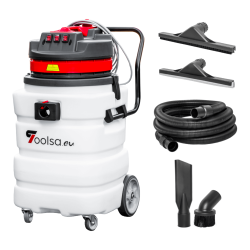
Toolsa WD3000 Wet/dry Sludge Vacuum Cleaner
- 230 v
- 50 Hz
- 230 V
zł3,688.77 2 999,00 zł net On order
A slurry vacuum picks up what a dust extractor will not touch: water, mud, the wet arisings from a grinder working wet, and sand. The difference is not power but which figure does the work — with liquid it is suction pressure, because a column of water has to be physically lifted rather than carried on a stream of air.
1 product
Two machines are offered, both with a 90 l container and different characters. The WD3000 runs 3000 W at 3000 mm H₂O of suction — about 294 mbar — so it pulls harder. The TWC-3/90 runs 3600 W with 620 m³/h of airflow and 8,000 cm² of filter area, so it moves more volume.
Typical work: clearing water off a floor after a flood or a wash-down, collecting slurry behind a wet grinder, taking standing water out of excavations, and lifting wet sand. For work behind a floor machine there is an automatic front suction nozzle for the TWC-3/90.
For dry dust — from grinding and scarifying concrete — the right machines are the class H vacuums for grinders and scarifiers.
Dust is light and airborne, so carrying it away on a stream is enough — what counts is the volume of air moved. Water and slurry do not float: they have to be lifted to the height of the hose, and that takes a pressure difference. Hence a different leading figure and a different build.
The second difference is the filter. In a dust extractor the filter works continuously and holds the dust back; drawing water through a paper or fabric cartridge would soak it within seconds and stop it passing air. So wet machines use filtration built for moisture and a large filter area — 8,000 cm² on the TWC-3/90 — rather than a cascade of HEPA cartridges.
The third is the container. 90 l of water means 90 kg inside the machine — which is why emptying has to be planned, and why machines of this class run on wheels rather than being carried.
| Specification | WD3000 | TWC-3/90 |
|---|---|---|
| Motor | 3000 W | 3600 W |
| Supply | 230 V, 50 Hz | 230 V, 50 Hz |
| Suction | 3000 mm H₂O (≈ 294 mbar) | 200 mbar |
| Airflow | 120 l/s (≈ 432 m³/h) | 620 m³/h |
| Container | 90 l | 90 l |
| Filter area | — | 8,000 cm² |
| Noise level | 82 dB(A) | 79 dB(A) |
| Inlet | ⌀ 40 mm | — |
| Mains lead | 7.2 m | — |
| Weight | — | 32 kg |
| Dimensions | ⌀ 440 × 950 mm | 600 × 650 × 980 mm |
| Product page | WD3000 | TWC-3/90 |
Suction is quoted in different units on the two machines, and it is worth converting: 1 mbar is roughly 10.2 mm of water column, so 3000 mm H₂O is about 294 mbar. The same for airflow — 120 l/s is 432 m³/h. Once converted it is clear these are not variants of each other: the WD3000 pulls harder and the TWC-3/90 moves more volume.
Wet grinding concrete produces the worst material there is to collect: a dense suspension of cement fines and water that hardens once it stands. It has to be taken up while the machine is working, not afterwards — from a puddle left to settle you recover only the water, because the solids bond to the floor.
That is what the automatic front suction nozzle for the TWC-3/90 is for: it lifts the suspension off the floor continuously, at the rate the grinder creates it.
Afterwards, flush the container and hose with clean water before the fines set inside. It is the same rule as with trowel tooling: hardened paste can only be removed mechanically, and inside a suction hose that is not possible at all.
For clean water off a floor, after a flood or a wash-down, airflow rules — what matters is how fast the machine moves volume, so the stronger stream on the TWC-3/90 (620 m³/h) shortens the job. For thick slurry, mud and wet sand suction matters more, because a suspension is heavier than water and offers more resistance in the hose — there the WD3000 with 294 mbar has the advantage.
90 l of water weighs 90 kg, so emptying is not something to improvise. In a flooded room what matters is the route to a gully or a door; with slurry it is where you are allowed to discharge it, because cement suspension does not go into the drains. Settle that before starting, not once the container is full.
79 dB(A) on the TWC-3/90 and 82 dB(A) on the WD3000 are levels at which hearing protection is required over a few hours. Cleaning up after a flood in an office, hotel or shop, a three-decibel difference is roughly a doubling of sound power — and often a stronger argument than litres per hour.
The ⌀ 40 mm inlet on the WD3000 works well with water and fine suspension. With coarser material — wet sand, grit, cutting debris — what decides is the narrowest passage in the line, which is usually the nozzle rather than the machine. Replacement hoses and nozzles are in vacuum cleaner accessories.
A slurry vacuum is a machine for lifting liquids and suspensions — water, mud, wet sand and the cement fines produced by wet grinding. It differs from a dust extractor in working by suction pressure rather than airflow alone: liquid has to be raised to the height of the hose, not carried on a stream of air. These machines have a 90 l container, 3000 and 3600 W motors, and filtration built for moisture rather than a cascade of HEPA cartridges.
A wet and dry vacuum is one that can lift both liquids and dry debris, which requires a container and filtration that tolerate water. Both machines here are wet and dry, but for construction dust they are not the right tool: extracting from a grinder or scarifier needs class H filtration — under 0.005% pass-through — because concrete dust carries carcinogenic crystalline silica. Wet machines are built around moisture and coarser particles instead.
Character, despite the same 90 l container. The WD3000 has 3000 W and 3000 mm H₂O of suction, about 294 mbar — it pulls harder, so it copes better with dense suspension and wet sand. The TWC-3/90 has 3600 W, 620 m³/h of airflow and 8,000 cm² of filter area — it moves more volume, so it clears clean water faster. It is also quieter: 79 against 82 dB(A).
Continuously, while the grinder is working, not afterwards. Cement fines mixed with water harden once they stand and bond to the floor, so from a settled puddle you recover only the water. The automatic front suction nozzle for the TWC-3/90 lifts it at the rate the machine produces it. When the work is finished, flush container and hose with clean water — hardened fines inside a suction hose are effectively impossible to remove.
Water alone in a 90 l container weighs about 90 kg, and slurry with cement fines weighs more, because its density is higher than water. Add the machine itself — 32 kg on the TWC-3/90. The practical conclusion is that emptying is planned before work starts: you need to know the route to a gully or outside, and a place where the suspension may legally be discharged, because cement slurry must not enter the drains.
One millibar is roughly 10.2 millimetres of water column, so 3000 mm H₂O is about 294 mbar. The conversion is often needed because manufacturers quote this figure in either unit, and without a common measure the machines look incomparable. The same applies to airflow: 120 l/s is 432 m³/h. Only after converting is it clear which machine pulls harder and which moves more volume.
Yes, and it is one of the standard applications — a 90 l container and 620 m³/h on the TWC-3/90 clear water off a floor faster than any manual method. The limit is not the machine but the emptying cycle: with a large volume of water it usually pays to use a submersible pump first and the vacuum for the residue a pump can no longer draw. Pumps for that job are in submersible excavation pumps.
Flush container, hose and nozzle with clean water immediately after finishing, before the cement suspension sets. Hardened fines reduce the bore of the hose and in the worst case block it permanently, because there is no way to scrape the inside. Dry the filter before storing the machine — a damp cartridge left for several days clogs and loses permeability. Replacement filters and hoses are in vacuum cleaner accessories.
Dry dust from grinding and scarifying is handled by the class H vacuums for grinders and scarifiers. The machines that leave slurry behind are in concrete grinders. For larger volumes of water the right tool is a submersible excavation pump. Nozzles, hoses and replacement filters are in vacuum cleaner accessories.
Essential cookies keep your cart and login working — the shop will not run without them. The rest let us measure traffic and target our ads, and we switch them on only with your consent. You can change your choice at any time using the “Cookie settings” link in the footer. Cookie policy
Essential
Cart, login, form security and remembering this choice. The shop will not work without them, so they need no consent.
Toolsa
Analytics
We count page views and checkout paths to find what is broken in the shop. We look at the data in aggregate.
Google Analytics · Microsoft Clarity
Marketing
We show our ads outside the shop and check which of them lead to a purchase. Phone callback requests land here too.
Google Ads · OptinMonster · Zadarma