
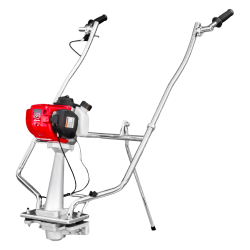
Lightest TA-MCD
Toolsa High Screed TA-MCD Power Screed Drive (Honda GX 35)
- Toolsa High Screed
- 12,7 kg
- Honda GX 35
zł4,920.00 4 000,00 zł net At your place on Monday
A power screed does two jobs at once: it brings concrete to level and compacts it at the same time. The engine drives an eccentric weight, the vibration passes through the blade into the mix and forces air out of it, while a layer of mortar rises to the top. A hand screed bar will not do the second part — it places the material but leaves voids in it, and those weaken the slab later.
3 products
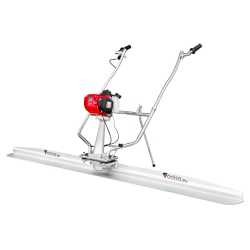
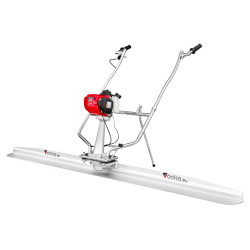
Two series are available. Thunder Screed, with a Honda GX 25 engine of 1,1 hp, takes blades of 2 and 2,5 m at a complete weight of 17 kg and a vibration frequency of 9 500 rpm. High Screed, with the larger Honda GX 35 (1,3 hp), works with blades of 2,4 and 3 m at a noise level of 50 dB(A).
Both series are modular: the drive unit and the blade are sold separately or together. One drive takes either blade within its own series, so changing working width means changing only the blade. Drives are not interchangeable between series, though — the TA-MCD mount fits High Screed blades only, and the TA-PCD fits Thunder Screed.
The preceding stage, spreading the mix, is covered by concrete rakes, and floating after screeding by bull floats.
Fresh concrete carries air — usually a few per cent by volume, and considerably more in a stiff mix discharged from height. Air left in the material forms voids, and the concrete around them is weaker and open to water. A slab with too many voids dusts sooner, breaks up at the edges and takes frost badly.
Vibration deals with this mechanically: the shaking briefly reduces friction between aggregate particles, the mix behaves like a less viscous liquid, the bubbles rise out and the particles settle closer together. A layer of mortar comes to the top at the same time, which makes the following stages easier.
The practical difference from a hand screed is that a power screed does both jobs in one pass. Done by hand, the mix has to be compacted first — with a poker vibrator on thicker sections — and then screeded to level separately. On slabs up to about 150 mm thick a power screed replaces both steps.
| Feature | Thunder Screed | High Screed |
|---|---|---|
| Engine | Honda GX 25 | Honda GX 35 |
| Output | 1,1 hp | 1,3 hp |
| Blade widths | 2 / 2,5 m | 2,4 / 3 m |
| Fuel tank | 0,55 l | 0,63 l |
| Vibration frequency | 9 500 rpm | — |
| Noise level | — | 50 dB(A) |
| Complete | 2 m · 2,5 m | 2,4 m · 3 m |
| Drive only | TA-PCD | TA-MCD, 12,7 kg |
| Blade only | TA-PCB | TA-MCB |
What decides the choice is the width of the bay rather than engine output. The blade has to bear on both rails or on the edges of the formwork, so it is chosen to match the spacing actually used on site. A blade too long for the bay is useless, and one too short calls for intermediate rails — extra work on every pass.
The second criterion is weight and how many hours a day the tool will run. A complete Thunder Screed weighs 17 kg and the High Screed drive alone 12,7 kg — with longer blades the mass rises, and operator fatigue with it, since the screed is worked leaning forward and drawn back towards the operator.
The modular build has a clear economic point. The drive — engine, eccentric and handles — is the expensive part of the set and never touches concrete. The blade works in the mix, wears down, and is what needs replacing.
One drive takes either blade within its own series: the TA-MCD works with High Screed blades of 2,4 and 3 m, the TA-PCD with Thunder Screed blades of 2 and 2,5 m. A gang working bays of differing width therefore buys one drive and two blades rather than two complete machines.
Drives are not interchangeable between series. The mount and the vibration characteristics are matched to a particular blade length, so a TA-MCD will not fit a Thunder Screed blade or the reverse. When ordering parts, the series name decides, not the width alone.
This parameter never appears in a price list, yet it genuinely limits how the working day is organised. The High Screed transmits 9 m/s² to the handles, and that figure is what the permitted exposure time for one operator is calculated from.
Regulations work with two thresholds for daily exposure. The exposure action value is 2,5 m/s², above which the employer must introduce measures to reduce risk. The exposure limit value is 5 m/s² and may not be exceeded at all. Since exposure is averaged over time, a tool at 9 m/s² reaches the action value after roughly 37 minutes and the daily limit after about 2,5 hours of continuous use.
The practical conclusion concerns planning rather than equipment: on a full day's pour, operators rotate. One person cannot legally spend eight hours on a power screed, however well they feel. The same arithmetic applies to concrete vibrators and to percussive tools generally.
A power screed wins wherever the concrete has to be compacted — which means practically every structural slab and every industrial floor. On thin levelling layers, screeds over existing bases and self-levelling compounds, compaction is either unnecessary or actively harmful, and the work is done with a hand screed bar instead.
The second criterion is access. A power screed needs a bay where the blade bears at both ends, and room to be drawn along the full length of the pass. In tight spaces, around columns and in corners there is no way to introduce it — those areas are finished by hand, exactly as with power trowels.
Width follows the spacing of the rails or formwork the blade has to bear on at both ends, not the size of the floor. The range covers 2 and 2,5 m in the Thunder Screed series and 2,4 and 3 m in High Screed. A longer blade means fewer passes and faster work, but also more weight and the need to keep it straight over the whole length. In a bay narrower than the blade the tool is useless; in a wider one, intermediate rails have to be set, which costs time on every pass.
On floors and slabs up to around 150 mm thick a power screed compacts the material adequately, because the vibration reaches about as deep as the layer itself. On thicker elements — footings, walls, columns, suspended slabs — surface vibration does not reach the lower parts and a poker vibrator is required, with its head working inside the mix. Both tools are often used on the same site for different elements and do not replace one another.
Both parts are stocked separately, and that is the main advantage of this design. The drive holds the engine and eccentric, never touches concrete and lasts for years; the blade works in the mix and is what wears. One drive takes either blade in its series — TA-MCD the 2,4 and 3 m blades, TA-PCD the 2 and 2,5 m. Drives are not interchangeable between series, so an order should state the series rather than the width alone.
Hand-arm vibration decides, and in the High Screed series it is 9 m/s². At that level the action value of 2,5 m/s² is reached after about 37 minutes, and the daily exposure limit of 5 m/s² after roughly 2,5 hours of continuous work. In practice that means operators must rotate on a full day's pour. The machine is not the constraint here — human exposure is, calculated as an average weighted by working time.
The Honda GX 25 and GX 35 are four-stroke engines running on unleaded petrol, with no oil mixed in — the oil sits in a separate sump, as in a car engine. The tanks are small: 0,55 l on Thunder Screed and 0,63 l on High Screed, which on a pour means refuelling during the day. Keep fuel on site, because a trip to fetch it falls exactly when the concrete will not wait.
Self-levelling compounds are spread without compaction — they flow out by themselves, and vibration separates their constituents rather than helping. Those materials call for the ⌀50,8 mm spreader bar from bull floats, worked through the mix in a swaying motion. A power screed belongs on concrete of plastic or stiff-plastic consistency, where there is something to compact.
The mix is spread before screeding with concrete rakes. After screeding the surface is closed by bull floats, and on elements thicker than a floor slab compaction passes to concrete vibrators. The full order of work is in concrete hand tools.
Essential cookies keep your cart and login working — the shop will not run without them. The rest let us measure traffic and target our ads, and we switch them on only with your consent. You can change your choice at any time using the “Cookie settings” link in the footer. Cookie policy
Essential
Cart, login, form security and remembering this choice. The shop will not work without them, so they need no consent.
Toolsa
Analytics
We count page views and checkout paths to find what is broken in the shop. We look at the data in aggregate.
Google Analytics · Microsoft Clarity
Marketing
We show our ads outside the shop and check which of them lead to a purchase. Phone callback requests land here too.
Google Ads · OptinMonster · Zadarma