
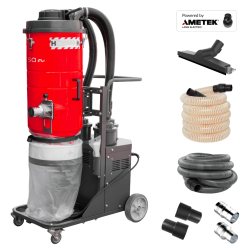
TAA0153
Toolsa Industrial Vacuum Cleaner TAMC3000 (3.6 Kw | 230 V | 3 HEPA H13 Filters)
- 65 kg
- 230 v
- 630 x 840 x 1470 mm
zł14,760.00 12 000,00 zł net At your place on Monday
A vacuum for a concrete grinder or scarifier is not a larger workshop vacuum — it is a dust extractor, sized to the amount of dust the machine produces continuously. A planetary grinder takes kilograms of material off a floor every hour, and all of it has to disappear at the rate it is created.
2 products
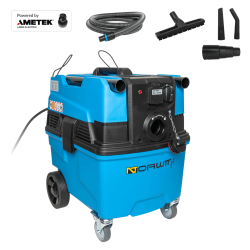
So airflow matters more than suction pressure: 400 m³/h on the TAMC2000 and 262 m³/h on the compact TAAC15. The second condition is holding that airflow all shift — hence Auto Clean systems that clear the filter during operation instead of waiting for the operator to shake it out.
All four machines are dust class H — the highest in EN 60335-2-69 — with HEPA H13 filters rated above 99.95% at 0.3 μm. On concrete that is not overkill: the dust carries respirable crystalline silica, a recognised carcinogen.
The machines producing that dust are in concrete grinders and concrete scarifiers. Replacement filters, bags and hoses are in vacuum cleaner accessories.
"Vacuum for a grinder" covers two entirely different jobs, and it is worth knowing which one you have landed on.
An orbital, random-orbit or angle grinder is a hand tool of a few hundred watts. It produces as much dust as it takes off a small area, and a workshop vacuum with a power-tool socket and a ⌀ 32–35 mm hose handles it. What matters there is the auto-start socket and a small footprint.
A concrete grinder or scarifier is a floor machine rated in kilowatts, removing material across a whole building. Dust collection then needs airflow in the hundreds of cubic metres per hour, a ⌀ 50–70 mm port and class H filtration, because concrete dust is carcinogenic and the volume is in another league.
This category covers the second case only. If you need dust collection for a hand-held sander working wood or plaster, the machine to look at is the compact TAAC15 — the smallest in the family at 13.5 kg with a 38 l container, designed for plasterwork and finishing.
Every extractor is described by two numbers that are easy to confuse and that answer different questions.
Airflow (m³/h) says how much air the machine moves per unit of time. It is what decides when extracting from a tool in motion: dust has to be carried out of the grinder shroud before it can disperse across the building. Under a grinding head, volume is what counts.
Suction pressure (mbar) says how hard the machine pulls when the flow is choked. That is what decides when lifting something heavy — water, slurry, wet debris — or pushing air through a long, narrow hose. These extractors run 240–250 mbar, which is ample for dust collection.
The practical consequence: size a grinder extractor by airflow and a water pick-up by suction. The second job belongs to wet and slurry vacuums, which have a 90 l container and a different filter arrangement.
| Specification | TAAC15 | TAMC2000 | TAMC3000 | TAAC3200 |
|---|---|---|---|---|
| Motor | 1.2 kW | 2.4 kW | 3.6 kW | 3.6 kW |
| Supply | 230 V | 230 V | 230 V | 230 V · 14.4 A |
| Airflow | 262 m³/h | 400 m³/h | — | — |
| Suction | 250 mbar | 240 mbar | 240 mbar | 240 mbar |
| Dust class | H | H | H | H |
| HEPA H13 filters | 1 | 2 | 3 | 3 |
| Filter cleaning | Auto Clean | manual | manual | Auto Clean |
| Container | 38 l | — | — | — |
| Inlet | — | — | — | 70 mm |
| Weight | 13.5 kg | 48 kg | 65 kg | 70 kg |
| Dimensions | 385 × 500 × 570 mm | 570 × 710 × 1300 mm | 630 × 840 × 1470 mm | 560 × 820 × 1400 mm |
| Product page | TAAC15 | TAMC2000 | TAMC3000 | TAAC3200 |
With the 3.6 kW machines, do the electrical arithmetic: the TAAC3200 draws 14.4 A, more than a typical 16 A circuit will give you alongside anything else. An extractor of this class gets its own circuit, not the same extension lead as the grinder.
An extractor starts losing performance in its first minute. Dust settles on the filter, resistance rises, and the volume of air passing through falls with it — after half an hour of grinding concrete, a machine with a loaded filter collects a fraction of what it collected at the start. Operators rarely notice, because the loss is gradual rather than sudden.
Auto Clean answers that mechanically: the system pulses dust off the filter on a cycle without interrupting work, so airflow stays close to its starting value all shift. On the TAAC3200 and TAAC15 it is factory-fitted.
On the manually cleaned machines — TAMC2000 and TAMC3000 — the same result comes from discipline: shake the filter down every half hour or so, before the loss of airflow becomes visible. On continuous work over a large floor that is a real difference in rate, not a convenience.
EN 60335-2-69 sorts industrial vacuums into three classes by how much dust the machine puts back into the room. Class L allows under 1%, class M under 0.1%, and class H under 0.005%. The gap between M and H is two orders of magnitude.
On concrete, class H is not excessive. Dust from grinding and scarifying carries respirable crystalline silica — particles fine enough to reach the alveoli and stay there. It is classified as a carcinogen, and in an enclosed building the concentrations during floor work run far above anything measured outdoors.
HEPA H13 filters capture over 99.95% of particles at 0.3 μm — the fraction that is hardest to catch and the most dangerous. They are replaced as a set and treated as consumables; they are in vacuum cleaner accessories.
Size the extractor to the tool it serves, because that sets dust per minute. A single-disc grinder and smaller scarifiers are covered by the TAMC2000 at 400 m³/h. Planetary grinders and scarifiers with drum widths in the hundreds of millimetres call for the 3.6 kW units. Plasterwork and finishing are the compact TAAC15.
A hose that is too narrow throttles airflow whatever the motor rating. The TAAC3200 has a 70 mm inlet suited to large floor machines; 50 mm hoses and nozzles serve smaller equipment and hand work. Compare the extractor inlet with the shroud outlet on the tool before buying, not the motor ratings.
A 3.6 kW unit on 230 V draws about 14.4 A, and the grinder next to it draws its own. Two such machines on one 16 A circuit will trip it, usually mid-pass. On floor work the extractor gets its own circuit from the board — that is a distribution decision, not an extension-lead one.
On continuous work — hours of grinding without breaks — Auto Clean holds the airflow and genuinely shortens the job. On intermittent work, with natural pauses to change tooling, manual filter shaking on the TAMC machines is enough and costs less.
A concrete grinder needs an industrial dust extractor of dust class H with airflow in the hundreds of cubic metres per hour, not a workshop vacuum. A single-disc grinder and smaller scarifiers are covered by the TAMC2000 at 2.4 kW and 400 m³/h; planetary grinders and wide scarifiers call for the 3.6 kW units — the TAMC3000 or the TAAC3200 with automatic filter cleaning. Airflow and inlet diameter decide, not motor rating alone.
By scale of the task. A hand-held orbital or random-orbit sander runs at a few hundred watts and produces as much dust as it takes off a small area — a workshop vacuum with a ⌀ 32–35 mm hose and a power-tool socket handles it. A concrete grinder is rated in kilowatts and removes material across a whole floor, so it needs hundreds of m³/h of airflow, a ⌀ 50–70 mm port and class H filtration, because concrete dust carries carcinogenic crystalline silica.
Class H is the highest filtration level in EN 60335-2-69: the machine may return less than 0.005% of the dust it draws in back to the room. For comparison, class M allows under 0.1% and class L under 1% — the gap between M and H is two orders of magnitude. Class H is required for carcinogenic dusts, and that is exactly what grinding and scarifying concrete produces, because it contains respirable crystalline silica.
Airflow, quoted in m³/h, is how much air the machine moves per unit of time, and it decides when extracting from a tool in motion — dust has to leave the shroud before it disperses. Suction pressure, quoted in mbar, is how hard the machine pulls when the flow is choked, and it decides when lifting water or slurry and when working through long, narrow hoses. Size a grinder extractor by airflow and a water pick-up by suction.
Because the filter starts loading in the first minute, and the loss of airflow is gradual enough that nobody notices it. After half an hour of grinding concrete, a machine with a loaded filter collects a fraction of what it did at the start while sounding exactly the same. Auto Clean pulses dust off the filter on a cycle without stopping work, so airflow holds all shift. On manually cleaned machines the same result needs the filter shaken down every half hour.
A 3.6 kW unit on 230 V draws about 14.4 A, as stated on the TAAC3200 data. The practical conclusion is that an extractor of this class and a grinder working beside it will not share one 16 A circuit — the breaker trips, usually mid-pass. On floor work the extractor gets its own circuit from the distribution board. Smaller machines are gentler: the TAMC2000 is 2.4 kW and the compact TAAC15 is 1.2 kW.
A HEPA filter is a consumable and is replaced when cleaning no longer restores airflow — that is, when the machine still pulls weakly after being shaken down. There is no single hours figure, because loading rate depends on the material: dust from quartz hardener and concrete kills a filter far faster than plaster dust. Filters are changed as a set so that resistance stays even across all cartridges; they are in vacuum cleaner accessories.
Not simultaneously. Airflow divides between the inlets, so each tool gets under half the volume it needs and dust escapes at both. Current draw compounds the problem — two floor machines and an extractor on one circuit will certainly trip it. Where two crews work in parallel, the answer is two extractors, each sized to its own tool.
The machines producing this dust are in concrete grinders and concrete scarifiers. Water, slurry and wet debris are collected by wet and slurry vacuums, while HEPA filters, bags, hoses and nozzles are in vacuum cleaner accessories. The full range is in industrial vacuum cleaners.
Essential cookies keep your cart and login working — the shop will not run without them. The rest let us measure traffic and target our ads, and we switch them on only with your consent. You can change your choice at any time using the “Cookie settings” link in the footer. Cookie policy
Essential
Cart, login, form security and remembering this choice. The shop will not work without them, so they need no consent.
Toolsa
Analytics
We count page views and checkout paths to find what is broken in the shop. We look at the data in aggregate.
Google Analytics · Microsoft Clarity
Marketing
We show our ads outside the shop and check which of them lead to a purchase. Phone callback requests land here too.
Google Ads · OptinMonster · Zadarma