
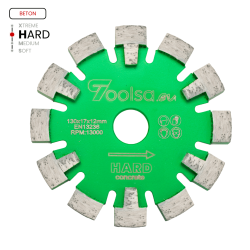
L-MHC
Toolsa LASER-MHC 130 X 17 Mm Floor Heating Cutter (Medium Hard Concrete)
- 22,2 mm
- 130 x 17 mm
- Średnio twardy i twardy beton
zł442.80 360,00 zł net At your place on Monday
An underfloor heating cutter is a 130 × 17 mm diamond wheel with a 22.2 mm bore that cuts the pipe groove in an underfloor heating milling machine. Diameter and bore decide whether the tool mounts at all. The letters in the name decide something else: how fast it cuts and how fast it wears out.
4 products
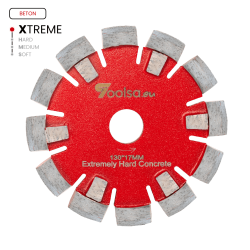
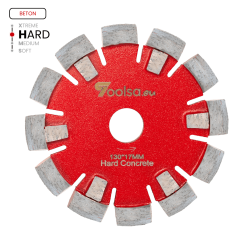
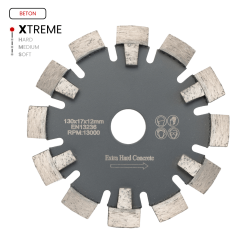
The code abbreviates the concrete the cutter is built for, not the hardness of the bond. The scale runs from SC (Soft Concrete) through MC, MHC and HC to EHC (Extra Hard Concrete). Two further codes cover abrasive floors: SAC and HAC.
Abrasiveness is a second, independent property of a floor — screed can be soft and at the same time abrasive enough to eat a cutter chosen on hardness alone. That is why the scale has two axes rather than one.
The letters in a cutter's name abbreviate the substrate it is built for. EHC spells out as Extra Hard Concrete, and the rest of the scale works the same way. That is the opposite of a common assumption — that the letter describes bond hardness. The bond was chosen by the manufacturer; the buyer judges the floor.
SC (Soft Concrete) is soft concrete, MC (Medium Concrete) medium, MHC (Medium Hard Concrete) covers the band between medium and hard, HC (Hard Concrete) is hard, and EHC is very hard: power-trowelled, surface-hardened, quartz-broadcast. Five steps, because the practical distance between a screed and an industrial floor is greater than between any two neighbouring grades.
Abrasiveness is independent of hardness and it is what most often throws the choice off. A fresh slab or a sand-rich screed can be soft and still consume a cutter as if it were industrial-grade concrete, because the spoil acts as a grinding paste. Two codes cover those floors: SAC (Soft Abrasive Concrete) for lightly abrasive material and HAC (High Abrasive Concrete) for heavily abrasive.
A diamond segment has to wear in order to expose fresh crystals. In hard concrete the matrix barely erodes, so the diamond rounds over and the tool stops biting — which is why hard concrete gets a soft bond. In abrasive concrete the opposite happens: the matrix disappears faster than the diamond can do its work, so a hard bond is needed. That relationship is already built into the code, which is why judging the floor is enough.
| Cutter | Code | Stands for | For which floor |
|---|---|---|---|
| Toolsa 130 × 17 | SC | Soft Concrete | soft concrete, cement screed |
| Toolsa 130 × 17 | MC | Medium Concrete | ordinary structural concrete |
| Toolsa LASER-MHC | MHC | Medium Hard Concrete | medium to hard concrete |
| Toolsa LASER-HC | HC | Hard Concrete | hard concrete, industrial floor |
| Toolsa 130 × 17 · LASER-EHC | EHC | Extra Hard Concrete | power-trowelled and surface-hardened concrete |
| Toolsa LASER-SAC | SAC | Soft Abrasive Concrete | soft, lightly abrasive substrate |
| Toolsa LASER-HAC | HAC | High Abrasive Concrete | heavily abrasive substrate, fresh slabs |
Every cutter is 130 mm in diameter and 17 mm wide with a 22.2 mm bore, so they all fit the same machine — the Toolsa THM130 M and other single- and three-phase machines of that size.
The mechanical fit is binary: a 130 mm diameter and a 22.2 mm bore either match the machine or the tool will not mount. The code has no bearing on it — any cutter in this range fits any 130 mm machine. The letter decides only the economics of the job: how many metres you get, and how much cutter is left afterwards.
Sites rarely come with floor documentation, so the first cutter doubles as a sample. If it still looks new after a dozen metres and the groove comes slowly, the concrete is harder than you assumed — go one grade up next time. If the segments vanish in front of you while the machine runs easily, you have met abrasive material and the right codes are SAC or HAC, even if the floor feels soft.
This is the classic trap in this category. Cement screed and fresh slabs feel soft, so the reflex is to pick a soft-concrete cutter — yet they wear tooling harder than plenty of structural concrete, because the spoil is full of sand. A cutter chosen on hardness alone can lose most of its budget on a single flat.
Our cutter data sheets state it plainly, and it is the cheapest way to keep a tool working: water carries away heat that would otherwise go into the bond and burn it out. The second rule from the same sheets is moderate down-pressure — the cutter should sink into the material on its own. Leaning on the machine does not speed up cutting, it only raises segment temperature and shortens their life.
The range comes in two series. The standard Toolsa 130 × 17 line covers SC, MC and EHC. The LASER line adds the intermediate grades and both abrasive classes — MHC, HC, SAC and HAC — plus its own EHC. The two lines therefore meet only on very hard concrete, and that is the one place where the choice does not follow from the floor.
They abbreviate the English name of the concrete the cutter is built for, not the hardness of the bond. SC is Soft Concrete, MC Medium Concrete, MHC Medium Hard Concrete, HC Hard Concrete and EHC Extra Hard Concrete. Two further codes describe abrasiveness: SAC is Soft Abrasive Concrete, HAC is High Abrasive Concrete. Bond hardness was set by the manufacturer, inversely to the material, so at the point of purchase you judge the floor rather than the tool. Every cutter in this range is 130 × 17 mm with a 22.2 mm bore.
Start from the type of floor: screed and cement slabs call for SC or one of the abrasive codes, ordinary structural concrete for MC, an industrial floor for HC, and power-trowelled or surface-hardened concrete for EHC. If you do not know what you are cutting, treat the first cutter as a sample: a tool that still looks new after a dozen metres means concrete harder than assumed, while segments disappearing in front of you mean abrasive material. The MHC grade covers the band between medium and hard and is a safe pick on an uneven floor.
They are two independent properties, and confusing them is the commonest selection error. Hardness says how difficult it is to cut into the material; abrasiveness says how badly the spoil destroys the tool while you work. A fresh slab or a sand-rich screed is soft, so the cutter enters easily, but the dust it produces acts as a grinding paste and consumes the bond faster than hard structural concrete would. That is why the range carries separate SAC and HAC codes rather than a single hardness scale from SC to EHC.
The one whose diameter and bore match the machine does. Every Toolsa underfloor heating cutter is 130 mm in diameter and 17 mm wide with a 22.2 mm bore, the size found on most single-phase and three-phase machines, including our THM130 M. The hardness code has nothing to do with fit: any cutter in this range mounts on any 130 mm machine. Groove width, on the other hand, comes from the cutter fitted rather than from a machine setting.
Mostly it depends on how well the code was matched, and only then on the metres cut. A cutter too soft for the floor loses its segments many times faster, while one too hard stops cutting although it still looks new, because the matrix does not erode and the diamond rounds over. Water cooling and moderate down-pressure both extend tool life: the cutter should sink into the material on its own. Leaning on the machine raises segment temperature instead of speeding up the work.
In the span of the scale. The standard Toolsa 130 × 17 line carries three codes — SC, MC and EHC — covering soft, medium and very hard concrete. The LASER line adds the intermediate MHC and HC grades and both abrasive classes, SAC and HAC, along with its own EHC. In practice that means the choice is unambiguous for most floors and follows directly from the code; the two lines overlap only on very hard concrete, where two cutters share the same purpose.
Water cooling extends cutter life and is recommended on the data sheets of every model in this range, because water carries away the heat that would otherwise burn out the bond around the diamond crystals. Dry cutting is possible and often more practical in a flat under refurbishment, but it requires extraction: respirable silica dust has to be taken at source, or after a few metres you cannot see your own groove. Either way the same pressure rule applies — the tool should enter the material on its own.
Depth is set by the machine, not the cutter. On our THM130 M the range reaches 25 mm, set with a lever and locking pin, and a 130 mm diameter leaves ample margin for that. Width, by contrast, comes from the cutter: the 17 mm range gives a channel for the PEX and PERT pipe normally used in underfloor heating. With a 16 mm pipe sunk to full depth, roughly 9 mm is left above it for repair mortar.
Machines for these cutters are in underfloor heating milling machines. Machines that work the whole floor surface — different tooling, different job — are in concrete scarifiers, with their wear parts in scarifier drums. Dust extraction for dry work is in vacuum cleaners for grinders and scarifiers.
Essential cookies keep your cart and login working — the shop will not run without them. The rest let us measure traffic and target our ads, and we switch them on only with your consent. You can change your choice at any time using the “Cookie settings” link in the footer. Cookie policy
Essential
Cart, login, form security and remembering this choice. The shop will not work without them, so they need no consent.
Toolsa
Analytics
We count page views and checkout paths to find what is broken in the shop. We look at the data in aggregate.
Google Analytics · Microsoft Clarity
Marketing
We show our ads outside the shop and check which of them lead to a purchase. Phone callback requests land here too.
Google Ads · OptinMonster · Zadarma