
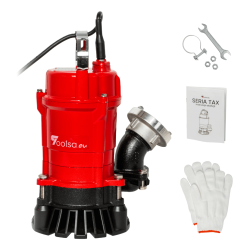
TAX10-6-0.6
Toolsa TAX10-6-0.6 Submersible Sludge Pump
- 230 v
- 50 Hz
- 230 V
zł1,228.77 999,00 zł net At your place on Tuesday
A submersible pump works immersed in the liquid it is clearing — it does not draw it from above but pushes it up from within. So there is no priming and no suction height to worry about: stood on the bottom of an excavation it starts moving water immediately, including when only a few millimetres are left.
2 products
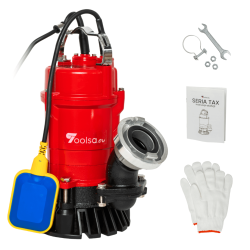
The TAX series covers excavation dewatering: 0.6 and 0.8 kW, up to 18 m³/h, head of 6 or 10 m, a 2" outlet and suction down to 2 mm of water. The F versions carry a float switch and cycle themselves.
The TAPWA series handles sewage: an agitator at the inlet and more head — 15 m at 0.75 kW and 30 m at 2.2 kW on a 400 V supply.
Hoses and cables are in pump accessories. For larger volumes and work without mains power, the answer is trash pumps; for clean water, clean water pumps.
Every pump data sheet quotes a maximum flow and a maximum head — and that pair is the most commonly misread in construction equipment. The two maxima exclude each other.
The 18 m³/h is achieved at zero head, discharging beside the pump. The 10 m of head is achieved at zero flow, with water merely standing in the hose. Real work sits between the two: the TAX10-10-0.8 delivers 10 m³/h at 10 m of head, not 18.
So selection is about the duty point, never either maximum on its own. Measure the real difference in level — from the water surface to the discharge — and read the flow at that head. A pump chosen on the "18 m³/h" figure alone always disappoints on site.
| Model | Application | Motor | Max head | Flow at duty point | Max flow | Supply |
|---|---|---|---|---|---|---|
| TAX10-6-0.6 | dirty water, excavations | 0.6 kW | 6 m | 10 m³/h at 6 m | 18 m³/h | 230 V |
| TAX10-6-0.6F | as above, with float | 0.6 kW | 6 m | 10 m³/h at 6 m | 18 m³/h | 230 V |
| TAX10-10-0.8 | dirty water, excavations | 0.8 kW | 10 m | 10 m³/h at 10 m | 18 m³/h | 230 V |
| TAX10-10-0.8F | as above, with float | 0.8 kW | 10 m | 10 m³/h at 10 m | 18 m³/h | 230 V |
| TAPWA10-10-0.75 | sewage, with agitator | 0.75 kW | 15 m | 10 m³/h at 10 m | 18 m³/h | 230 V |
| TAPWA15-20-2.2 | sewage, with agitator | 2.2 kW | 30 m | 15 m³/h at 20 m | 25 m³/h | 400 V |
Every pump here has a 2" (50–52 mm) outlet and handles liquid up to +50°C. The TAX series draws down to 2 mm — effectively dry — and that, rather than flow rate, is the reason a pump like this stays on site.
The F versions carry a float switch — a sensor riding on the surface that starts the pump as the level rises and stops it as the level falls. The difference is not convenience.
A submersible running dry loses its cooling, because the liquid it moves is what carries heat away from the motor. A quarter of an hour in an empty excavation can damage it. In a pit that fills unevenly — after rain, from seepage, while lowering the water table — nobody watches a pump around the clock, and that is where a float pays for itself on the first use.
Versions without a float make sense where inflow is steady and somebody is present: dewatering during works, transferring between tanks, or any setup with manual control.
The TAX series is built for contaminated water: rainwater in an excavation, water carrying sand, turbid water after a downpour. It handles suspended solids but is not a machine for fibrous material.
The TAPWA series has an agitator at the inlet that keeps solids in suspension instead of letting them settle into a layer. That lets it work in sewage and in liquid with sediment an ordinary submersible would leave behind — because it would draw the water off the top and leave the solids in place.
The second difference is head: 15 and 30 m against 6–10 m on the TAX series. That follows from the application — sewage usually has to be lifted into an existing installation rather than discharged beside the pit.
Head is measured from the liquid surface to the discharge point, not from the bottom. Hose losses add to it, rising with length and falling with diameter. Practically: if the discharge is 8 m higher, a pump with 6 m of maximum head moves nothing at all, whatever its 18 m³/h maximum flow suggests.
Clean rainwater, water with sand, water with sediment and sewage are four different jobs. The first three are covered by TAX; where sediment settles into a layer, and for sewage, you need an agitator, which means TAPWA. A pump chosen for cleaner duty than it gets blocks within the hour.
Five of the six run from a 230 V socket. The largest, TAPWA15-20-2.2, needs 400 V — which on an excavation without a distribution board settles the question before any hydraulic figure does.
If so, take the float version. Running dry removes the pump's cooling, and a pit rarely fills evenly. Where somebody is present and inflow is steady, the version without a float is simpler and cheaper.
Excavation dewatering calls for a submersible pump rated for contaminated water — here the TAX series: 0.6 or 0.8 kW, a 2" outlet, up to 18 m³/h and 6 or 10 m of head. Two things matter besides flow: suction down to 2 mm, effectively dry, and the float switch on the F versions, which stops the pump once the water has gone. Selection starts from the level difference between the water surface and the discharge point.
Because maximum flow and maximum head never occur at the same time. The 18 m³/h is achieved at zero head, discharging beside the pump; the 10 m of head is achieved at zero flow. Real duty sits between: the TAX10-10-0.8 delivers 10 m³/h at 10 m. Hose losses add to that, rising with hose length and falling with diameter.
It starts the pump as the liquid rises and stops it once the level falls, so the machine never runs dry. This is not a convenience: a submersible is cooled by the liquid it moves, so a quarter of an hour in an empty pit can damage it. In an excavation filling unevenly — after rain or from seepage — a float pays for itself on the first use. Versions without one suit steady inflow under supervision.
Inlet design and range. TAX pumps handle contaminated water — rainwater, water with sand, turbid water from an excavation — with 6 or 10 m of head. TAPWA has an agitator at the inlet that keeps sediment in suspension rather than letting it settle, so it works in sewage and liquid with solids. It also reaches higher: 15 m at 0.75 kW and 30 m at 2.2 kW, because sewage usually has to be lifted into an existing installation.
The TAX series draws down to 2 mm, effectively dry — and that, rather than flow rate, is why a pump like this stays on site. What remains is a film cleared with a wet and slurry vacuum or by hand. Pumps without that feature stop drawing at a few centimetres, which at handover of an excavation is the difference between finished and not.
Sand in suspension, yes — the TAX series is rated for contaminated water and moves that material. The limit is sediment that has already settled into a layer: an ordinary pump then draws the water off the top and leaves the solids in place. That is what the TAPWA series with its agitator is for. Where there is a large volume of solid material, the right tool is a trash pump.
Five of the six run from an ordinary 230 V socket at 50 Hz, with motors from 0.6 to 0.8 kW. The exception is the 2.2 kW TAPWA15-20-2.2, which needs 400 V — on an excavation without a distribution board that settles the question before any hydraulic figure does. Running from a generator, allow headroom for the motor's starting current.
Every pump here has a 2" outlet, 50–52 mm, matching the TAX-2" fire hose in 20 m lengths. Never fit a hose narrower than the outlet — flow resistance rises sharply and the pump loses output while running perfectly normally. Over longer runs a 3" (75 mm) hose with a reducer pays off, because line losses are markedly lower. Hoses are in pump accessories.
Fire hoses, cables and fittings are in pump accessories. For large volumes and work without mains power the answer is trash pumps, and for clean water and domestic systems clean water pumps. Residual water and slurry on a floor are picked up by wet and slurry vacuums.
Essential cookies keep your cart and login working — the shop will not run without them. The rest let us measure traffic and target our ads, and we switch them on only with your consent. You can change your choice at any time using the “Cookie settings” link in the footer. Cookie policy
Essential
Cart, login, form security and remembering this choice. The shop will not work without them, so they need no consent.
Toolsa
Analytics
We count page views and checkout paths to find what is broken in the shop. We look at the data in aggregate.
Google Analytics · Microsoft Clarity
Marketing
We show our ads outside the shop and check which of them lead to a purchase. Phone callback requests land here too.
Google Ads · OptinMonster · Zadarma