
TAX3
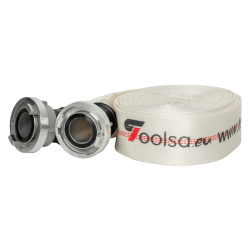
Toolsa TAX-3 Fire Hose, 3 Inch (75 Mm, 20 M)
- Toolsa seria TAX
- 75 mm
- 20 m
zł281.67 229,00 zł net At your place on Monday
A hose is not an accessory to a pump — it is part of the hydraulic system, and it can take away most of the output. Every metre of line adds resistance that rises with length and falls sharply with diameter. A pump rated at 18 m³/h at the outlet can deliver a fraction of that through an undersized hose while running perfectly normally.
1 product
Two fire hoses of 20 m are offered: TAX-2" at 50 mm, matching the outlet on the TAX pumps directly, and TAX-3" at 75 mm — for longer runs, where line losses become the main problem.
The third item is a 7 m power cable for TAX series pumps — something nobody buys in advance but without which the pump stops.
The pumps this equipment fits are in submersible excavation pumps, and the whole family is reviewed in industrial dewatering pumps.
Flow resistance in a line rises in proportion to length, but as diameter falls it rises far faster — because the cross-section shrinks while the liquid's velocity against the walls climbs. The effect is that dropping to a narrower hose hurts more than doubling the run.
The practical conclusion is unambiguous: never use a hose narrower than the pump outlet. Every submersible pump in this range has a 2" (50–52 mm) outlet, which is what the TAX-2" hose is matched to.
Over runs of several tens of metres it pays to go the other way and use the 3" (75 mm) hose with a reducer at the outlet. The larger bore lowers velocity and with it the losses — the pump then delivers noticeably more, although nothing about the pump has changed.
| Item | Size | For | Compatibility |
|---|---|---|---|
| TAX-2" fire hose | 50 mm · 20 m | standard runs, straight onto the outlet | TAX series |
| TAX-3" fire hose | 75 mm · 20 m | long runs, lower losses | TAX series |
| Power cable | 7 m | service part | TAX series |
Both hoses are 20 m, which covers a typical run from an excavation to the discharge point. Longer routes are made up by joining lengths — and that is where the difference between 2" and 3" stops being theoretical.
A fire hose is flat when empty and takes its shape from the pressure inside. With construction pumps that has three practical consequences a rigid hose cannot offer.
First, it rolls flat, so twenty metres packs into something one person can carry and stow in a boot alongside the pump. Second, it does not kink over edges the way a fixed-bore hose does; it lies over unevenness instead of forming the folds that throttle flow. Third, after work it drains completely when dragged out, which matters if the kit is going into an unheated store.
There is one price for all that: a flat hose will not draw. It cannot be used on the suction side of a surface pump, because vacuum simply collapses it. With submersible pumps that is irrelevant — they only ever discharge.
A 2" outlet means a 2" hose as a minimum. Every restriction along the way — couplings and reducers included — is a point of loss, and those losses add up. A restriction at the far end costs as much as one at the pump.
The hose runs along the bottom of the excavation, up the batter and across the site — the real route is often twice the distance on a plan. With two 20 m lengths it is already worth working out whether the 3" hose pays.
A hose laid over a sharp formwork edge throttles the flow exactly where nobody can see it, and chafes through at the same point. A few boards under the route cost a minute and save both the output and the hose.
Water left in a hose in frost splits it from the inside. A fire hose is drained by dragging it out and only then rolled — the same applies to the pump, where frozen water wrecks the impeller.
One no narrower than the pump outlet. Every submersible in this range has a 2" outlet, 50–52 mm, matched by the TAX-2" fire hose in 20 m lengths. For longer routes the TAX-3" at 75 mm with a reducer at the outlet pays off, because line losses are markedly lower. A restriction anywhere along the run reduces the output of the whole system.
Usually the hose rather than the pump. Flow resistance rises in proportion to length, but far faster as diameter falls, because the cross-section shrinks while liquid velocity against the walls climbs. A hose narrower than the outlet, or folded over the edge of an excavation, can take away most of the output while the pump runs perfectly normally and shows no sign of a fault.
Bore, and therefore losses along the length. A 3" (75 mm) hose has a much larger cross-section than a 2" (50 mm), so at the same flow the velocity is lower and the losses smaller. Over a short run the difference is slight, but over tens of metres the pump delivers noticeably more through the 3" hose — although nothing in the pump has changed. Both hoses are 20 m long.
Because it is flat when empty and takes shape from the pressure inside. So it rolls flat and twenty metres can be carried in one hand, it does not kink over the edges of an excavation the way a fixed-bore hose does, and after work it drains completely when dragged out. It has one limitation: it will not draw, because vacuum collapses it. With submersible pumps that does not matter, since they only discharge.
No. A flat hose holds its shape only through internal pressure; under vacuum it collapses and flow stops. The suction side of a surface pump or a trash pump needs a spiral-reinforced hose that holds its bore whatever the pressure. Submersible pumps have no suction side — they work immersed and only discharge — so a fire hose is the correct answer there.
Drain it before rolling. Water left in a hose in frost splits it from the inside, and suspended solids from an excavation dry into a layer that stiffens the material and accelerates cracking at the folds. A fire hose is drained by dragging it along the ground from the pump end, and only then rolled. The same applies to the pump itself — water frozen inside wrecks the impeller.
The 7 m cable for TAX series pumps is a service part, and replacing it means opening the motor housing — the component that keeps the whole pump sealed. That is a job for a service centre or a qualified electrician: a cable gland that no longer seals on a submersible pump ends in a flooded winding rather than simply a failed cable.
Measure along the real route rather than in a straight line: the hose runs along the bottom of the excavation, up the batter and across the site, so it is often twice the distance shown on a plan. A 20 m length covers typical excavation dewatering with the discharge nearby. With two lengths it is worth working out whether the 3" diameter pays, because losses build with every metre.
The pumps this equipment fits are in submersible excavation pumps. The whole family — from clean water to slurry — is reviewed in industrial dewatering pumps, and petrol machines for large volumes are in trash pumps.
Essential cookies keep your cart and login working — the shop will not run without them. The rest let us measure traffic and target our ads, and we switch them on only with your consent. You can change your choice at any time using the “Cookie settings” link in the footer. Cookie policy
Essential
Cart, login, form security and remembering this choice. The shop will not work without them, so they need no consent.
Toolsa
Analytics
We count page views and checkout paths to find what is broken in the shop. We look at the data in aggregate.
Google Analytics · Microsoft Clarity
Marketing
We show our ads outside the shop and check which of them lead to a purchase. Phone callback requests land here too.
Google Ads · OptinMonster · Zadarma