
TPT836
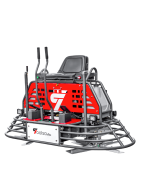
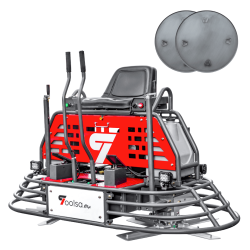
Toolsa TPT-836 EHG Self-Propelled Power Trowel (Rato R740 | 25 HP)
- 350 kg
- Rato R740
- Dwucylindrowy, czterosuwowy
zł36,900.00 30 000,00 zł net At your place on Monday
A power trowel closes the surface of a fresh concrete slab: rotating blades compact the cement paste, level out minor irregularities and give the top layer a smoothness no hand tool achieves. It is not only about appearance — a densified surface layer is harder, less absorbent and wears more slowly, so the quality of trowelling decides how long an industrial floor lasts.
2 products
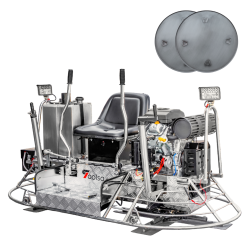
Machines fall into three groups by area covered and by how they are operated. Edging trowels at 600 mm work along walls, in corners and around columns, where a larger machine cannot reach. Walk-behind power trowels at 940 mm handle slabs from a few hundred square metres. Ride-on power trowels with twin rotors of 2 × 900 or 2 × 1200 mm, operated from a seat, are for work where pace decides — warehouses, halls and slabs measured in thousands of square metres.
Every machine has variable speed across 70–140 rpm, and the largest unit 0–180 rpm, covering the full sequence from the first pass on a float pan through to final finishing on blades. Engines are four-stroke petrol units from 5.5 to 35 hp.
Trowelling has one time window: the concrete has to be set enough to carry the machine, yet still plastic enough to be compacted. Hitting that moment matters more than the machine itself, which is why on larger slabs the sequence of entry is planned, not just the equipment.
Pans and blades are matched to machine diameter and to the stage of work — see trowel blades and pans. Separate categories cover walk-behind power trowels and ride-on power trowels.
Trowelling has one window and it cannot be moved. The concrete must be set enough to carry the machine and still plastic enough to be compacted. Going in too early tears the surface and pushes the blades into the mix; too late and the machine simply slides over a hardened layer, achieving nothing but noise.
The site test is a boot print: when a footstep leaves a mark about 3–5 mm deep, it is time for the first pass on a float pan. Before that, the slab is only entered on boards or in wide-soled boots. The timing itself depends on temperature, humidity, mix design and how absorbent the substrate is — in hot weather the window can close within two hours, while in cold conditions it opens only after several.
That is where the usual working sequence on larger slabs comes from: the edging machine goes in first, because edges and the areas around columns set faster than the middle of the pour, and only then does the main machine follow. Above a thousand square metres the window is often shorter than the time one machine needs to cover the area — and that, rather than operator comfort, is what justifies a ride-on trowel.
| Model | Type | Trowelling diameter | Engine | Speed | Blades | Weight |
|---|---|---|---|---|---|---|
| TPT-600 | edging | 600 mm | 5,1 kW (7 hp) | 70–140 rpm | 4 | 53 kg |
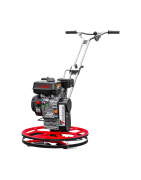
| TPT-900 | walk-behind | 940 mm | 4–5,1 kW (5.5–7 hp) | 70–140 rpm | 4 | 76–83 kg |
| TPT-900R10 | walk-behind | 940 mm | 7,4 kW (10 hp) | 70–140 rpm | 4 | 87 kg |
| TPT-836 EHG | ride-on | 2 × 900 mm | 18,5 kW (25 hp) | 70–150 rpm | 8 | 350 kg |
| TPT-836 Low Rider | ride-on, low profile | 2 × 900 mm | 18,5 kW (25 hp) | 70–150 rpm | 8 | 350 kg |
| TPT-1046 EHG | ride-on | 2 × 1200 mm | 25,7 kW (35 hp) | 0–180 rpm | 8 | — |
All machines run air-cooled four-stroke engines; the ride-on units are twin-cylinder. The lower end of the speed range, from 70 rpm, covers the first pass on a pan, while the upper limit of 150–180 rpm is for final finishing on blades. Ride-on machines use an EHG helical gearbox — quieter and able to carry more torque than a straight-cut design.
The Low Rider has the same working specification as the standard TPT-836 — 2 × 900 mm, 25 hp, 350 kg — and differs in overall height. That matters where the machine has to pass under a low lintel, through a restricted door opening or into an underground car park. On such projects the choice between versions is not about output but about whether the machine can get onto the slab at all.
The same machine runs two kinds of tooling, and the sequence never changes.
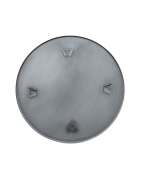
A float pan — a full disc fitted over the blade spider — spreads pressure across the whole area. It goes on first, while the concrete is still soft: it levels, closes the pores and beds the aggregate without leaving edge marks. Pan diameter follows the machine, hence sizes of 610, 945, 970 and 1170 mm — slightly larger than the trowelling diameter, because they have to extend beyond the blade circle.
Blades work directly, over a much smaller contact area, so unit pressure is far higher. They follow the pan once the surface has set enough not to be scored. Blade pitch changes as work progresses: nearly flat at first, then raised step by step over successive passes, which increases pressure and refines the finish. The final passes at steep pitch and high speed produce what is called a burnished or mirror finish.
Reversing the order goes badly: blades on green concrete gouge the surface, while a pan on a hardened slab merely rides over it. There is also a practical reason for keeping pans and blades as matched sets — mixing worn and new blades on one spider gives uneven pressure across the arms, which shows on the finished slab as a repeating pattern. Tooling for both stages is in trowel blades and pans.
An industrial floor rarely ends with trowelling alone. A dry shake hardener — cement blended with quartz or corundum aggregate — is broadcast onto the fresh surface and then worked into the top layer with the trowel. The result is a wearing surface far more abrasion-resistant than the concrete beneath, and it is that layer which takes forklift traffic.
Uniformity decides the outcome. Unevenly spread hardener produces patches of differing colour and, more seriously, differing hardness — over-applied areas can delaminate, under-applied ones wear through sooner. Broadcasting by hand from a bucket does not give that consistency over large areas, which is why a spreader with adjustable output is used. Timing is the second condition: the hardener goes down within the same window in which the trowel is working, so spreading and trowelling follow one another without pause.
Up to a few hundred square metres a walk-behind machine at 940 mm is enough — one operator will cover the area inside the window. Above a thousand square metres the arithmetic stops working: concrete sets faster than a hand-guided machine can cross the pour. That is when a ride-on unit becomes the answer, covering a strip more than twice as wide per pass with twin 2 × 1200 mm rotors.
No circular machine reaches a wall — a band always remains, as wide as the rotor radius plus the guard. On a slab with numerous columns, recesses and thresholds, the share of such areas grows enough that a separate 600 mm edging machine stops being an accessory and becomes the condition for finishing inside the window. On a clear open hall, finishing the edges with a hand float is sufficient.
A ride-on trowel weighs 350 kg and drives onto the slab under its own power, but it has to get there first. In underground car parks, halls with low doors and buildings with restricted headroom the standard profile can be too tall — which is what the low-profile version is for, at identical working specification.
At the same 940 mm diameter we offer engines from 5.5 to 10 hp. The difference shows not on an easy slab but when working a dry shake hardener and on the final passes at steep blade pitch, where resistance rises and a weaker engine starts losing revs. The more powerful unit also carries a larger tank, 5.4 l against 3.6 l, which means one refuelling stop fewer inside the working window.
The moment is judged by a boot print: when a footstep leaves a mark 3–5 mm deep, the slab is ready for the first pass on a float pan. Earlier, the machine pushes the blades into the mix and tears the surface; later, it slides across a hardened layer with no effect. The window depends on temperature and humidity — in hot weather it closes roughly two hours after the pour, in cold conditions it opens later and lasts longer. This is also why edges are trowelled before the middle of larger slabs: concrete sets faster against walls and columns.
Trowelling cannot be postponed to the following day — after a dozen or so hours the concrete has set to the point where blades no longer densify the surface layer and merely pass over it. What remains for a hardened slab is diamond grinding, a process that removes material instead of closing it, so a different technology and a different cost. If the window has been missed, the right approach is preparing the surface with a concrete grinder and applying a finishing layer if required.
Rotor count, how the machine is operated, and pace. A walk-behind has one rotor of 940 mm, is guided by handles, weighs 76–87 kg and suits slabs up to a few hundred square metres. A ride-on has twin rotors of 2 × 900 or 2 × 1200 mm, the operator sits on the machine, and 350 kg of weight gives downward pressure no hand-guided machine can match. What settles the choice is not budget but whether you can cover the slab inside the setting window.
A circular machine never reaches the wall — a band remains, as wide as the rotor radius plus its guard. An edging trowel at 600 mm and 53 kg is small enough to work those areas: along walls, in corners, around columns and gullies. It also matters for timing, because slab edges set faster than the middle and must be worked earlier — the difference can reach half an hour on a windy site, which is enough to lose the edge band entirely. In a hall with many obstructions, the edging machine decides whether the job finishes inside the window.
Always the pan, then blades. A pan is a full disc that spreads pressure over the whole area and goes onto concrete still soft enough that blades would score it with their edges. Blades work over a smaller contact area, so unit pressure is much higher, and they follow only once the surface has set enough not to be marked. Over successive passes their pitch is raised, progressively increasing pressure and refining the finish.
A mirror finish results from several passes in the right order, not from one operation. After the pan pass, blades go on and the machine crosses the slab repeatedly, with blade pitch and speed increased each time — the upper range of our machines is 150–180 rpm. Every pass closes the surface further, and rising pressure refines the microtexture. Timing is the condition: the surface must be hard enough to take high pressure yet still workable enough to densify. A dry shake hardener applied at the earlier stage strengthens the effect.
A dry shake is cement blended with quartz or corundum aggregate, worked into the fresh surface with the trowel. It creates a wearing layer far more abrasion-resistant than concrete alone — the layer that carries forklift traffic in a warehouse. Even distribution is what decides quality: over-applied areas can delaminate, under-applied ones wear through sooner, and the difference also shows as patches on the finished floor. Hand broadcasting from a bucket cannot deliver that consistency over large areas, so a spreader with adjustable output is used, feeding material within the same window in which the trowel is working.
The limit is set by concrete setting time rather than machine output. A walk-behind unit at 940 mm handles slabs up to a few hundred square metres, because that is what it can cross before the window closes. Above a thousand square metres you either bring in several machines at once or move to a ride-on, which with 2 × 1200 mm rotors covers a strip more than twice as wide per pass. When planning, remember the window shortens in hot weather and with rapid-setting mixes.
At 940 mm our machines run engines from 5.5 to 10 hp, and the difference appears not on an easy slab but when working a dry shake hardener and on final passes at steep blade pitch, where resistance rises and a weaker engine loses revs. The stronger unit also has a 5.4 l tank instead of 3.6 l — one refuelling stop fewer inside the window. Ride-on machines start at 25 hp, because they must drive two rotors and move 350 kg of their own weight.
Blades go first — they work directly on concrete carrying quartz hardener, so they wear faster than anything else and are replaced regularly, always as a complete set to keep pressure even across all arms. Second is the centrifugal clutch, loaded at every start under load. Third is the gearbox: ride-on machines use EHG helical gearing, which carries more torque and runs quieter but needs its oil level watched. With oil changed every few dozen hours and a clear air filter, the engine typically outlasts several sets of blades.
Outdoors the process runs differently and often stops short of a full finish. A burnished surface is smooth and becomes slippery in rain, so on driveways, terraces and yards the work usually ends after the pan pass or the first blade passes, with texture added afterwards by broom finishing. Conditions differ too: sun and wind accelerate evaporation from the surface, cutting the window by as much as half compared with working under a roof, and the concrete can set from the top while remaining soft further down. That is why external pours are planned for hours of lower sun, and why a 600 mm edging machine matters even more — slab edges exposed to wind set noticeably faster than the middle.
The category divides by machine type: walk-behind power trowels guided by handles and ride-on power trowels with the operator seated. Pans and blades matched to diameter and stage are in trowel blades and pans. Where the window has been missed and the slab has hardened, the right machine becomes a concrete grinder. Edges and areas the machine cannot reach are finished with concrete hand tools.
Essential cookies keep your cart and login working — the shop will not run without them. The rest let us measure traffic and target our ads, and we switch them on only with your consent. You can change your choice at any time using the “Cookie settings” link in the footer. Cookie policy
Essential
Cart, login, form security and remembering this choice. The shop will not work without them, so they need no consent.
Toolsa
Analytics
We count page views and checkout paths to find what is broken in the shop. We look at the data in aggregate.
Google Analytics · Microsoft Clarity
Marketing
We show our ads outside the shop and check which of them lead to a purchase. Phone callback requests land here too.
Google Ads · OptinMonster · Zadarma