
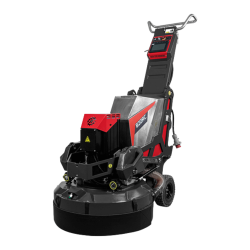
Most powerful TA820RC
Toolsa Planetary Grinder THTG820-RC (18.5 Kw | 400 V)
- 620 kg
- 820 mm
- 400 V
zł110,700.00 90 000,00 zł net On order
A planetary grinder turns on two levels at once: a large carrier plate rotates one way while the satellite heads carrying the diamond tooling rotate the other. Every point on the floor is therefore worked from several directions, and the machine leaves none of the arc marks a single-disc grinder shows across a whole building under raking light.
1 product
The second effect matters just as much: tooling wears evenly around its circumference, so segments come down flat instead of wearing away on one side. That is why polished concrete floors are only ever produced on planetary machines.
Five machines are offered, from 460 to 820 mm working width and 2.3 to 18.5 kW, with stepless speed across 300–1950 rpm. The two smallest run from a 230 V socket; the largest need 400 V.
Segments and pads are chosen separately — they are in diamond pads and segments. When to grind at all, and how to size a machine to the job, is covered in concrete grinders.
On a single-disc machine the tooling sweeps one circle. Every point on the floor is worked from the same direction every time, which leaves a pattern of arcs — invisible close up, obvious under light raking along the slab. On a floor that is going to be polished, that pattern is permanent.
On a planetary head the carrier plate turns one way and the satellites carrying the tooling turn the other. Each segment's path is the sum of both motions, so the same patch of concrete receives successive passes at different angles. The arc pattern has no way of forming, and the surface comes out uniform regardless of how the machine is walked.
The second benefit is even tool wear. A segment spinning about its own axis abrades all the way round rather than on its leading edge. A set comes down flat, every segment keeps the same height, and pressure stays evenly distributed to the end of its life — which a single disc cannot achieve.
The price of both is mass and power. Driving several satellites needs a gearbox and a rigid frame, so a 460 mm machine in this class weighs 135–194 kg, not a few tens.
| Specification | HTG-460 | TA460-PV | TA600-PV | TGX858-RC | THTG820-RC |
|---|---|---|---|---|---|
| Working width | 460 mm | 460 mm | 600 mm | 815 mm | 820 mm |
| Motor | 2.3 kW | 3 kW | 5.5 kW | 15 kW | 18.5 kW |
| Supply | 230 V | 230 V single-phase | 400 V | 400 V | 400 V |
| Rated current | — | 11.8 A | 19 A | — | 39.3 A |
| Speed | 350–1500 rpm | 300–1400 rpm | 300–1800 rpm | 350–1950 rpm | 350–1950 rpm |
| Inverter | — | 4 kW | 7.5 kW | — | — |
| Water tank | 15 l | 30 l | 30 l | 30 l | 25 l |
| Added weight | — | 30 kg | 30 kg | — | — |
| Weight | 194 kg | 135 kg | 200 kg | 595 kg | 620 kg |
| Dimensions | 1539 × 462 × 927 mm | — | — | 2171 × 825 × 1904 mm | — |
| Product page | HTG-460 | TA460-PV | TA600-PV | TGX858-RC | THTG820-RC |
The two 460 mm machines differ in construction rather than width: TA460-PV has a 4 kW inverter and takes 30 kg of added weight, while HTG-460 is heavier in itself (194 against 135 kg) with a smaller water tank. The first lets you set pressure to the task; the second delivers it from the start.
Stepless speed is not a convenience. At low speed — the bottom of the range is 300–350 rpm — the segment cuts aggressively, which is how concrete is opened up, coatings are stripped and unevenness is taken out. At the top, up to 1950 rpm, the tooling begins to burnish rather than abrade, and that is where gloss comes from.
The second variable is pressure, which follows from machine mass plus any added weight: 30 kg on the TA460-PV and TA600-PV. More pressure means faster stock removal, but also faster segment wear and a greater risk that a bond which is too soft simply eats itself without progress.
Both are set together with segment hardness — which is chosen inversely to concrete hardness. The full explanation is in the parent category, concrete grinders; the tooling itself is in diamond pads and segments.
Splitting the range into 230 V and 400 V machines is not about class but about the physical limit of a single-phase socket. The TA460-PV draws 11.8 A, so it fits a typical 16 A circuit — though with nothing left over for a dust extractor working beside it.
Above that, machines need three-phase: the TA600-PV draws 19 A and the THTG820-RC 39.3 A. That is no longer an extension-lead question but a site supply and distribution one.
The practical consequence when pricing a job: if the building has only single-phase sockets, the choice narrows to the two smallest machines whatever the floor area — and then it is the 460 mm width, not the budget, that sets the schedule.
The order is the opposite of what intuition suggests: establish what supply the building has, and only then pick a width within that class. An 820 mm machine on a site without 400 V is useless, while a 460 mm machine plugged into an existing socket works from day one.
595 and 620 kg on the largest machines means a goods lift or a ramp, and on upper floors a check on the structural rating. The 135–200 kg machines go up a ramp with two people. In refurbishment work inside occupied buildings this decides more often than output does.
An 820 mm working width wins on an open hall, but in rooms with columns, recesses and narrow doorways it loses that to manoeuvrability. On a floor broken up by obstructions, a 460 or 600 mm machine finishes sooner, because less has to be made good along the walls afterwards.
Dry grinding without extraction is not acceptable — concrete dust carries carcinogenic crystalline silica. The extractor is sized to the machine rather than to the area and needs its own circuit; when working wet, collection moves to a slurry vacuum. The machines carry 15–30 l water tanks.
A planetary grinder is a machine for working concrete floors in which a large carrier plate rotates one way while satellite heads holding the diamond tooling rotate the other. Each segment's path is the sum of both motions, so the same patch of floor is worked at different angles. In this range the working width runs from 460 to 820 mm, motors from 2.3 to 18.5 kW, and speed is stepless across 300–1950 rpm.
Because no point on the floor is ever worked from the same direction twice. On a single-disc machine the tooling sweeps one circle and leaves a pattern of arcs — invisible close up, obvious under light raking along the slab. With two counter-rotating levels that pattern has no way of forming. This is why floors destined to be polished are only ever ground on planetary machines.
Because speed decides whether the tooling cuts or burnishes. At low speed — from 300–350 rpm — the segment removes material aggressively, which is how concrete is opened, coatings stripped and unevenness taken out. At the top of the range, up to 1950 rpm, the tooling burnishes the surface and that is where gloss appears. One machine therefore covers every stage from stripping to polishing without swapping to another.
It increases tool pressure on the floor, and so the rate of stock removal. The TA460-PV and TA600-PV take 30 kg when hard concrete has to be opened or a thick coating stripped, and the ballast comes off again for finishing passes. More pressure also means faster segment wear, so the weight is not left on permanently — it is matched to the stage of work along with speed and bond hardness.
The line falls at 400 V. The TA460-PV draws 11.8 A from a 230 V socket, so it fits a typical 16 A circuit — but with nothing left for an extractor working alongside. Above that class the machines need three-phase: the TA600-PV draws 19 A and the THTG820-RC 39.3 A. If the building has only single-phase sockets, the choice narrows to the two smallest machines whatever the floor area.
In construction and in how pressure is obtained. The TA460-PV weighs 135 kg, has a 4 kW inverter and accepts 30 kg of added weight, so pressure is set to the task. The HTG-460 weighs 194 kg, giving more down-pressure from the outset but without ballast adjustment; it also has a smaller water tank — 15 against 30 l — and a narrower speed range, 350 to 1500 rpm. The first is more versatile, the second simpler.
From 135 kg on the smallest machine to 620 kg on the largest. The 135–200 kg units go up a ramp with two people and fit a goods lift. The 595 and 620 kg machines need a lift rated for them or a ramp, and on upper floors a check on the structural rating of the slab. In refurbishment inside occupied buildings this criterion decides the choice more often than output.
Not on a floor broken up by obstructions. An 820 mm width wins on an open hall, but in rooms with columns, recesses and narrow doorways a 460 or 600 mm machine finishes sooner, because it leaves fewer strips to make good along the walls and is easier to walk between obstacles. So floor area alone is not the criterion — shape and the number of obstructions belong beside it.
When to grind and how to size a machine is covered by the parent category, concrete grinders. Segments, pads and adapters are in diamond pads and segments, and discs for single-disc machines in diamond grinding discs. Dust is collected by vacuums for grinders and scarifiers, and slurry from wet work by wet and slurry vacuums.
Essential cookies keep your cart and login working — the shop will not run without them. The rest let us measure traffic and target our ads, and we switch them on only with your consent. You can change your choice at any time using the “Cookie settings” link in the footer. Cookie policy
Essential
Cart, login, form security and remembering this choice. The shop will not work without them, so they need no consent.
Toolsa
Analytics
We count page views and checkout paths to find what is broken in the shop. We look at the data in aggregate.
Google Analytics · Microsoft Clarity
Marketing
We show our ads outside the shop and check which of them lead to a purchase. Phone callback requests land here too.
Google Ads · OptinMonster · Zadarma