
Skip to product list 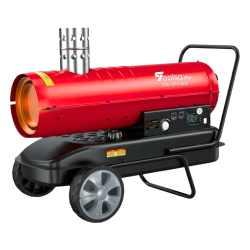
Accessories
Oil-Fired Air Heaters
3 products
A diesel heater delivers output no electrical installation will supply. The smallest machine in this category is 20 kW and the largest 63 kW — between four and twenty times what a socket-powered unit provides. For an industrial unit, a large marquee or a building under construction, it is the only route.
3 products
TA-DV30
Toolsa TA-DV30 Indirect Diesel Heater (30 kW)
- 30,5 kg
- 230 v
- 50 Hz
zł2,706.00 2 200,00 zł net On order
Most powerful TA-D215
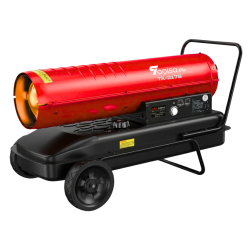
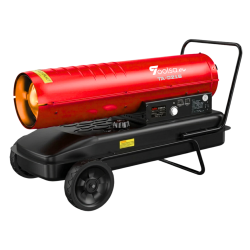
Toolsa TA-D215 Diesel Heater (63 kW)
- 22,8 kg
- 230 v
- 50 Hz
zł2,458.77 1 999,00 zł net On order
Manufacturer, not a middleman Toolsa machines are ours — we know them from the design side, not from a catalogue.
Service and parts on site Wearing parts stay in our warehouse — the machine does not wait for a delivery from abroad.
Dispatch with a real date Every item shows the delivery day, not “24–48 h”.
Matched to your site Tell us the layer and the area — we will match the machine and the tooling. +48 732 081 091
Filters
Ciężar
Moc
Zalecana powierzchnia m³
Zużycie paliwa
Wymiary
Price zł
Sort
These machines fall into two kinds, and the difference between them settles where each may be used. Direct-fired heaters — the TA-D175 and TA-D215 at 51 and 63 kW — send combustion products into the building along with the warm air, so they work only where air is continuously exchanged. Indirect-fired heaters — the TA-DV series at 20, 30 and 50 kW — have a sealed combustion chamber and a separate flue spigot, which makes them suitable for enclosed spaces and marquees with people inside.
Every model carries a 38 or 50 l tank and burns between 1,9 and 5,8 l an hour at full output. That works out at roughly 9 to 20 hours of running per tank — and the thermostat fitted to all of them extends that appreciably.
Read moreShow less
Machines that add nothing to the air they heat, at lower outputs, are in electric air heaters, and the rules for sizing output to volume are in air heaters.
Direct-fired or indirect-fired
The split into two kinds matters more here than any difference in output, because it decides whether a machine may be used in a given building at all. Output settles only how large a space it will heat.
Direct-fired
The burner fires into the open air stream, which passes straight into the building. Nothing escapes up a flue, so a machine weighing about 22 kg yields 51 or 63 kW — the best ratio of output to size and price in the range. Combustion products and water vapour travel into the space along with the heat, which is why these machines are used only where air exchange is assured: units with open doors, structures enclosed on three sides, buildings still open to the weather.
Indirect-fired
The combustion chamber is sealed and separated from the heated air stream, and the products of combustion leave through a dedicated flue spigot running outside the building. The air returning to the room never touched them, so the machine suits enclosed spaces, marquees and rooms under finishing works. The price is a flue that has to be run out, and a higher cost for the same output.
Models, consumption and run time
| Model | Kind | Output | Volume | Consumption | Tank | Run time |
|---|---|---|---|---|---|---|
| TA-DV20 | indirect | 20 kW | up to 320 m³ | 1,9 l/h | 38 l | approx. 20 h |
| TA-DV30 | indirect | 30 kW | up to 480 m³ | 2,9 l/h | 50 l | approx. 17 h |
| TA-DV50 | indirect | 50 kW | up to 800 m³ | 4,6 l/h | 50 l | approx. 11 h |
| TA-D175 | direct | 51 kW | up to 1 020 m³ | 4,8 l/h | 50 l | approx. 10 h |
| TA-D215 | direct | 63 kW | up to 1 260 m³ | 5,8 l/h | 50 l | approx. 9 h |
Run time per tank often matters more than consumption itself. A TA-DV20 will work a full day and night without anyone looking at the tank, while a TA-D215 running without pause needs filling in the middle of an eight-hour shift. The thermostat changes that arithmetic substantially: once the set temperature is reached the machine stops firing, so real consumption in an already-warm building falls well below the catalogue figure.
All models run on 230 V — the supply drives only the fan, the fuel pump and the ignition, not the heating itself. The draw is small enough that these machines run from a generator without difficulty, which matters on a site with no mains connection.
Fuel in winter
This comes round every year and is the commonest reason a perfectly sound machine will not start in cold weather. Diesel is sold in seasonal grades: summer grade begins dropping wax at around 0 °C, winter grade works to roughly −20 °C, and arctic grade below that. Fuel bought in September and kept in a can until January is still summer fuel — in frost it will gel in the filter regardless of the condition of the machine.
The symptoms are distinctive: the heater lights and dies after half a minute, the flame is unstable, and everything returns to normal once the machine is brought indoors. Before looking for a fault in the nozzle or the pump, it is worth establishing what fuel is in the tank and when it was bought.
Cleanliness is the other half of the question. Diesel stored in a can through a season collects water from condensation and picks up sediment, and a heater reacts to this sooner than a vehicle engine does, because its nozzle is far smaller in section. Fuel poured from the bottom of a can left over from last winter is among the most frequent causes of a blocked filter.
Flue and positioning
On indirect-fired machines the flue is part of the installation rather than an accessory. The flue spigot differs from the warm-air outlet in diameter and has a far higher thermal rating — connecting air ducting to it is an error that can end in fire or poisoning. The required diameter, length and minimum draught are stated in the manual for the specific model, and that is what governs, not the apparent similarity of the connectors.
Ducting from heater accessories connects only to the air outlet. The TA-DV20 and TA-DV30 take 250 mm ducting and the TA-DV50 takes 300 mm. Where a marquee is involved, the standard arrangement is to stand the machine outside and feed heat in through ducting via an inlet in the side wall.
Whichever kind is used, a heater is never positioned so that the hot air stream plays onto tarpaulin, polythene, insulation board or marquee fabric, and it is never run in a cellar or a closed garage "just for a while". Carbon monoxide has no smell and cannot be detected without an alarm, so the absence of any noticeable effect confirms nothing.
Frequently asked questions
Which diesel heater may be used in an enclosed room?
Only an indirect-fired machine — in our range the TA-DV series at 20, 30 and 50 kW, with a sealed combustion chamber and a flue run outside. The direct-fired 51 and 63 kW models discharge combustion products into the heated space and require assured air exchange. The size of the room does not alter this: in an unventilated building of several thousand cubic metres a direct-fired machine is exactly as inadmissible as in a small workshop. The required air-change rate is given in the manual for the specific model.
How much diesel does a space heater use?
Consumption runs from 1,9 l/h at 20 kW to 5,8 l/h at 63 kW, rising in proportion to output. The more practical measure is run time per tank: from about 9 hours on the largest model to 20 hours on the TA-DV20 with its 38 l tank. These are continuous full-output figures — in a building already up to temperature the thermostat shuts the burner down for a substantial part of the time, and actual consumption falls well below them.
Why does the heater cut out shortly after lighting in cold weather?
The usual cause is summer-grade fuel in the tank. Summer diesel starts dropping wax at around 0 °C and blocks the filter, so the machine lights and dies after half a minute despite being perfectly sound. Winter grade works down to about −20 °C. The telltale sign is that the problem disappears once the machine is brought into a warm room. The second common cause is dirty fuel from the bottom of a can — a heater's nozzle is small in section and reacts to sediment sooner than a vehicle engine does.
Can a diesel heater run from a generator?
The 230 V supply serves only the fan, the fuel pump and the ignition — the heat comes from burning diesel, not from electricity. The power draw is small enough that running from a generator presents no difficulty even with the 63 kW model. This is the standard arrangement on a site without a mains connection: one generator feeding the heater and the tools together. The only point worth checking is that the generator holds a stable voltage, since the ignition circuit is sensitive to fluctuation.
How is output matched to an industrial unit?
The starting figure is 16–20 m³ per kilowatt with the building closed up and outside temperatures near freezing. Volume is floor area times height — leaving out the height is the usual reason a machine arrives half the size required. A unit of 300 m² standing 6 m high is 1 800 m³, which puts it in the 63 kW bracket. With uninsulated walls, doors in regular use or frost below −10 °C, choose output with a margin: a machine working at its limit never reaches the set temperature.
Can ducting be connected to an indirect-fired heater?
Ducting connects to the warm-air outlet and never to the flue spigot — these are two separate systems of different diameter and different thermal rating. The TA-DV20 and TA-DV30 take 250 mm ducting, the TA-DV50 takes 300 mm. Connecting ducting to a flue is dangerous, because flue-gas temperatures exceed what the ducting material will take and combustion products would then enter the heated space. Which spigot serves which purpose is settled by the manual, not by the diameter of the connector.
Diesel or electric for a marquee?
For a marquee with guests inside, the answer is an indirect-fired diesel machine standing outside, with heat fed in through ducting via a side-wall inlet — that arrangement deals with safety, noise and fuel odour at once. An electric machine is inherently safe but limited by output: the largest is 15 kW covering 300 m³, whereas a 10 × 20 m marquee holds around 700 m³ behind fabric that barely insulates. For that volume the right choice is the TA-DV50, or in hard frost two smaller machines at opposite ends of the structure.
Related categories
Machines that burn nothing, for smaller volumes, are in electric air heaters. Ducting in 250 and 300 mm is in heater accessories, and a comparison of every type together with the sizing rules is in air heaters.
Essential cookies keep your cart and login working — the shop will not run without them. The rest let us measure traffic and target our ads, and we switch them on only with your consent. You can change your choice at any time using the “Cookie settings” link in the footer. Cookie policy
Settings
Essential
Cart, login, form security and remembering this choice. The shop will not work without them, so they need no consent.
Toolsa
Analytics
We count page views and checkout paths to find what is broken in the shop. We look at the data in aggregate.
Google Analytics · Microsoft Clarity
Marketing
We show our ads outside the shop and check which of them lead to a purchase. Phone callback requests land here too.
Google Ads · OptinMonster · Zadarma