
TAA0151
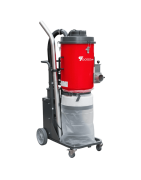
Toolsa Industrial Vacuum Cleaner TAMC2000 (2,4 Kw | 230 V | 2 HEPA H13 Filters)
- 48 kg
- 230 v
- 570 x 710 x 1300 mm
zł11,057.70 8 990,00 zł net At your place on Monday
On site, an industrial vacuum does one of three jobs, and that is where selection starts — not with the motor rating. It either extracts dust from a working machine, lifts water and slurry, or cleans up afterwards — and each job has a different leading figure and a different filter arrangement.
4 products
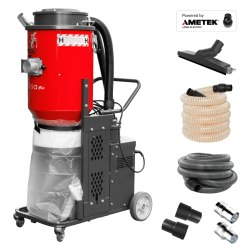
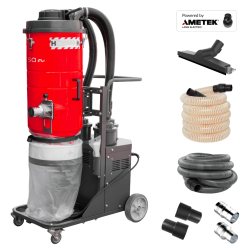
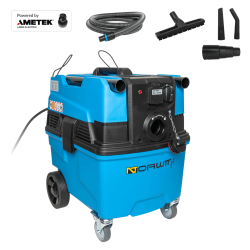
Pick a type, and more filters will show up.
Six machines are offered, from 1.2 to 3.6 kW, all on 230 V. Four dust extractors are dust class H with HEPA H13 filters; two wet machines have a 90 l container and filtration built for moisture.
The subcategories follow those jobs: vacuums for grinders and scarifiers handle floor-machine extraction, and wet and slurry vacuums take water, mud and wet arisings. Filters, bags, hoses and nozzles are in vacuum cleaner accessories.
With the 3.6 kW units, do the electrics first: a 14.4 A draw will not share a 16 A circuit with a grinder.
"Industrial vacuum" covers machines that share little beyond a housing on wheels. Here is the split that every sensible selection starts from.
A concrete grinder or scarifier produces dust continuously, and all of it has to disappear at the rate it appears. What decides is airflow — hundreds of cubic metres per hour — and whether the filter can hold that airflow all shift. Machines for this: TAMC2000, TAMC3000, TAAC3200.
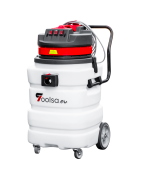
Liquid has to be raised to the height of the hose rather than carried on a stream, so suction pressure decides. The filter cannot be paper, because it would soak, and the container has to hold volume measured in tens of litres. Machines: WD3000 and TWC-3/90, both with a 90 l container.
Sanding skim coat, cutting plasterboard and cleaning up after finishing trades produce less dust than a floor machine, but very fine dust that stays airborne for hours. Filtration efficiency and handling matter here, not power. Machine: TAAC15 — 1.2 kW, 13.5 kg, 38 l container.
| Model | Job | Motor | Airflow | Suction | Class / container | Weight |
|---|---|---|---|---|---|---|
| TAAC15 | plaster, finishing | 1.2 kW | 262 m³/h | 250 mbar | H · 38 l | 13.5 kg |
| TAMC2000 | machine extraction | 2.4 kW | 400 m³/h | 240 mbar | H | 48 kg |
| TAMC3000 | machine extraction | 3.6 kW | — | 240 mbar | H | 65 kg |
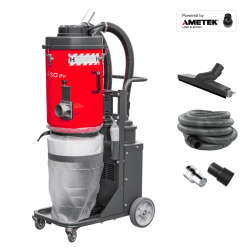
| TAAC3200 | machine extraction | 3.6 kW · 14.4 A | — | 240 mbar | H | 70 kg |
| WD3000 | water and slurry | 3000 W | 432 m³/h | ≈ 294 mbar | 90 l | — |
| TWC-3/90 | water and slurry | 3600 W | 620 m³/h | 200 mbar | 90 l | 32 kg |
WD3000 airflow is converted from 120 l/s and its suction from 3000 mm H₂O — manufacturers quote these in different units, and without a common measure the machines look incomparable. Conversions: 1 mbar ≈ 10.2 mm H₂O, 1 l/s = 3.6 m³/h.
A 3.6 kW machine on 230 V draws about 14.4 A. A standard site circuit is protected at 16 A, so the extractor takes almost all of it — and the grinder it serves draws its own. Two such machines on one circuit end in a tripped breaker, usually mid-pass.
Two conclusions follow. First, on floor work the extractor gets its own circuit from the board — a distribution decision, not an extension-lead one. Second, if that cannot be arranged, the right answer is a 2.4 kW machine matched to a smaller tool, not a bigger machine working in bursts.
Cable length is worth its own calculation. Voltage drop along a thin extension reel lowers motor speed, and lower speed means less airflow — precisely what you paid for.
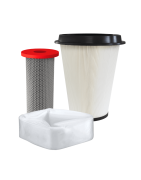
Not electricity — filters. A HEPA cartridge loads incomparably faster on concrete dust or quartz hardener than on plaster dust. A machine with automatic filter cleaning consumes cartridges more slowly, because dust never has time to embed itself — a real difference in the annual figure, not just convenience.
The second item is bags. Working with a bag costs material but gives clean emptying: class H dust is not tipped into a bin, because at that moment everything the machine removed goes straight back into the air. With carcinogenic dust the bag is not an economic choice but part of the same protection as the filter.
The third is the hose. Dragged behind the machine and chafed over floor edges, it wears faster than anything else outside the unit; an antistatic hose additionally drains the charge that builds up at high dust flow. All of it is in vacuum cleaner accessories.
Start from the job, not the motor rating. Extracting from a concrete grinder or scarifier needs a dust class H machine with airflow in the hundreds of m³/h — the TAMC2000 for smaller tools, the 3.6 kW units for planetary grinders. Lifting water and slurry needs a 90 l container and high suction. Plaster and finishing work is covered by the compact TAAC15 at 1.2 kW and 13.5 kg.
Scale and filtration class. A workshop vacuum runs from a few hundred watts to about 1.5 kW, filters to class L and handles dust from hand tools. The industrial machines here run 1.2–3.6 kW, filter to class H — under 0.005% pass-through — and work continuously alongside machines removing kilograms of material an hour. The inlet differs too: 50–70 mm rather than 32–35 mm.
Wet and dry machines lift both, but they do not replace a dust extractor on floor work. Extraction from a grinder needs class H filtration, because concrete dust carries carcinogenic crystalline silica, whereas wet machines are filtered for moisture and coarser particles. It does not work the other way either: you do not draw water through an extractor with a cascade of HEPA cartridges, because they soak immediately.
About 14.4 A at 230 V, as stated on the TAAC3200 data. A standard site circuit is protected at 16 A, so such a machine takes almost all of it and will not share with a grinder. On floor work the extractor gets a separate circuit from the board. Where that is impossible, a 2.4 kW machine matched to a smaller tool makes more sense than a bigger one working in bursts.
Filters, not electricity. A HEPA cartridge loads many times faster on concrete dust and quartz hardener than on plaster dust, and a machine with a loaded filter collects a fraction of what it should. Automatic filter cleaning slows cartridge consumption, because dust never embeds. Bags are the second item and the suction hose the third — it chafes along the floor and wears faster than anything else outside the machine.
Yes, and that is the only arrangement that makes sense — an extractor works connected to the tool shroud, rather than picking dust off the floor afterwards. You only have to match diameters: the TAAC3200 has a 70 mm inlet for large floor machines, while 50 mm hoses serve smaller equipment. A hose that is too narrow throttles airflow whatever the motor rating, so compare ports rather than kilowatts.
Before the fill starts restricting airflow — well short of a full container. With class H dust, emptying means changing the bag rather than tipping it out: tipped dust returns to the air in full and defeats the point of the filtration. On wet machines, mass decides — 90 l of water is 90 kg, so where and how you will empty it is settled before work starts.
It will do it, but it is not designed for it. These machines are matched to working alongside a tool — taking dust from a grinder shroud or lifting water off a floor — and that is where their specification earns its keep. For clearing dust and light debris across large areas, sweepers work better, because working width matters there rather than airflow. An industrial vacuum stays a specialist tool.
Floor-machine extraction is covered by vacuums for grinders and scarifiers, and water, mud and wet arisings by wet and slurry vacuums. HEPA filters, bags, hoses, nozzles and spare parts are in vacuum cleaner accessories. The machines producing this dust are in concrete grinders and concrete scarifiers.
Essential cookies keep your cart and login working — the shop will not run without them. The rest let us measure traffic and target our ads, and we switch them on only with your consent. You can change your choice at any time using the “Cookie settings” link in the footer. Cookie policy
Essential
Cart, login, form security and remembering this choice. The shop will not work without them, so they need no consent.
Toolsa
Analytics
We count page views and checkout paths to find what is broken in the shop. We look at the data in aggregate.
Google Analytics · Microsoft Clarity
Marketing
We show our ads outside the shop and check which of them lead to a purchase. Phone callback requests land here too.
Google Ads · OptinMonster · Zadarma