
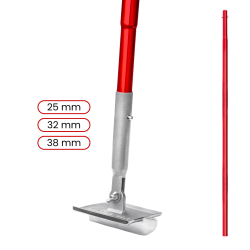
More options 82TA09
Toolsa Stainless Steel Walking Concrete Groover With Pole (180 x 110 Mm)
- 180 x 110 mm
- 25 mm | 32 mm | 38 mm
zł1,107.00 900,00 zł net On order
A concrete trowel finishes the surface once the slab has been screeded to level. Which trowel is picked up, and at what moment, matters more than the quality of the mix itself: this is the stage where pores are closed, edges formed and joints cut — and those joints decide where the slab will crack later.
2 products
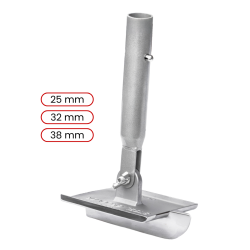
The range covers five distinct jobs. Magnesium floats — from 508 × 79,4 mm up to darbies with double handles — work early, straight after screeding. Steel finishing trowels in high-carbon steel, at 280, 305 and 356 × 114 mm, smooth the surface at the end. Edgers round the rim of the slab, groovers cut contraction joints, and corner trowels work the junction with walls.
The order never varies, because it follows what the concrete is doing. Magnesium first, since it will not stick to a wet mix and leaves the surface open. Then edges and joints, while the material still holds a cut. Steel last, closing the pores — used too early it traps water below the surface, and after the first winter the top layer starts to flake.
The walking versions on poles let edges be formed and joints cut without stepping onto the fresh slab. The full sequence is set out in concrete hand tools.
The three words are not interchangeable, though they are often treated as such. A float opens the surface and brings up moisture, and is made of magnesium for that reason. A trowel closes the surface and is made of steel. A darby is a long float with two handles, used for levelling larger areas between those two stages.
Naming alone is not enough when ordering. Three things decide: the working material (magnesium or steel), the size of the blade, and the shape of the edge — square, round, half-round or profiled for a specific job. Two tools sharing a name can belong at opposite ends of the process.
These tools divide by what they have to do to the surface, not by size. That division is the more useful one, because it is where assembling a kit begins.
| Job | Tool | Typical size | When |
|---|---|---|---|
| Initial floating | magnesium float | 508 × 79,4 mm | straight after screeding |
| Levelling a larger area | darby, double handle | long blade | after initial floating |
| Slab edge | edger | 102 mm | while concrete holds a shape |
| Contraction joint | groover | 110 mm | with the edges |
| Corner at a wall | corner trowel | 152 × 152 × 102 mm | with the edges |
| Final finishing | steel finishing trowel | 280 / 305 / 356 × 114 mm | once it carries the tool's weight |
| Spreading adhesive | notched trowel | 280 × 114 mm | outside the concrete cycle |
Two further tools cover narrower cases. The cove trowel in R30 and R50 radii forms a coved fillet where the floor meets the wall — used where a floor has to be washable and cannot have a square internal corner collecting dirt. The half-round trowel at 356 and 406 × 102 mm combines a square end with a rounded one, so it serves the field and its edge without changing tools.
This is not a choice between a better and a worse tool but between two stages of the same job. Magnesium does not stick to a fresh mix and leaves the surface open, so surplus water can still evaporate. Steel closes the pores and gives a smooth finish — but only once that water has gone.
Reversing the order is the commonest mistake on slabs, and it only shows up a season later. Closing the surface with steel before the concrete has stopped bleeding traps water beneath a thin layer of mortar. In winter that water freezes, expands and lifts the layer — the floor starts flaking off in sheets, even though the concrete underneath is sound.
A third material is stainless steel, which we use for groovers. The reason is practical: the tool works inside a channel where mortar collects on both sides of the blade and is awkward to clean off straight away, and carbon steel corrodes in those conditions faster than it can be washed. Blue Steel forms its own group — a springier steel used where the blade has to flex slightly under pressure, which means corners and edges.
The same edger comes hand-held and mounted on a pole. The difference is not comfort but whether anyone has to step onto the fresh slab. On a narrow path or a border up to about two metres across, the hand version worked from outside is enough. On a wider floor the edge is out of reach, and the choice is between a walking tool and walking on concrete that has not yet set.
The walking range covers edgers at 228 × 102 and 228 × 152 mm and a groover at 180 × 110 mm. The groover blade alone, 609,6 × 203 mm, is available separately to fit an existing pole — because what wears out is the blade, not the tube.
A finishing trowel smooths and closes the surface of a slab at the end of the process. The blade is flat high-carbon steel, most often 280, 305 or 356 × 114 mm, and it goes on once the concrete has set enough to carry the weight of the tool without taking marks. Steel closes the pores and leaves a surface that is smooth and harder-wearing, but also more slippery — which is why external slabs are usually not taken to this stage and are finished with a broomed texture instead.
A full pour needs both, because they belong to different stages — the magnesium float is typically 508 × 79,4 mm, the steel trowel 280 to 356 × 114 mm. The magnesium float goes on straight after screeding: it does not stick to the wet mix and leaves the surface open, so water can still evaporate. The steel trowel smooths at the end, once the surface will carry the tool. If the budget allows only one, the type of floor decides — an external slab finished with a broom does not need the steel trowel, while an internal floor that has to come out smooth cannot be done without it.
A square edge spalls under load, because a thin corner of concrete has no way to carry the pressure — a barrow wheel or a pallet set down on the rim is enough. An edger forms a radius there, spreading the load over a larger area. The work is done while the concrete still holds a shape, that is after initial floating, in the same phase as the joints. On washable floors a coved fillet is added where the slab meets the wall, using an R30 or R50 tool, so that dirt cannot collect in the corner.
A groover cuts the joint in fresh concrete, right after initial floating, while the material still holds the shape of the cut. A saw cuts after the slab has set and gives a cleaner joint, but the window is narrow: cutting has to happen before the slab starts cracking on its own. Both do the same job — deciding where the shrinkage crack will appear. The cut should reach about a quarter of the slab depth, and joint spacing should not exceed roughly 30 times that depth.
A notched trowel has no part in the concrete cycle — it spreads adhesive for tiles, cladding and self-levelling compounds. The notches meter a constant thickness and leave ribs which collapse as the tile is pressed down, filling the bed without trapping air. Our model is 280 × 114 mm with a high-carbon steel blade. Notch size follows the format of the covering: the larger the tile, the deeper the notches, because the adhesive bed has to take up greater variation in the substrate.
A darby is a long-bladed float with two handles, worked with both hands. It levels larger areas after initial floating, where an ordinary float is too short and a bull float on a pole too imprecise. It is held flat and drawn in arcs, cutting down local high spots — the blade runs several times longer than the 280–356 mm of an ordinary trowel, so it bridges two points at once. The range covers magnesium versions with round and square ends: the round end leaves no edge marks when the direction changes, while the square end works better against a wall and along the rim of the slab.
The earlier stage — initial floating across a large area — is covered by bull floats. Non-slip texture is applied with fresno brooms, and on large floors the finishing passes to power trowels. The full order of stages is in concrete hand tools.
Essential cookies keep your cart and login working — the shop will not run without them. The rest let us measure traffic and target our ads, and we switch them on only with your consent. You can change your choice at any time using the “Cookie settings” link in the footer. Cookie policy
Essential
Cart, login, form security and remembering this choice. The shop will not work without them, so they need no consent.
Toolsa
Analytics
We count page views and checkout paths to find what is broken in the shop. We look at the data in aggregate.
Google Analytics · Microsoft Clarity
Marketing
We show our ads outside the shop and check which of them lead to a purchase. Phone callback requests land here too.
Google Ads · OptinMonster · Zadarma