
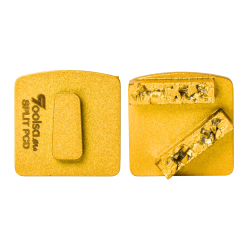
SPCD-RL
Redilock Toolsa SPLIT-PCD Diamond Segment For Resin Removal (1-3 Mm)
- Zdzieranie żywic epoksydowych z betonu
- 1-3 mm
- RediLock
zł183.27 149,00 zł net At your place on Monday
Three different tools run on a grinder's plate, and confusing them is the commonest reason a machine "won't cut". Diamond segments open concrete and remove material. PCD segments strip coatings — resin, adhesive, paint — that diamond only smears. Hook-and-loop pads remove almost nothing: they produce gloss.
2 products
Metal segments of 40 × 12 × 12 mm come in grits 20, 30, 80 and 120 and in four grades — SC, MC, HC and XHC — whose code names the concrete hardness, not the bond: SC goes on soft concrete, XHC on very hard. Polishing pads at 3" (10 × 80 mm) run from grit 50 to 1000.
Mounting is a separate matter. Two systems are offered — magnetic with three pins and RediLock — plus adapters that let tooling from one system run on a machine built for the other.
The machines are in planetary concrete grinders, and the bond-selection rule is explained in concrete grinders.
Diamond crystals in a metal bond abrade concrete, stone and terrazzo. This is the tool for levelling a floor, exposing aggregate and preparing a substrate for resin. Segments of 40 × 12 × 12 mm mount either magnetically with three pins or in the RediLock system, and run wet or dry.
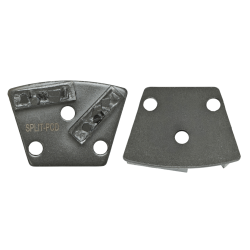
PCD is polycrystalline diamond in the form of hard plates that do not abrade a coating but lift and tear it off. That matters because epoxy resin, adhesive and heavier paint soften under the heat of an ordinary diamond segment and clog it instead of coming away. These PCD segments remove coatings 1–3 mm thick.
Hook-and-loop pads in grits 50–1000 are not for removing material. Their job is closing the micro-profile, which is what shows as gloss. They follow the segments, in rising grit, and work at the higher end of the machine's speed range.
| Tool | For | Grit | Mounting |
|---|---|---|---|
| SC RediLock | soft concrete | 20 · 30 · 80 · 120 | RediLock |
| MC · MC RediLock | medium-hard concrete | 20 · 30 · 80 · 120 | magnetic + 3 pins / RediLock |
| HC · HC RediLock | hard concrete | 20 · 30 · 80 · 120 | magnetic + 3 pins / RediLock |
| XHC RediLock | extra hard concrete | 20 · 30 · 80 · 120 | RediLock |
| SPLIT-PCD · SPLIT-PCD RediLock | epoxy resin 1–3 mm | — | magnetic + 3 pins / RediLock |
| PCD RediLock | adhesives | — | RediLock |
| Polishing pad 3" | polishing concrete | 50 · 100 · 200 · 400 · 800 · 1000 | hook and loop |
| KL/RL adapter | Klindex segments on RediLock | — | adapter |
| RLV adapter | hook-and-loop pads on RediLock | — | adapter |
The SC, MC, HC and XHC designations describe the concrete the segment is meant for, not the hardness of the bond itself — the bond is chosen inversely, as below. The number after the designation, for example HC30, is the grit.
A segment wears at a controlled rate and that is how it keeps exposing fresh diamond. In hard concrete the bond barely wears, so it has to be soft for the tool to sharpen itself at all. In soft, abrasive concrete the opposite applies: the material strips the bond itself, so it has to be hard, or the segment disappears within tens of square metres.
That inversion is the commonest ordering mistake, which is why the markings in this range refer to the concrete: SC is the segment for soft concrete, XHC for extra hard. Nothing has to be converted in your head — assess the floor and order accordingly.
The symptoms of a wrong choice are unambiguous. A glazed segment — shiny, smooth, no progress despite pressure — is too hard for the material. A segment vanishing before your eyes is too soft. The full mechanism is explained in concrete grinders.
Every pass leaves scratches the size of its grit. The next grit has to be close enough to remove them before the tooling wears out. Jumping from 30 to 400 does not save time — it produces a floor with polished coarse-grit scratches.
Hence the grit ladder in this range. Metal segments 20 and 30 open the concrete and remove material; 80 and 120 refine what they leave. Only then do the polishing pads follow: 50, 100, 200, 400, 800 and 1000, each removing the trace of the last.
The working rule: never skip more than one step, and on hard floors skip none. The check is to light the floor at a low angle after each stage — scratches visible under raking light will not disappear on their own at the next grit.
Segments here come in two mountings. Magnetic with three pins uses the magnet to hold the tool while the pins carry the torque — a magnet alone would not survive the cutting load. RediLock is a snap system in which the tool enters a socket in the plate and locks mechanically.
Because machines on site come in different systems, two adapters are offered. KL/RL lets Klindex segments run on a RediLock plate, and RLV lets hook-and-loop pads run on a RediLock machine. This is not a workaround but a way of using the tooling a crew already owns instead of buying a full set when the machine changes.
Check the socket in the machine plate before ordering, not the badge on the housing — that is what decides which system and which adapter you need.
It is the working tool mounted on a grinder's plate, made of diamond crystals set in a metal bond. It abrades concrete, stone and terrazzo, opening the surface and removing material. These segments measure 40 × 12 × 12 mm, come in grits 20, 30, 80 and 120 and in four versions matched to concrete hardness — SC, MC, HC and XHC — and run wet or dry.
Inversely to what intuition suggests: a soft bond for hard concrete, a hard bond for soft and abrasive concrete. The reason is that the segment has to wear in order to expose fresh diamond; in hard concrete the bond barely wears, in soft concrete it disappears too quickly. The markings in this range, however, refer to the concrete rather than the bond: SC is for soft concrete, XHC for extra hard. Assess the floor and order accordingly.
The coarsest needed to remove the unevenness or coating — usually 20 or 30 — and upward from there. Every pass leaves scratches the size of its grit, and the next grit has to remove them before the tooling wears out. Jumping from 30 to 400 saves no time; it produces a floor with polished coarse-grit scratches. The check is to light the floor at a low angle after each stage.
In how it works and what it is for. A diamond segment abrades material, so it suits concrete, stone and terrazzo. A PCD segment carries hard polycrystalline diamond plates that lift and tear a coating off rather than abrading it. That matters with epoxy resin, adhesives and heavier paint — under an ordinary segment these soften with heat and clog the tool. These PCD segments remove coatings 1–3 mm thick.
In how the tool is held. In the magnetic arrangement a magnet holds the segment on the plate while three pins carry the torque, because the magnet alone would not survive the cutting load. RediLock is a snap system — the tool enters a socket in the plate and locks mechanically. Both work well; before ordering, check the socket in the machine plate rather than the badge on the housing, because that is what decides the fit.
They let tooling from one system run on a machine built for another. The KL/RL adapter allows Klindex segments on a RediLock plate, and the RLV allows hook-and-loop polishing pads on a RediLock machine. This matters when changing machine or working with hired equipment: rather than buying a new set of tooling, the crew uses what it has. An adapter changes only the mounting, not how the tool performs.
These segments run in both modes and the choice depends on conditions. Wet grinding extends segment life and eliminates airborne dust, but produces slurry that has to be collected continuously with a slurry vacuum before the cement fines bond to the floor. Dry grinding is faster and cleaner to tidy up after, but only ever with extraction — concrete dust carries carcinogenic crystalline silica.
By height and by behaviour. A segment worn down to the point where the body starts touching the floor is finished outright. Before that come the symptoms of a wrong choice: a glazed segment — shiny, smooth, no progress despite pressure — is too hard for the material, while one disappearing before your eyes is too soft. In both cases the problem is selection, not tool quality. Segments are replaced as a set so pressure stays even.
The machines this tooling runs on are in planetary concrete grinders, and discs for single-disc machines in diamond grinding discs. The bond-selection rule and the wider context of grinding are covered by the parent category, concrete grinders. Dust is collected by vacuums for grinders and scarifiers.
Essential cookies keep your cart and login working — the shop will not run without them. The rest let us measure traffic and target our ads, and we switch them on only with your consent. You can change your choice at any time using the “Cookie settings” link in the footer. Cookie policy
Essential
Cart, login, form security and remembering this choice. The shop will not work without them, so they need no consent.
Toolsa
Analytics
We count page views and checkout paths to find what is broken in the shop. We look at the data in aggregate.
Google Analytics · Microsoft Clarity
Marketing
We show our ads outside the shop and check which of them lead to a purchase. Phone callback requests land here too.
Google Ads · OptinMonster · Zadarma