
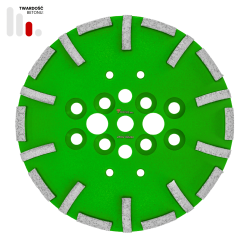
TMC250-30
Toolsa TMC 250 Diamond Grinding Disc, Medium-Hard Concrete (Grit 30)
- Toolsa GX 250, Norton Clipper CG 252 i inne
- 10 x 10 x 40 mm
- Średnio twardy beton
zł675.27 549,00 zł net At your place on Monday
A grinding disc is the finished working tool of a single-disc floor grinder: a full set of segments carried on one 250 mm body that bolts on with four screws. Unlike a head with replaceable segments, a disc holds one grit permanently and does one stage of work — it opens the concrete or it strips a coating.
5 products
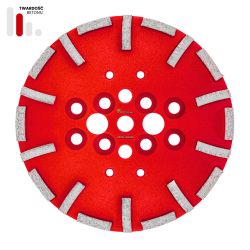
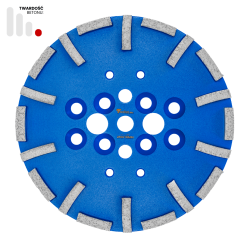
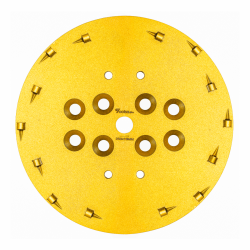
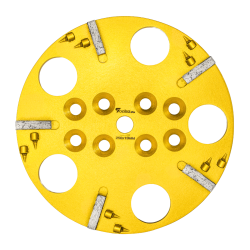
Three discs match floor hardness: TSC for soft, abrasive concrete, TMC for medium-hard, THC for hard concrete. Each carries 20 segments of 10 × 10 × 40 mm in grit 30. The other two remove coatings: PCD works with no depth limiter at all, while PCD Hybrid adds a grinding segment that keeps that depth in check.
All five fit the Toolsa GX 250, the Norton Clipper CG 252 and other 250 mm machines with a four-bolt pattern. Machines are in concrete grinders, replaceable tooling in diamond pads and segments.
A 250 mm single-disc grinder can be tooled two ways, and that is the first decision a buyer makes. Both reach the same concrete, but they spread the cost differently and limit the job differently.
Segments sit on the body and cannot be taken off individually. A disc therefore keeps one grit for its whole life and performs one stage of work; when the segments are gone, the whole tool is replaced. What you get in return is a four-bolt fitting and nothing to match up: the tool is balanced at the factory and the operator has nothing to get wrong.
Our concrete discs carry 20 segments measuring 10 × 10 × 40 mm. Contact area with the floor is 80 cm² — roughly 16% of the 250 mm disc face, which measures 491 cm². The rest is clearance for spoil; if diamond covered the whole circle, the tool would skate over the laitance instead of lifting it.
A head holds segments magnetically or in the RediLock system and lets you step through grits without taking the tooling off the machine. It is the only route if the floor is going to be polished: grits 20, 30, 80 and 120 in segments and 50–1000 in pads are covered in diamond pads and segments. There, only the segment wears out and the head stays.
Our single-disc Toolsa GX 250 grinder ships with a grit 30 disc for hard concrete and a diamond segment head, plus a wall dust guard. The head is removable, so one machine strips with a disc and polishes with segments — buying a disc does not close off the other route.
The letters describe the floor the disc is built for: TSC for soft, abrasive concrete and screeds, TMC for medium-hard, THC for hard concrete and industrial floors. The bond was chosen at the factory — inversely to the material, because the matrix has to wear away to expose fresh diamond crystals. The mechanism and the full hardness scale are set out under diamond segments; with a disc, judging the floor is enough.
All three come in grit 30 — the grain for opening concrete, taking off laitance and exposing aggregate. There is no finishing-grit disc in the range, and that is not an oversight: with one permanent set of segments, a polishing tool would be useful for one stage in a hundred.
Polycrystalline diamond gets under a layer and tears it off in sheets rather than grinding it down. This is the tool for epoxy resin, carpet adhesive and thick coatings that kill an ordinary diamond segment within minutes. The PCD 250 disc carries PCD cutters only, with no element limiting how deep it goes — it can take several millimetres in a single pass. On a thin layer and a level floor, that is too much.
The PCD Hybrid 250 disc adds an ordinary grit 30 grinding segment. It rides on the concrete and supports the tool, so the PCD cutters cannot sink deeper than they need to. The hybrid works more slowly than full PCD but leaves the substrate flat — this is the version for paint, thin adhesive and any coating under which the concrete has to stay level.
| Disc | For | Segments | Grit | Depth control |
|---|---|---|---|---|
| TSC 250 | soft, abrasive concrete and screed | 20 × 10 × 10 × 40 mm | 30 | full segment contact |
| TMC 250 | medium-hard concrete | 20 × 10 × 10 × 40 mm | 30 | full segment contact |
| THC 250 | hard concrete, industrial floor | 20 × 10 × 10 × 40 mm | 30 | full segment contact |
| PCD 250 | epoxy resin and adhesive | PCD cutters | — | none — takes several mm |
| PCD Hybrid 250 | paint, adhesive, thin resin | PCD + grinding segment | 30 | segment supports the disc |
Every disc has a 250 mm body and a four-bolt hole pattern, so it fits the Toolsa GX 250, the Norton Clipper CG 252 and other machines of that class.
If a layer of foreign material sits on the floor — resin, adhesive, paint — a diamond disc will clog with it before it lifts anything. Coatings go to PCD or PCD Hybrid; bare concrete goes to TSC, TMC or THC. The line is sharp: PCD tears, diamond grinds, and neither tool substitutes for the other. Once the coating is off, you go back to a diamond disc to level the exposed concrete.
Concrete with no paperwork is judged in use. If the disc still looks new after a dozen square metres and progress is slow, the floor is hard and the segment is not opening — go one code up next time. If segments vanish in front of you and dense dust pours out from under the machine, the concrete is soft and abrasive, which is TSC territory. Cement screeds and fresh slabs almost always behave as soft material, even though they feel hard to the hand.
A disc does not cut by itself — the mass of the machine presses it down. The GX 250 weighs 60 kg, and a 2 × 7 kg weight kit brings it to 74 kg, close to a quarter more. On hard concrete that is often the difference between grinding and burnishing the surface with no result. The inverter gives 350–1500 rpm, which at the rim of a 250 mm disc means a peripheral speed of 4.6 to 19.6 m/s — one range that covers both sticky adhesive and hard screed.
The disc scale stops at THC. Very hard floors — power-trowelled, surface-hardened, quartz-broadcast — call for the XHC code, which exists only as a segment for a head. A disc will work there, but THC will cut slowly and wear unevenly. Machines built for that kind of work are in planetary concrete grinders.
Dry grinding releases respirable silica dust, and the GX 250 carries a Ø 50 mm vacuum port and a wall dust guard precisely to capture it at source. Without extraction the dust settles on the disc and acts like grease between diamond and concrete: the tool stops biting although it is not worn. Vacuums matched to this work are in vacuum cleaners for grinders and scarifiers.
A disc is a finished tool: 20 segments of 10 × 10 × 40 mm on a 250 mm body that bolts on with four screws. It holds one grit permanently and is replaced whole once worn. A head carries segments magnetically or in the RediLock system, lets you run grits 20, 30, 80 and 120 without removing the tooling from the machine, and only the segment wears out. The disc is simpler and quicker to fit; the head is cheaper to run and the only sensible choice when the floor is going to be polished. The Toolsa GX 250 accepts both — its head is removable.
The disc code describes the concrete, not the bond: TSC goes on soft, abrasive concrete and screeds, TMC on medium-hard, THC on hard concrete and industrial floors. All three carry 20 segments in grit 30. Bond hardness was set by the manufacturer, inversely to the material, because the matrix has to wear away to expose fresh diamond crystals. In practice: a disc that still looks new after a dozen square metres and cuts slowly is too soft a match for the floor; a disc disappearing in front of you has met concrete that is too abrasive for it.
The PCD 250 disc lifts layers of foreign material off concrete: epoxy resin, carpet adhesive, thick paint coatings. Polycrystalline diamond gets underneath and tears them off in sheets instead of grinding them, which is why it does not clog the way a diamond segment does when soft adhesive smears its matrix within minutes. The version with PCD cutters only has no element limiting depth and can take several millimetres in one pass. It is a stripping tool, not a levelling one: afterwards the floor is brought back to flat with a grit 30 diamond disc.
Depth control is the difference. The PCD 250 carries PCD cutters only and works as aggressively as it can — several millimetres in one pass, so on a thin coating it will gouge the concrete. The PCD Hybrid 250 adds an ordinary grit 30 grinding segment that rides on the concrete and supports the tool, so the cutters cannot sink deeper than needed. The hybrid runs more slowly but leaves a flat substrate. Full PCD is for thick resin and hard adhesive; the hybrid is for paint, thin adhesive and anywhere the concrete has to stay level.
No. Discs bolt on with four screws to single-disc 250 mm machines — the Toolsa GX 250, the Norton Clipper CG 252 and designs with the same hole pattern. A planetary head carries several smaller plates spinning on their own axes and takes segments held magnetically or in the RediLock system, not one large disc. The two arrangements are not interchangeable. The GX 250 is the exception in that its head is removable, so the same machine runs a disc one day and segments the next — but a disc still cannot be fitted to a planetary machine.
Not a disc from this range. All three concrete discs are grit 30, the grain for opening the surface, removing laitance and exposing aggregate. Gloss appears only after the following grits have been run — 80 and 120 in segments, then 50, 100, 200, 400, 800 and 1000 in diamond pads. No stage can be skipped, because each grit removes the scratches left by the one before. The disc therefore does the first step, and the finish is built on a head with replaceable segments and pads.
Segment height is the material budget, and it is about 10 mm. It goes down faster the more abrasive the floor is and the worse the code is matched — on screed a THC disc wears many times faster than a TSC. The signal to replace is diamond worn away and matrix metal showing: the tool starts burnishing the concrete instead of lifting it, and the machine heats up with nothing to show for it. With a disc the whole tool is replaced, since individual segments cannot be unbolted — that is the main cost difference against a segment head.
Yes, and not only because of the respirable silica dust released by dry grinding. The GX 250 has a Ø 50 mm port and a wall dust guard because the spoil has to be lifted from under the disc: a layer of dust between diamond and concrete acts as a lubricant and the tool stops biting even though it is not worn. An industrial vacuum with a suitable filter class also keeps the edge of the ground strip visible, which decides how straight the work looks along a wall. Models matched to floor machines are in the vacuum cleaners for grinders and scarifiers category.
Machines for these discs are in concrete grinders and planetary concrete grinders. Replaceable tooling — segments in grits 20–120, PCD segments and polishing pads — is in diamond pads and segments. Dust extraction, without which dry work makes no sense, is in vacuum cleaners for grinders and scarifiers.
Essential cookies keep your cart and login working — the shop will not run without them. The rest let us measure traffic and target our ads, and we switch them on only with your consent. You can change your choice at any time using the “Cookie settings” link in the footer. Cookie policy
Essential
Cart, login, form security and remembering this choice. The shop will not work without them, so they need no consent.
Toolsa
Analytics
We count page views and checkout paths to find what is broken in the shop. We look at the data in aggregate.
Google Analytics · Microsoft Clarity
Marketing
We show our ads outside the shop and check which of them lead to a purchase. Phone callback requests land here too.
Google Ads · OptinMonster · Zadarma