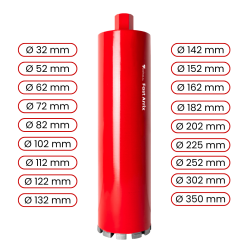
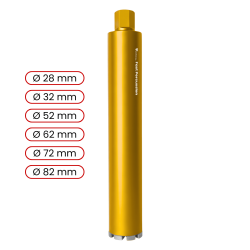
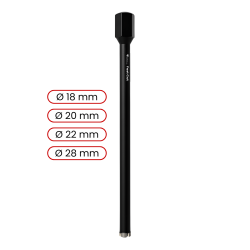
Start from the largest diameter you will cut
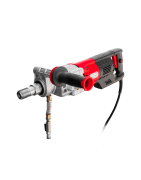
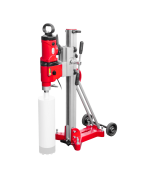
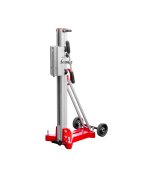
Service penetrations for cable and pipe up to 80 mm are hand-held work — an 1 800 W machine is enough and setting up takes as long as plugging it in. Openings for ventilation, drainage and services through a load-bearing wall usually start at 100 mm and require a stand — at which point a complete rig with a matched motor often makes more sense than buying machine and stand separately.
Decide whether you need three gears
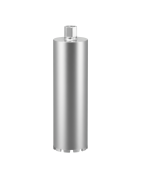
Speed is matched to diameter: the larger the bit, the slower it turns, because what matters is rim speed. A three-speed gearbox spanning 580–2800 rpm lets one machine run an 18 mm bit and a 200 mm core alike. If you only ever drill within one size band, that versatility stops earning its keep.
Check the current before connecting
The 1 800 W machine draws 9 A and the 2 600 W one 12 A. On a site board that is immaterial, but in an occupied building a socket circuit may be protected at 10 A, and the more powerful drill can trip it on start-up under load. Running from a generator, the same rule applies as with any motor: size the set with headroom for starting current.
Settle wet or dry before you start
Water fed through the G 1/4" port cools the segments and flushes debris, so the bit lasts longer and the hole is cleaner. In an occupied building water is often unacceptable — then you drill dry, with extraction through the 36 or 48 mm port, remembering that concrete dust contains respirable crystalline silica rather than ordinary dust.