
Core Drills
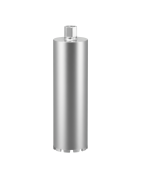
A core drill cuts a clean-walled hole in concrete instead of hammering the material apart. It works with a diamond core bit — a tube carrying segments on its rim — so it cuts only the circumference of the hole while the centre stays as a core that comes out whole once the bit is through. That is why reinforcement is no obstacle: the bit cuts straight through rebar without deflecting and without cracking the concrete around the opening.
Filters
Ciężar
Skrzynia biegów
Sort
The whole category divides on one figure: 80 mm. Up to that diameter the machine may be hand-held; above it, a stand is required — not as a manufacturer's preference but because of the torque a jammed bit sends back to the operator. On a stand the same machines reach 200 mm, while hand-held they stop at 80 mm despite identical power.
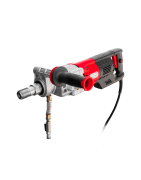
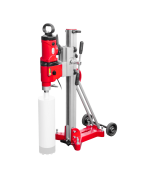
The range covers hand-held machines of 1 800–2 600 W, including a brushless version and one with mechanical micro-impact, plus complete rigs supplied with motor and stand. All share a 1¼" UNC spindle, an additional G 1/2" thread and a G 1/4" water connection, so bits and accessories interchange between models.
Read moreShow less
The bit works by rotation alone, which is what keeps it cutting through rebar on the same line. Cooling water feeds through the G 1/4" port, and the micro-impact version adds a 36 or 48 mm extraction port for dry drilling.
Machines run on 110 V or 230 V single phase, so no three-phase supply is needed on site — the 110 V option matching standard UK transformer practice.
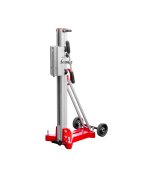
Separate categories cover handheld core drills, complete core drills, core drill stands and diamond core drill bits matched to diameter and material.
Eighty millimetres — where hand-held work ends
The same machine will cut a 200 mm hole on a stand and 80 mm held in the hands. The difference is not power, but what happens the moment the bit jams on a reinforcing bar.
Torque delivered to the bit comes back to the operator when the bit binds, and it scales with radius: a 160 mm bit has twice the lever arm of an 80 mm one, so at equal power the kick is twice as strong. Beyond that size a person simply cannot hold the machine — and the kick arrives in a fraction of a second, without warning, usually when a segment meets a bar running at an angle to the drilling axis.
A stand transfers that torque into the substrate instead of into the operator's wrists. That is why our datasheets carry two limits for the same machine: 80 mm hand-held and 200 mm once mounted on the DS 250 stand. Below 80 mm hand-held work makes complete sense — faster to set up, cheaper, and sufficient for service penetrations. Above it, the stand stops being a convenience and becomes a condition of working safely.
Toolsa core drill specifications
| Model | Power | Weight | Gears | Speed | Concrete: hand / stand | Current |
|---|---|---|---|---|---|---|
| DD-18 | 1 800 W | 8 kg | 3 | 580 / 1400 / 2800 rpm | 80 / 200 mm | 9 A |
| DDB-26 | 2 600 W | 7,1 kg | 3 | 620 / 1330 / 2680 rpm | 80 / 200 mm | 12 A |
| DDB-26P | 2 600 W | 7,1 kg | 1 | 840 rpm | 80 / 200 mm | 12 A |
| DS220-22 | 2 200 W | rig with stand | 3 | 580 / 1400 / 2800 rpm | — / 200 mm | — |
| DS400-33 | rig with DD-33 motor | rig with stand | 3 | — | — / larger diameters | — |
Every machine carries a 1¼" UNC male spindle (7 threads per inch) plus a G 1/2" female thread, a G 1/4" water inlet, and runs on 110 V or 230 V. Two threads mean one machine accepts both standard imperial core bits and smaller metric-threaded bits without an adaptor — worth noting on UK sites, where 110 V transformer supply is the norm.
Why the more powerful machine weighs less
One line in the table looks like an error: the DDB-26 delivers 2 600 W at 7,1 kg, while the less powerful DD-18 at 1 800 W weighs 8 kg. The reason is the brushless motor. With no brushes or commutator there is less material in the rotor, less heat lost to friction and room to shrink the housing at the same useful output. Those 0,9 kg tell after the first hour of overhead work — and after the first hole when drilling a soffit.
There is a service consequence too: no brushes to replace and no commutator wear from arcing, which removes the most common maintenance item on machines of this class.
Fixing the stand — three methods and their conditions
The stand has to carry the torque generated when a bit binds. Which fixing to use is decided by what the substrate will take, not by convenience.
Anchor
The most secure method and the default at large diameters. A hole is drilled for the anchor, the stud goes in and the base plate bolts to it. It costs one fixing hole beside the actual work, which matters on a finished floor — there will be a mark to make good afterwards. It holds regardless of how smooth the surface is, and it is the only method that allows full torque at 200 mm.
Vacuum
The base plate is held down by a vacuum pump — in our range the VP-120. Its advantage is leaving no fixing hole at all, which suits finished floors and work on a client's premises. The conditions are strict: the surface must be smooth, non-porous and dry — porous concrete, fresh render or a wet floor will not hold vacuum. It is not used for drilling upwards into a soffit, nor at the largest diameters where torque exceeds the holding force.
Jack between floor and ceiling
The stand braces itself with a column between floor and ceiling, giving a fixing without drilling and without any requirement for smoothness. In return it needs a known, constant room height and a ceiling that will take the load. This is the usual answer when drilling penetrations through a slab, where an anchor would have to go above the operator's head.
Micro-impact — what it does and when it helps
The DDB-26P carries mechanical micro-impact, which should not be confused with hammer action. A rotary hammer breaks material with the energy of individual heavy blows. Micro-impact in a core drill adds low-amplitude, high-frequency vibration to the rotation — it does not break the concrete but interrupts what is called glazing of the segment.
A diamond segment cuts for as long as sharp grit stands proud of its bond. In concrete with a high content of hard aggregate the bond can be polished smooth faster than it wears away — the segment stops cutting and starts sliding, and the machine heats up without progress. Micro-impact keeps the grit exposed, so drilling continues without withdrawing the bit to dress it on an abrasive block.
The design has a consequence: one gear instead of three, at a fixed 840 rpm. That is a deliberate trade — the impact mechanism works within a narrow speed band, so a single ratio matched to it replaces a three-speed gearbox. For holes that cut without resistance, a three-speed machine is quicker; for concrete that refuses to be drilled, micro-impact is the right answer. This version also has a 36 or 48 mm extraction port, so it is prepared for dry drilling with a vacuum.
Choosing a core drill
Start from the largest diameter you will cut
Service penetrations for cable and pipe up to 80 mm are hand-held work — an 1 800 W machine is enough and setting up takes as long as plugging it in. Openings for ventilation, drainage and services through a load-bearing wall usually start at 100 mm and require a stand — at which point a complete rig with a matched motor often makes more sense than buying machine and stand separately.
Decide whether you need three gears
Speed is matched to diameter: the larger the bit, the slower it turns, because what matters is rim speed. A three-speed gearbox spanning 580–2800 rpm lets one machine run an 18 mm bit and a 200 mm core alike. If you only ever drill within one size band, that versatility stops earning its keep.
Check the current before connecting
The 1 800 W machine draws 9 A and the 2 600 W one 12 A. On a site board that is immaterial, but in an occupied building a socket circuit may be protected at 10 A, and the more powerful drill can trip it on start-up under load. Running from a generator, the same rule applies as with any motor: size the set with headroom for starting current.
Settle wet or dry before you start
Water fed through the G 1/4" port cools the segments and flushes debris, so the bit lasts longer and the hole is cleaner. In an occupied building water is often unacceptable — then you drill dry, with extraction through the 36 or 48 mm port, remembering that concrete dust contains respirable crystalline silica rather than ordinary dust.
Frequently asked questions
Which core drill is best?
The choice follows hole diameter rather than machine power. For service penetrations up to 80 mm, a hand-held machine of 1 800–2 600 W is enough and sets up in seconds. Above that a stand is needed, because the torque from a jammed bit exceeds what hands can hold. Where concrete is heavily reinforced or full of hard aggregate, the micro-impact version has the advantage, since it stops segments glazing over. For many holes of differing sizes, a three-speed machine spanning 580–2800 rpm is the practical choice.
Does a core drill use hammer action?
A conventional core drill works by rotation alone — the diamond bit cuts concrete rather than breaking it, which is exactly why it passes through rebar without deflecting. A separate matter is micro-impact, fitted to the DDB-26P: low-amplitude vibration added to rotation, whose purpose is not to break material but to keep the segments sharp. Rotary hammer action is never used with a core bit — it would shatter the diamond segments and wreck the edge of the hole.
What diameter can be drilled without a stand?
The limit is 80 mm, and it comes from physics rather than caution. Reaction torque scales with bit radius, so at 160 mm the kick after binding on a bar is twice what it is at 80 mm — strong enough to tear the machine out of your hands. A stand transfers that torque to the substrate and raises the permissible diameter to 200 mm. Both figures describe the same machine: what changes is the mounting, not the power.
How does a core drill differ from a rotary hammer?
In how it works and in what it leaves behind. A rotary hammer breaks concrete with blows, so the hole wall is rough and a reinforcing bar stops progress. A core drill cuts an annulus with a diamond bit: only the circumference is removed, the centre comes out as a whole core, and rebar is cut along with the concrete. The wall is smooth, so the opening is ready for a sleeve or penetration seal straight away. The price of that precision is the need for cooling — water or extraction — and a heavier machine.
How is a core drill stand fixed?
Three ways, each with conditions. An anchor gives the most secure fixing and is the only one allowing full torque at 200 mm, but needs a fixing hole beside the work. Vacuum from a pump leaves no mark, yet demands a smooth, dry, non-porous surface — porous concrete or a wet floor will not hold it. A jack braced between floor and ceiling needs neither drilling nor smoothness, but assumes a known room height. For drilling upwards into a soffit, anchor or jack remain the practical options.
Wet or dry drilling?
Wet keeps segments cooler and extends bit life, flushes debris out of the hole and produces no dust at all — water feeds through the G 1/4" connection. The difficulty comes in occupied buildings, where water runs down the wall and reaches places it should not. Dry drilling is then the answer, with a vacuum connected to the 36 or 48 mm port. Dry without extraction is not an alternative: concrete dust contains respirable crystalline silica, classified as carcinogenic to humans.
Will one machine take different bits?
Compatibility comes from two threads present on every machine at once: a 1¼" UNC male spindle with seven threads per inch — the standard for most working-diameter core bits — and a G 1/2" female thread for smaller diamond bits. One machine therefore runs an 18 mm bit for fixings and a 200 mm core for ventilation. When buying bits, check the thread rather than the machine brand, because the thread is what decides fit.
What do I do when the bit stops cutting?
The usual cause is glazing: the bond has polished smooth and the diamond grit no longer stands proud. The symptom is unmistakable — the machine runs evenly, heats up, and the hole stops deepening however hard you press. The remedy is dressing the bit on an abrasive material such as an aerated concrete block or sandstone, which exposes fresh grit. Micro-impact prevents it happening in the first place by keeping segments open during the cut. The opposite symptom, a segment disappearing rapidly, means the bond is too soft for that concrete.
What supply does a core drill need?
All our machines run on single-phase 110 V or 230 V, so no three-phase connection is required — which matters on UK sites, where 110 V transformer supply is standard practice. Rated current is what needs checking: 9 A on the 1 800 W machine and 12 A on the 2 600 W one. In an occupied building where a socket circuit may be protected at 10 A, the more powerful drill can trip it on start-up, particularly if a vacuum is running on the same circuit.
What happens to the core afterwards?
A cylinder of concrete stays inside the bit — a core whose diameter is smaller than the hole by the segment wall thickness. On a 200 mm hole through a 250 mm wall that core weighs over ten kilograms, and when drilling a slab from below it can drop out on its own, so the space beneath is secured before work starts. Drilling horizontally, the core usually stays in the bit and is knocked out from the shank end once the machine is unplugged. The core is useful too: it shows a section through the full thickness, so rebar spacing and the condition of the concrete inside are visible — information no external survey provides.
How fast does a core drill cut?
Progress depends far more on what is inside the concrete than on the machine's rating. Plain concrete cuts steadily, while every reinforcing bar the bit meets slows it noticeably, because steel and aggregate cut at different rates. As a working rule, a hole through a 200 mm wall takes minutes rather than seconds, and the same hole through a heavily reinforced slab can take several times longer. Two things make more difference than power: a bit whose bond suits the concrete, and adequate cooling — an overheated segment stops cutting altogether. That is also why forcing the machine rarely helps; steady pressure with water flowing cuts faster than leaning on a bit that has already glazed.
Accessories and related machines
The category splits by how the machine is used: handheld core drills for diameters within hand-held reach, and complete core drills supplied as rigs above that limit. Stands and mountings are in core drill stands, while bits matched to diameter and material sit in diamond core drill bits. For dry drilling, extraction equipment is in vacuum cleaners for grinders and scarifiers.
Essential cookies keep your cart and login working — the shop will not run without them. The rest let us measure traffic and target our ads, and we switch them on only with your consent. You can change your choice at any time using the “Cookie settings” link in the footer. Cookie policy
Settings
Essential
Cart, login, form security and remembering this choice. The shop will not work without them, so they need no consent.
Toolsa
Analytics
We count page views and checkout paths to find what is broken in the shop. We look at the data in aggregate.
Google Analytics · Microsoft Clarity
Marketing
We show our ads outside the shop and check which of them lead to a purchase. Phone callback requests land here too.
Google Ads · OptinMonster · Zadarma