
TA-PVE25
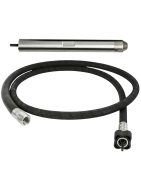
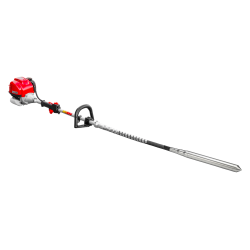
Toolsa Power-Bar PVE25 Portable Petrol Concrete Vibrator (Honda GX35, 0.5 M, 45 Mm)
- 45 mm
- 16 kg
- Honda GX 35
zł4,918.77 3 999,00 zł net At your place on Monday
An internal vibrator — a concrete poker, in the wording most UK sites use — compacts concrete from the inside. The poker head is immersed in the mix and vibrates at tens of thousands of oscillations a minute; the aggregate briefly loses internal friction, trapped air rises out, and the material closes up around the reinforcement and against the formwork.
1 product
It does what no surface tool can. A vibratory screed compacts a slab through its full depth, but in a footing, a wall, a column or a beam, vibration from the surface never reaches the bottom — only a poker does.
Two arrangements are offered. The STORM 2300 is a 230 V electric drive rated 2300 W, weighing 5.5 kg and turning at 12,000 rpm under load, to which you match a 2, 3 or 4 m shaft and a 38 or 48 mm poker. The Power-Bar is a petrol unit with a Honda GX 35, a 45 mm poker on a 0.5 m hose and an output of up to 25 m³/h.
Shafts and pokers are consumables and bought separately — they are in vibrator shafts and poker heads.
This is the first decision, and it is not about power. It is about access to electricity and how the work is done.
The electric STORM 2300 needs a 230 V supply and draws 10 A, so on a site with a distribution board, or inside a building, it is the obvious choice: 5.5 kg, no engine noise and no exhaust, which matters when pouring floors indoors. It is also modular — one drive takes different shafts and pokers.
The Power-Bar, with its Honda GX 35, needs nothing but fuel. It weighs 16 kg but is a complete portable unit with the poker on a 0.5 m hose — the operator carries it along a trench or across an open site where a cable would be the main obstruction. Rated output is up to 25 m³/h.
That short 0.5 m hose is also its limit: it will not reach the bottom of tall formwork the way a 4 m shaft on the electric drive does. It is a tool for footings, trenches and elements where the operator stands beside the concrete rather than above it.
| Specification | STORM 2300 (drive) | STORM 2300 (complete) | Power-Bar TA-PVE25 |
|---|---|---|---|
| Supply | 230 V, 50 Hz | 230 V, 50 Hz | petrol, Honda GX 35 |
| Output | 2300 W | 2300 W | 1.3 hp (35.8 cc) |
| Current draw | 10 A | 10 A | — |
| Speed | 17,500 / 12,000 rpm | 17,500 / 12,000 rpm | 9,000–9,500 rpm |
| Poker | separate | 38 or 48 mm | 45 mm |
| Shaft / hose | separate | 2, 3 or 4 m | 0.5 m |
| Protection | double insulated, IP 34 | double insulated, IP 34 | — |
| Output rate | — | — | up to 25 m³/h |
| Weight | 5.5 kg | 5.5 kg (drive) | 16 kg |
| Product page | STORM 2300 | complete | Power-Bar |
The two speeds quoted for the electric drive describe one motor in two states: 17,500 rpm free-running and 12,000 rpm with the poker working in concrete. The second is the one doing the job — the first only tells you how much reserve the motor has before the mix pulls it down.
A poker works in a radius, not at a point. The accepted figure for effective compaction is 8–10 poker diameters: about 30–38 cm for a 38 mm head and about 38–48 cm for a 48 mm one. Insertions are spaced so those radii overlap — otherwise a band of uncompacted concrete is left between them, invisible from the outside.
Time at each point is counted in seconds, not minutes. The signal to withdraw is that air bubbles stop rising and a film of cement paste appears around the head — carrying on past that does harm, because heavy aggregate settles while paste collects at the top. That is segregation, and it shows up later as a weak, dusting surface layer.
The poker is withdrawn slowly and still running, so the hole behind it closes. Pulled out sharply, it leaves a void down its whole length.
Three things a poker is not for: moving concrete along the formwork (it separates the mix), leaning on the reinforcement (vibration through the bars loosens their bond to the concrete) and touching the formwork (it marks the face and opens the joints).
The housing is polyamide 6.6 with 30% glass fibre — a material that survives a drop off the formwork and does not conduct. Together with double insulation and an IP 34 rating, that gives a drive you can hold with a wet hand next to wet concrete, which here is a basic condition rather than a feature.
The shaft changes without tools, through a 7 mm square socket. That is the same standard used by flexible shafts from several manufacturers, so the drive is not tied to one range of shafts and swapping a worn shaft on site takes moments rather than a trip to a service centre.
The motor is single-phase with carbon brushes shielded from dust. Brushes are a consumable, and in practice it is they, not the windings, that set the first service interval.
A 38 mm head passes between closely spaced bars and works in walls, columns and ring beams, where access decides. A 48 mm head has a larger radius of action and more energy, so it suits strip footings, slabs and mass elements where the thinner one would need twice as many insertions. In congested reinforcement the thicker head will not reach the bottom; in a wide footing the thinner one doubles the work.
The shaft has to let the poker reach the bottom while the operator stands clear of the formwork: 3 and 4 m for walls and columns, usually 2 m for footings and slabs. A longer shaft is not a safer "just in case" choice — the longer it is, the more is lost in torsion and the harder it is to handle.
A 2300 W drive draws 10 A and has to get it throughout the pour. On site that means a distribution board and a cable sized for the run, not a thin extension reel — voltage drop shows up as lost revs, and lost revs mean worse compaction for the same time in the mix. Where there is no supply, the right answer is a petrol unit rather than a generator bought for one tool.
The drive never touches concrete and lasts; the shaft and poker work in the mix and wear out. That is why the STORM 2300 is sold both complete and as a bare drive, and why shafts and pokers are a category of their own.
It is an internal vibrator — a concrete poker — run from a single-phase 230 V supply, in which the motor drives a poker head through a flexible shaft immersed in the mix. Our STORM 2300 drive is rated 2300 W, draws 10 A and turns at 17,500 rpm free-running and 12,000 rpm with the poker working in concrete. The drive weighs 5.5 kg, is double insulated to IP 34, and the shaft changes without tools through a 7 mm square socket.
Diameter follows the element and the bar spacing, not the size of the job. A 38 mm poker passes between closely spaced reinforcement and works in walls, columns and ring beams. A 48 mm poker has a greater radius of action and more energy, so it suits strip footings, slabs and mass elements where the thinner head would need twice the insertions. The accepted figure for effective compaction is 8–10 poker diameters: roughly 30–38 cm for 38 mm and 38–48 cm for 48 mm.
Some tens of seconds, and it is what you see that decides, not a stopwatch. The head is held until air bubbles stop coming up and a film of cement paste forms around it, which means the air has left that zone. Insertions are then spaced so the radii of action overlap; otherwise a band of uncompacted concrete is left between them, and nothing on the surface reveals it.
It segregates: heavy aggregate settles and lighter cement paste collects near the surface. The result is a weak, dusting top layer, reduced strength in the upper part of the section and greater shrinkage, which means a higher risk of cracking. Over-vibration costs as much as under-vibration and simply shows up later, which is why the moment to withdraw is judged by the bubbles stopping rather than by adding a safety margin.
Supply and construction. The electric STORM 2300 needs a 230 V socket and 10 A, but weighs 5.5 kg, produces no exhaust and is modular — one drive takes 2, 3 and 4 m shafts and 38 and 48 mm pokers. The petrol Power-Bar with its Honda GX 35 needs no electricity and can be carried anywhere, but weighs 16 kg and has a fixed 45 mm poker on a 0.5 m hose, so it will not reach into deep formwork.
Yes, with headroom. The drive draws 10 A continuously, and a single-phase motor pulls noticeably more than its rated current at start-up, so a generator sized at exactly 2.3 kW will bog down every time it is started. A thin extension reel causes the same problem from the other end: voltage drop lowers the speed, and lower speed means worse compaction for the same time in the mix. With no distribution board on site, a petrol unit is the simpler answer.
No. A head dragged sideways separates the mix — aggregate is left behind while paste flows forward — so the effect is the opposite of what is intended. Concrete is spread before vibration, by shovel or by placing it correctly from the pump, and the poker goes into material that is already distributed. For the same reason a poker is never rested against reinforcement or formwork: vibration carried into the bars loosens their bond with the concrete.
For the petrol Power-Bar the stated figure is up to 25 m³/h. For electric drives, output depends on the combination — poker diameter, shaft length and the consistency of the mix — so the specification gives the parameters it follows from rather than a single number. In practice the limit is not the machine but the rate concrete arrives and the number of operators, because every part of the element has to be reached before the mix starts to set.
Flexible shafts, poker heads, hoses and couplings are in vibrator shafts and poker heads. Slabs up to about 150 mm are compacted from above with vibratory screeds, and the surface is closed afterwards by power trowels. Where there is no site supply, power comes from inverter generators.
Essential cookies keep your cart and login working — the shop will not run without them. The rest let us measure traffic and target our ads, and we switch them on only with your consent. You can change your choice at any time using the “Cookie settings” link in the footer. Cookie policy
Essential
Cart, login, form security and remembering this choice. The shop will not work without them, so they need no consent.
Toolsa
Analytics
We count page views and checkout paths to find what is broken in the shop. We look at the data in aggregate.
Google Analytics · Microsoft Clarity
Marketing
We show our ads outside the shop and check which of them lead to a purchase. Phone callback requests land here too.
Google Ads · OptinMonster · Zadarma