
L-SAC
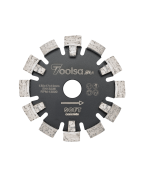
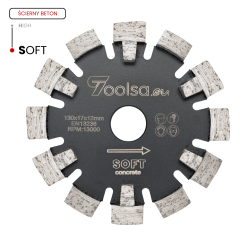
Toolsa LASER-SAC 130 X 17 Mm Floor Heating Cutter (Soft Abrasive Concrete)
- 22,2 mm
- 130 x 17 mm
- Miękki ścierny beton
zł442.80 360,00 zł net At your place on Monday
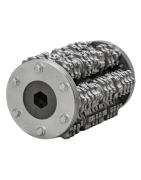
A floor scarifier removes the top layer of concrete by impact — cutters hang loosely on shafts inside a rotating drum and strike the surface as it turns, chipping material away. That is the fundamental difference from grinding, where diamond abrades the surface: scarifying removes millimetres rather than tenths of a millimetre, and leaves a rough, textured finish rather than a smooth one.
4 products
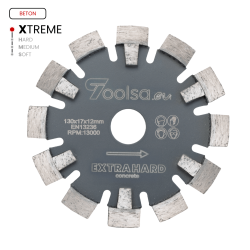
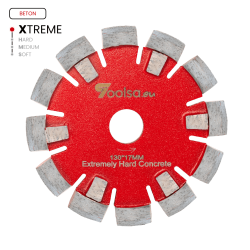
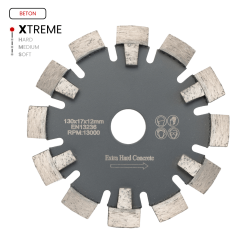
Hence two applications. The first is taking off a thick layer: old coatings, adhesive, oil-soaked concrete or laitance that a grinder would take far too long to clear. The second is creating texture — on ramps, slopes and floors where grip matters, the scarified finish is the end result rather than an intermediate stage.
Our surface scarifiers work at 200–250 mm width and cut from 1 to 8 mm deep in a single pass, driven electrically at 230 or 400 V, or by a Honda GX petrol engine. The largest machine is self-propelled; the rest are operator-guided.
Drum construction decides working pace more than power does. Ours carry 68 to 90 cutters on 4 or 6 shafts — the denser the pattern, the more even the finish and the steadier the machine. Every unit has a 38 or 48 mm extraction port, because scarifying is never done without a vacuum.
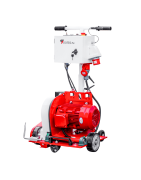
A separate machine is the underfloor heating scarifier: rather than removing a layer across the whole floor, it cuts a channel 16 or 17.3 mm wide and up to 25 mm deep, into which heating pipe is laid in an existing screed. Those are in underfloor heating scarifiers, with cutting discs in underfloor heating cutters.
Both machines work a floor and both look similar, yet they do opposite things. Confusing them costs either time or the need to correct your own work.
A scarifier works by impact. Cutters hang loosely on shafts within the drum; as it turns they swing out and strike the concrete, chipping material off. It removes 1–8 mm per pass and leaves a distinctly rough surface with a visible pattern. It is fast wherever a lot of material has to go, and the depth is set mechanically rather than judged by feel, so the same amount comes off across the whole area.
A grinder works by abrasion. Diamond segments take off tenths of a millimetre and smooth the surface. It is slower through thick layers, but it is the only one that produces a smooth finish.
In practice they often run in sequence: the scarifier strips the heavy coating, then a concrete grinder removes the scarified pattern and prepares the surface for a thin coating. Where texture is the objective, however — a ramp, a slope, a wash bay — scarifying is the final stage and grinding would only destroy the result.
| Model | Working width | Depth | Drive | Drum | Extraction | Travel | Weight |
|---|---|---|---|---|---|---|---|
| TSC-150 | 200 mm | to 3 mm | 2,2 kW / 230 V | 4 shafts, 68 cutters | 38 mm | manual | 67 kg |
| TSC-200 | 200 mm | 3–5 mm | Honda GX 200, 5–7 hp | 6 shafts, 72 cutters | 48 mm | manual | 110 kg |
| TSC-250 Auto Drive | 250 mm | 0–8 mm | 7,5 kW / 400 V | 6 shafts, 90 cutters | 48 mm | self-propelled | 209 kg |
Shaft and cutter count says more about a machine than its power rating. A drum with 6 shafts and 90 cutters works the surface more densely and leaves a more even pattern than a four-shaft drum, because the same width carries more impact points. Depth adjustable from 0 mm allows a gradual approach — with a thick coating it is better to take two passes of 4 mm than one at 8 mm, as the machine runs steadier and cutters last longer.
Petrol is independent of a power supply and makes sense wherever there is no connection — car parks, yards, buildings before handover. It must not be used in enclosed spaces without ventilation, because of exhaust fumes. Electric suits interiors but needs power: the 2,2 and 3 kW models run from a 230 V socket, while the 7,5 kW unit requires 400 V. That last constraint often decides matters on sites without a three-phase connection, leaving either a single-phase machine or a generator of adequate output.
Despite the similar name, this is not a variant of the surface machine. A channel scarifier does not remove a layer across the floor — it cuts a narrow groove into which heating pipe is laid within an existing screed.
Its specification follows directly from that task: channel width 16 or 17.3 mm matched to pipe diameter, depth up to 25 mm, and a 130 mm disc. The machine reaches to about 10 cm from a wall, and a 22.2 mm bore allows the pipe to be taken vertically. The cutting motor is 4 kW, with a separate 0,44 kW feed motor — which keeps travel speed constant, so the channel holds an even depth along its whole length.
The application is narrow and specific: adding underfloor heating without breaking out and re-pouring the floor. On a domestic refurbishment that is the difference between a few days' work and replacing the whole screed, drying time included.
Scarifying chips material away, so the dust is coarser than from grinding — which does not make it less dangerous. The fine fraction contains respirable crystalline silica, a carcinogen that causes silicosis, and the quantity produced while removing 8 mm of material is correspondingly greater than when grinding off tenths of a millimetre.
Our machines have 38 or 48 mm extraction ports sized to the drum. The vacuum must be an industrial unit with fine-dust filtration and preferably automatic filter cleaning: scarifying blocks a filter faster than any other concrete process, and a blocked filter means extraction has stopped while the motor carries on running. Suitable equipment is in vacuum cleaners for grinders and scarifiers.
Thin coatings, laitance and texturing all sit within 1–3 mm — a 2,2–3 kW machine is enough. Heavier layers such as old adhesive, paint or concrete contaminated with oil to a depth of several millimetres call for a unit reaching 5–8 mm. Beyond that depth scarifying stops being the right technology: removing layers measured in centimetres is work for demolition equipment, not floor scarifiers.
Guided machines of 67–110 kg suit areas up to a few hundred square metres and anywhere requiring manoeuvring. On large halls and yards a self-propelled unit wins: the operator is not pushing 209 kg all day, and constant travel speed translates into even cutting depth — guided by hand, pace changes involuntarily and the finish varies with it.
This constraint decides more often than floor area does. Occupied interiors rule out a petrol machine because of exhaust. The 7,5 kW unit needs 400 V, so a site with only a single-phase socket is limited to machines up to 3 kW. Running from a generator, allow for starting current and size the set with headroom.
Cutters differ in material and shape: star-pattern types for stripping coatings and thin layers, carbide for hard concrete, and special designs for abrasive materials. What matters is suiting the substrate hardness — too soft and a cutter is gone within a quarter of an hour, too hard and it skates instead of chipping. Check the marking on the specific cutter before ordering, because it governs working pace more than machine power does.
The working principle and the finish. A scarifier strikes: loosely mounted cutters chip material off, removing 1–8 mm per pass and leaving a rough surface. A grinder abrades with diamond, taking tenths of a millimetre and smoothing. Scarifying is chosen when a thick layer must go or when texture is wanted deliberately; grinding when the surface has to be smooth or prepared for a thin coating. On one project they often run in sequence: scarifier first, then a grinder to remove the pattern it left.
From 1 to 8 mm per pass depending on the model: 2,2–3 kW machines work within 1–3 mm, while the 7,5 kW unit reaches 8 mm. With thicker layers, two shallower passes beat one at maximum depth — the machine runs steadier, the pattern is more even and cutters wear more slowly. Depths measured in centimetres are beyond a floor scarifier and require different equipment altogether.
Available supply and removal depth decide it. The 2,2 and 3 kW machines run from a 230 V socket and handle 1–3 mm, which covers coatings, adhesive and laitance. The 7,5 kW unit needs 400 V but reaches 8 mm and is self-propelled, which changes working pace on large areas. Without a three-phase connection the options are a single-phase machine, a petrol version, or a generator sized with headroom for starting current.
That calls for a separate machine — a channel scarifier rather than a surface one. It cuts a groove 16 or 17.3 mm wide and up to 25 mm deep, matched to heating pipe diameter, using a 130 mm disc. A surface scarifier removes a layer across the whole field and will not produce a groove. The channel machine works to about 10 cm from a wall, and a separate feed motor holds travel speed constant so the groove keeps an even depth — guided by hand the pipe would sit unevenly.
That is exactly what channel cutting is for. Grooves are cut into the existing screed, heating pipe is laid into them and grouted, instead of breaking out the floor and pouring a new one. The condition is sufficient screed thickness — the groove goes to 25 mm, so the floor needs depth beyond that and must be free of reinforcement or services in that zone. On a domestic refurbishment this is the difference between a few days' work and replacing the screed with its full drying period.
The scarified pattern increases grip, and where grip is the point it is the finished result rather than an intermediate stage. This covers ramps and slopes where wheels must not spin, wash bays and wet areas where a smooth floor becomes slippery, and industrial zones with anti-slip requirements. In such applications the surface is not ground afterwards, because grinding would remove the texture just created.
Adhesive and other flexible materials sit on the boundary between two technologies. A scarifier will take it off together with a thin layer of concrete, which is often quickest over large areas with thick, dried deposits. With soft adhesive, however, PCD segments on a grinder tend to work better, because a cutter can clog. The practical rule: the harder and thicker the material, the more scarifying pays; the softer and thinner, the better a concrete grinder with the right tooling performs.
Our scarifier drums carry 68 to 90 cutters on 4 or 6 shafts. That figure describes impact density: more cutters across the same working width means more contact points, so a more even pattern and steadier running. A sparser drum works more aggressively and leaves a coarser texture, which can be exactly what is wanted for grip. Cutters are replaced as complete sets, because topping up individually loads the shafts unevenly — a new cutter beside a worn one sits deeper, takes a disproportionate share of the impacts and fails sooner.
Three checks come first. Reinforcement cover — if bars sit shallower than the intended depth, the cutters will find them. Services in the slab: underfloor heating, conduits and pipes turn up in unexpected places, particularly in altered buildings, and a cutter reaching 8 mm will damage them. Loose fragments and protruding fixings — anchors, remnants of profiles and spalled pieces tear cutters out or jam the drum. The floor itself should be dry and swept: moisture turns dust into a wet mass that blocks the port and hose within minutes, stopping extraction without any warning.
Cutters — they work directly on concrete and are the consumable, replaced in complete sets. Second come the shafts they sit on: ours are 12–18 mm in diameter depending on model, and they wear from cutter movement, which shows as growing play and an uneven pattern. Third are the drum bearings, impact-loaded on every rotation. The drive itself, given clear extraction and regular cleaning of dust from the housing, typically outlasts many sets of cutters.
A cutter strikes concrete and chips it away, but behaves differently against steel — it does not cut through, it bounces, and prolonged contact blunts or fractures it. That is why reinforcement cover is checked before starting: if bars sit shallower than the intended depth, either reduce the depth or choose another method. Hitting steel is unmistakable — the sound turns metallic, the machine begins to jump and a bright mark appears on the surface. Carrying on past that signal destroys a full set of cutters within minutes. The same applies to mesh, anchors and embedded steel sections, which turn up in unexpected places when refurbishing older floors.
Output depends on removal depth far more than on machine size. Texturing a sound floor at 1 mm progresses several times faster than stripping a bonded epoxy coating at 5 mm, even though the machine and the drum are identical. Working width sets the ratio between machines — 250 mm against 200 mm is a quarter more per pass — while travel speed decides the rest, which is where a self-propelled unit pulls ahead of one pushed by hand. Real figures also absorb cutter changes, emptying the vacuum and manoeuvring around obstacles. A useful rule when planning: measure a small trial area at the intended depth before quoting the whole floor, because the same machine on the same site can differ by a factor of several between a light texturing pass and heavy coating removal.
Machines for cutting heating-pipe channels have their own category: underfloor heating scarifiers, with discs in underfloor heating cutters. Dust extraction, without which scarifying is not carried out at all, is in vacuum cleaners for grinders and scarifiers. Where the surface has to end up smooth, the next step is a concrete grinder.
Essential cookies keep your cart and login working — the shop will not run without them. The rest let us measure traffic and target our ads, and we switch them on only with your consent. You can change your choice at any time using the “Cookie settings” link in the footer. Cookie policy
Essential
Cart, login, form security and remembering this choice. The shop will not work without them, so they need no consent.
Toolsa
Analytics
We count page views and checkout paths to find what is broken in the shop. We look at the data in aggregate.
Google Analytics · Microsoft Clarity
Marketing
We show our ads outside the shop and check which of them lead to a purchase. Phone callback requests land here too.
Google Ads · OptinMonster · Zadarma