
More options 91TA25
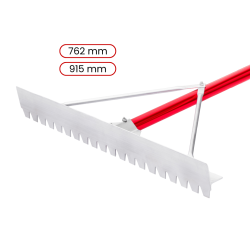
Toolsa Magnesium Asphalt Rake With Blunt Tines (762 | 915 Mm)
zł343.17 279,00 zł net On order
A concrete rake spreads fresh mix across the pour as soon as it comes off the truck. It is the first tool in the sequence of work on a slab and the only one that will move concrete quickly to where it is wanted — a shovel is too slow, and a screed levels rather than moves material.
2 products
The basic division follows the material being worked. Aluminium rakes at 500 and 508 mm are made for concrete: stiff, light and unaffected by mortar. Magnesium rakes at 762 and 915 mm are for asphalt, which is laid hot — magnesium is the metal it sticks to least.
The second choice concerns the working edge. Tined versions let the mix pass between the tines and distribute it, instead of dragging the whole mass along. Plain-edged versions work as a pull bar and suit taking off surplus. The Dual Face model combines the two: tines on one side, a plain edge on the other.
Every model comes on a pole of roughly 1 530 mm, long enough to work from the edge of the pour without stepping into fresh concrete. The stages that follow are set out in concrete hand tools.
Three terms circulate for tools that look similar and do different jobs. A concrete rake has tines and spreads the mix. A placer or come-along has a plain blade and pulls material along, which is what you want when taking off surplus rather than distributing it. An asphalt lute is the plain-bladed equivalent for hot-laid material, usually wider than anything used on concrete.
The tools differ from garden rakes in everything but outline: a working width of 500–915 mm against a typical 400, enough stiffness to move a dense material, and a pole built to take pulling rather than only sweeping. A garden rake pressed into concrete work generally lasts one pour.
The choice of material is not about price or preference but about what the tool has to work against. Asphalt is laid hot and clings to metal — magnesium holds it least, which is why asphalt rakes are made from it. Concrete does not stick in that way but is abrasive and loads the working edge heavily, so the stiffer and cheaper aluminium wins there.
| Model | Material | For | Width | Edge |
|---|---|---|---|---|
| Gold anodised | anodised aluminium | concrete | 495 / 762 mm | tined |
| Blue anodised | anodised aluminium | concrete | 508 mm | tined |
| Red | aluminium | concrete | 508 mm | tined |
| Dual Face | aluminium | concrete | 508 mm | tined and plain |
| With brackets and hook | aluminium | concrete, mesh | 508 mm | plain + hook |
| Aluminium tined | aluminium | concrete | 508 mm | tined |
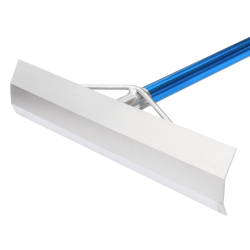
| Magnesium plain | magnesium | asphalt | 762 / 915 mm | plain |
| Magnesium, sharp tines | magnesium | asphalt | 762 / 915 mm | sharp tines |
| Magnesium, blunt tines | magnesium | asphalt | 762 / 915 mm | blunt tines |
| Steel, general purpose | steel | concrete, asphalt, sand | 500 mm | tined |
Magnesium rakes are noticeably wider than the aluminium ones — 762 and 915 mm against 500–508 mm. That follows from how the work is done: asphalt is spread over larger areas in a thinner layer, so width buys output, and the low mass of magnesium makes that width manageable through a shift.
The steel model sits outside this division. Steel is heavier and less comfortable over a long day, but it tolerates contact with aggregate and stone that aluminium will not — which is why the 500 mm version also covers sand and sub-base work, where the tool scrapes against gravel.
This is what decides how the tool treats the material. Tines let the mix pass between them, so the rake distributes concrete instead of pushing the whole mass ahead of it. For spreading fresh mix off the truck that is the only sensible option — a plain edge at this stage gathers everything into a ridge that then has to be broken down again.
A plain edge works as a pull bar and earns its place later: taking off surplus, levelling ahead of the screed, and gathering the last of the material at the edge. Hence the Dual Face version with tines on one side and a plain edge on the other, which turns the change of stage into simply turning the tool over.
With asphalt the division runs differently. Sharp tines break up material that has started to clump in transit or at the edge of the drop. Blunt tines spread without disturbing the structure of the layer, and are used where the mix is still plastic and needs no breaking up.
The version with brackets and hook answers a separate problem. The hook lifts reinforcement mesh during the pour so it ends up around mid-depth of the slab rather than lying on the base — which is the difference between reinforcement that works and steel that merely rusts underneath.
Aluminium forms a thin oxide film of its own that protects it from further oxidation. Anodising thickens that film deliberately in an electrochemical process — the surface becomes harder than bare aluminium and considerably more resistant to abrasion and to the chemical action of fresh mortar, which is alkaline.
In practice an anodised tool keeps a smooth working face for longer, and that translates into two things: less material clings to the edge during work, and what does cling washes off more easily afterwards. The colour — Gold or Blue — comes from dye held in the pores of the anodic layer, not from a coating that could flake away.
For concrete the standard is 500 or 508 mm, and that covers most pours. Anything narrower means more passes; anything wider becomes heavy to control in a stiff mix, because resistance rises in proportion to the area of the edge. The 762 and 915 mm widths belong to the magnesium asphalt versions, where material is spread in a thinner layer and the low mass of magnesium makes the extra width workable. Those widths are not used on concrete.
Tines are the right choice for spreading fresh mix, because they let concrete through and distribute it rather than pushing the whole mass ahead of the tool. A plain edge comes into its own later: removing surplus and levelling ahead of the screed. Where one tool has to cover both jobs, the 508 mm Dual Face version carries tines on one side and a plain edge on the other, so moving between stages means turning the rake over in your hands rather than fetching a second tool.
At a push, but an aluminium tool will stick to hot material and lose its edge sooner. Asphalt rakes are made from magnesium precisely because hot mix adheres to it least of the metals in use. Temperature matters too: the material is laid hot, and magnesium takes that contact without distorting. The exception is the 500 mm steel model, specified for concrete, asphalt and sand alike — heavier to work with, but able to take contact with aggregate.
The hook lifts reinforcement mesh during the pour so that it finishes around mid-depth of the slab. Mesh left on the base and buried in concrete does no work — concrete carries compression by itself, and the steel is there to take tension in the zone where tension occurs. In a 150 mm slab the mesh should end up roughly 70–80 mm off the base. Hooking it up as the pour advances is quicker than setting it on spacers, though less precise, so structural slabs are done on spacers instead.
Wash the mortar off before it sets — in practice 2 to 3 hours from finishing work, and less in hot weather. Concrete left to harden between the tines can only be removed mechanically, which ruins the working face and, on anodised models, breaches the protective layer. Aluminium and magnesium do not corrode, but magnesium is soft and does not take being dropped onto hard ground. Storing the tool so the pole is not loaded along its length keeps it from taking a permanent bend.
The stage after spreading is screeding to level — that is the job of bull floats, and on larger areas of vibratory screeds. The full order of work on a slab, from spreading through to non-slip texture, is in concrete hand tools.
Essential cookies keep your cart and login working — the shop will not run without them. The rest let us measure traffic and target our ads, and we switch them on only with your consent. You can change your choice at any time using the “Cookie settings” link in the footer. Cookie policy
Essential
Cart, login, form security and remembering this choice. The shop will not work without them, so they need no consent.
Toolsa
Analytics
We count page views and checkout paths to find what is broken in the shop. We look at the data in aggregate.
Google Analytics · Microsoft Clarity
Marketing
We show our ads outside the shop and check which of them lead to a purchase. Phone callback requests land here too.
Google Ads · OptinMonster · Zadarma