
TAHTG450
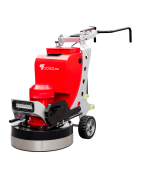
Toolsa HTG-460 Planetary Concrete Floor Grinder (460 Mm Working Width)
- 194 kg
- 460 mm
- 230 v
zł27,060.00 22 000,00 zł net At your place on Tuesday
Two very different machines share the name “concrete grinder”. One is an angle grinder with a 125–180 mm cup wheel and a dust shroud — a hand tool for edges, corners and small repairs. The other is a walk-behind or remote-controlled concrete floor grinder with a working width of 250–820 mm and a weight between 60 and 620 kg, built to process whole floors. This category covers the second kind.
5 products
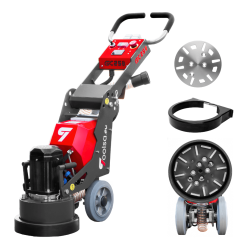
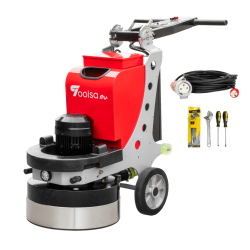
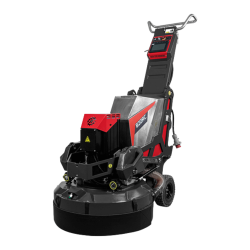
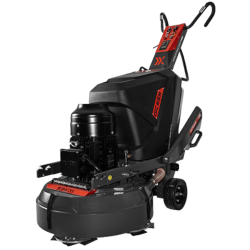
Pick a type, and more filters will show up.
A floor machine works differently from a tool held in the hands: its own weight provides even downward pressure, and a planetary head — a rotating plate carrying smaller satellite discs that spin as well — removes material evenly across the full width instead of cutting swirl marks. That is what produces a flat floor rather than a rippled one, which decides the whole job when the surface is going under resin or into polishing.
Power runs from 1,1 kW on a single-phase supply to 18,5 kW at 400 V, and variable speed across 300–1950 rpm lets you match the stage: slower for grinding, faster for polishing. Machines with a 15–30 l water tank also run wet.
The same machine handles four jobs — surface preparation before resin, removal of old coatings and adhesive, concrete polishing and terrazzo grinding. What changes is the tooling and the speed, not the machine — which is why one purchase covers the whole sequence from stripping to a polished finish.
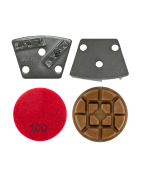
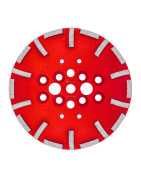
Abrasives are chosen per task: see diamond pads and segments and diamond grinding discs. Dry grinding always pairs with dust extraction — that equipment sits in vacuum cleaners for grinders and scarifiers.
Grinding removes the top layer of a floor; how much and how smoothly depends on the tooling. The same machine covers four different jobs, separated only by the segments fitted and the speed selected.
A resin coating bonds to concrete only if it keys into the structure rather than into the laitance that rises to the surface during power trowelling. Grinding opens the pores and creates the roughness described by a CSP profile. The work is done with grinding segments at low speed, around 300–600 rpm. The same pass removes the unevenness left by trowelling, because a machine weighing 200 kg cuts the high spots off instead of following the profile beneath it.
Carpet adhesive, paint residue and old epoxy come off with PCD segments, whose cutting edge is polycrystalline diamond. Flexible materials would clog a conventional diamond segment within minutes — PCD tears them up and feeds them to the extractor. This is the dirtiest stage of any floor refurbishment and the one where dust extraction matters most.
Polished concrete is built up through successive passes with progressively finer grit, from grinding segments through to polishing pads, typically in six to eight steps. Each pass removes the scratches left by the one before, which is why steps cannot be skipped. High speed matters here — up to 1950 rpm — along with even downward pressure that a hand-held machine cannot provide. The result is a floor needing no coating at all: the gloss is in the concrete itself.
Terrazzo, surface-hardened floors and concrete with decorative aggregate are worked the same way as an ordinary slab, only with more care over segment choice — exposing aggregate to a set depth demands control over how much material comes off in a single pass. On large industrial areas machines with a working width of 815–820 mm start to make sense, covering a strip more than three times wider per pass than a 250 mm unit.
| Model | Working width | Motor power | Supply | Speed | Water tank | Weight |
|---|---|---|---|---|---|---|
| GX-250 | 250 mm | 1,1 kW | 110 / 230 V | 350–1500 rpm | — | 60 kg |
| TA460-PV | 460 mm | 3 kW | 230 V | 300–1400 rpm | 30 l | 135 kg |
| HTG-460 | 460 mm | 2,3 kW | 230 V | 350–1500 rpm | 15 l | 194 kg |
| TA600-PV | 600 mm | 5,5 kW | 400 V | 300–1800 rpm | 30 l | 200 kg |
| TGX858-RC | 815 mm | 15 kW | 400 V | 350–1950 rpm | 30 l | 595 kg |
| THTG820-RC | 820 mm | 18,5 kW | 400 V | 350–1950 rpm | 25 l | 620 kg |
The TA460-PV and TA600-PV accept an extra 30 kg of ballast, used to increase downward pressure when stripping hard coatings. Rated current is 11,8 A for the TA460-PV, 19 A for the TA600-PV and 39,3 A for the THTG820-RC — figures worth checking against the site distribution board or generator before connecting.
Width translates into output directly, but not proportionally. An 820 mm machine covers a strip more than three times wider per pass than a 250 mm one, yet on a floor broken up by columns, recesses and thresholds the advantage melts away, because the larger the machine, the more places it cannot reach. In practice big units take the open field while a 250 mm machine or an angle grinder with a shroud finishes walls and corners.
The second constraint is the supply. The 15 kW and 18,5 kW units need 400 V and suitable protection, so on a site without a three-phase connection the choice narrows to machines up to 3 kW on 230 V — or a generator of adequate output.
Grinding concrete releases respirable crystalline silica. This is not ordinary dust: particles fine enough to reach the alveoli cause silicosis, and the International Agency for Research on Cancer classifies respirable crystalline silica as carcinogenic to humans. The consequences do not appear after one day's work but after years, and they are irreversible.
That leaves two ways of working. Dry, the machine must have an industrial vacuum matched to the port diameter, with filtration that captures fine dust and preferably automatic filter cleaning — without it the filter blocks within a quarter of an hour and extraction stops while the motor carries on running. Wet, the dust is bound at source by water from a 15–30 l tank; the dust problem disappears but slurry takes its place, and it has to be collected before it dries, because dried slurry grips the floor harder than the coating you removed.
Which to choose is mostly a question of stage and site: polishing is usually done dry so the finish can be judged, while stripping thick coatings is often cleaner wet. Extraction equipment sits in vacuum cleaners for grinders and scarifiers.
For a garage, a cellar or a single room, a 250 mm machine weighing about 60 kg is enough — one person can carry it up stairs. Halls, warehouses and industrial floors call for 460–600 mm units, and areas measured in thousands of square metres justify the 815–820 mm machines, with the caveat that at 595–620 kg transport and access need planning before delivery.
This constraint often matters more than floor area. Machines up to 3 kW run from a 230 V socket; above that a 400 V supply is required. Running from a generator, remember that the motor draws several times its rated power at start-up, so the generator is sized with margin rather than exactly — for a 3 kW machine that means a unit of at least 4,5 kW.
This is where mistakes are most often made. The harder the concrete, the softer the segment bond — and the other way round. The reason is that the bond has to wear at a rate that keeps exposing fresh diamond. In hard concrete, abrasion is slow, so a soft bond is needed to wear back and uncover the diamond. In soft, abrasive concrete the opposite holds: a soft bond would vanish within a quarter of an hour, so a hard one is used. Get it backwards and the segment either stops cutting and merely burnishes the surface, or disappears fast enough to turn the job into a loss.
Every planetary machine here carries a 15–30 l water tank, while the single-disc GX-250 works dry with extraction. Wet grinding eliminates dust and extends segment life, but the slurry has to be collected and the floor must dry before any coating goes down. Dry grinding is faster and the result is visible immediately — provided a vacuum is connected, at which point the extractor stops being an accessory and becomes part of the machine.
Area decides it. A whole floor is worked with a walk-behind machine carrying a planetary head — its weight gives even pressure and the satellite discs remove material uniformly instead of cutting swirl marks. Edges, corners and spots around pipework are finished with a 125–180 mm angle grinder fitted with a dust shroud. For stripping adhesive and old coatings, PCD segments are the most effective tooling, and for polishing it is successive passes with progressively finer pads. No single tool does all of it; a 250 mm machine is the compromise where carrying in a 200 kg unit makes no sense.
For a room of a few dozen square metres, the right machine has a 250 mm working width and weighs around 60 kg, running from a 230 V socket. It fits through a doorway, one person can carry it, and speed adjustable across 350–1500 rpm covers both grinding and polishing. Machines of 460 mm and above struggle to manoeuvre in such a space, and at 135–200 kg getting them down stairs becomes a project of its own.
Dry grinding without extraction is unacceptable on health grounds. The process releases respirable crystalline silica, classified by the International Agency for Research on Cancer as carcinogenic to humans and known to cause silicosis. The dust is fine enough to stay airborne for hours and to travel into adjoining rooms. There are two correct answers: an industrial vacuum with fine-dust filtration connected to the machine port, or wet working, where water from a 15–30 l tank binds the dust at source. A mask alone replaces neither.
What settles it is square metres per year, not the cost of one hire. For a one-off garage refurbishment, hiring works out cheaper and leaves no machine of 60–200 kg to store. Buying starts to pay when grinding recurs — and then a second argument appears that no cost calculation shows: your own machine is available on the day the floor is ready, not on the day the hire company has one free. For commercial work, tooling matters too, since segments in hired machines are rarely matched to the hardness of the concrete in front of you.
On a single-disc machine the segments sit on one rotating plate, so rim speed is far higher than at the centre and the finish carries visible arcs. A planetary head has a main plate carrying several smaller discs that also spin on their own axes, so each segment follows an irregular path and scratches do not repeat. The result is a more even surface with no characteristic swirls, which is why planetary machines are used for polishing and for surfaces going under resin. A single-disc 250 mm unit still makes sense where low weight and access matter more.
Wet removes dust at source, segments run cooler and last longer, and the machine can work without a vacuum. The price is slurry that has to be collected before it dries, plus drying time before any coating. Dry is faster, the result is visible straight away and stages follow one another without interruption — as long as a vacuum is connected. In practice, stripping thick coatings is often cleaner wet, while polishing is done dry so the gloss can be judged as it develops.
The rule runs opposite to intuition: the harder the concrete, the softer the segment bond. The bond must wear at a rate that keeps exposing fresh diamond — in hard concrete abrasion is slow, so a bond that wears back on its own is needed. In soft, abrasive concrete the reverse applies: a soft bond would be gone within a quarter of an hour, so a hard one is specified. The symptoms of a wrong choice are unmistakable: too hard and the segment stops cutting and only burnishes; too soft and it disappears while you watch. Hardness markings help — see diamond pads and segments.
Output depends on how much material has to come off, not only on machine size. Simply opening the pores before resin progresses many times faster than stripping thick epoxy or levelling a slab. Working width alone gives only the ratio: an 820 mm strip is more than three times a 250 mm one per pass. Real figures also absorb segment changes, emptying the vacuum and the shape of the room — a floor broken up by columns can reduce a large machine's advantage to nothing.
Local high spots, overpours and steps between pours will come off — a weight of 135–620 kg means the tool cuts humps rather than following the profile beneath. Grinding will not correct falls or dips across a large area, though: levelling a sunken section would mean taking the same depth off everywhere else. Where differences exceed a few millimetres per metre, a levelling compound makes more sense, with grinding used to prepare the substrate for it. Deeper removal is a job for concrete scarifiers.
Machines up to 3 kW run from a single-phase 230 V socket — that covers the 250 and 460 mm units. Above that, a three-phase 400 V supply is required: the 600 mm machine at 5,5 kW and the 15 and 18,5 kW units. Check rated current as well as voltage, because 39,3 A on the largest machine needs correspondingly rated protection at the board — site installations are not always prepared for it.
Coating manufacturers specify the required roughness as a CSP number, and the figure comes from the datasheet of the product going down, not from the grinder. Thin coatings key into a lightly opened surface, while thicker self-levelling systems call for a coarser profile that only heavier removal produces. Two things follow for the machine. First, segment choice and pass count are dictated by the coating, so read its datasheet before starting. Second, the profile has to be even across the whole floor — a patch left smoother than the rest becomes the place where the coating lifts first, and that is exactly what a planetary head prevents by removing material uniformly rather than in arcs.
Planetary machines have their own category: planetary concrete grinders. Abrasives are selected for the task and the substrate — diamond pads and segments for grinding and polishing, diamond grinding discs for resin and adhesive. Dust extraction, the condition for working dry, is in vacuum cleaners for grinders and scarifiers. Where more material has to come off a floor than grinding can take, the right machine is a concrete scarifier.
Essential cookies keep your cart and login working — the shop will not run without them. The rest let us measure traffic and target our ads, and we switch them on only with your consent. You can change your choice at any time using the “Cookie settings” link in the footer. Cookie policy
Essential
Cart, login, form security and remembering this choice. The shop will not work without them, so they need no consent.
Toolsa
Analytics
We count page views and checkout paths to find what is broken in the shop. We look at the data in aggregate.
Google Analytics · Microsoft Clarity
Marketing
We show our ads outside the shop and check which of them lead to a purchase. Phone callback requests land here too.
Google Ads · OptinMonster · Zadarma