
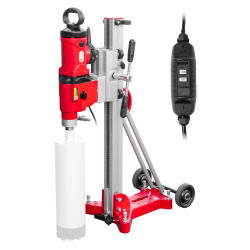
Pack DS400-33
Toolsa DS400-33 Complete Core Drill Rig
- 50–60 Hz
- 15,3 kg
- 350 | 180 | 80 mm
zł11,439.00 9 300,00 zł net At your place on Monday
A rig-mounted core drill is the same technology as a hand-held machine without the limit a person imposes. A motor clamped to a column does not have to pass reaction torque into the operator's arms, so the diameter range rises from 80 to 220 or 400 mm — and feed on a handwheel advances evenly, without drift.
2 products
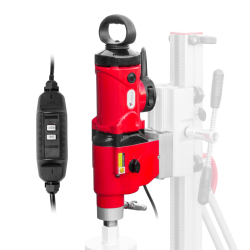
Two drives are offered in two forms. The DD 22 (2200 W, to 220 mm) and DD 33 (3300 W, to 400 mm) can be bought as motors alone — if you already have a stand — or as complete rigs, DS220-22 and DS400-33, with the stand matched at the factory.
Both have three gears, a 1¼" UNC thread and a G 1/4" water connection. They differ in current draw: 11 A against 16 A, which in an existing installation is often the deciding factor.
The supporting structures are in core drill stands, bits in diamond core drill bits, and machines for hand-held work in hand-held core drills.
The same motor appears here in two forms, and it is worth knowing which you are buying.
A bare motor — DD 22 or DD 33 — makes sense when a stand is already owned and matches: the DD 22 works with the DS 250, the DD 33 with the DS 400. It is also the route for a crew replacing a worn motor while keeping the structure.
A complete rig — DS220-22 or DS400-33 — is the same motor with a factory-matched stand. The benefit is certainty that the stand's range matches the motor's: you cannot end up with a 400 mm machine on a column rated for 252 mm.
The weights in the data are for the motor alone — 9.5 and 15.3 kg — while the stand adds 16.5 or 27.8 kg. When planning transport, the total is what counts, not the figure on the motor sheet.
| Specification | DD 22 / DS220-22 | DD 33 / DS400-33 |
|---|---|---|
| Power | 2200 W | 3300 W |
| Max diameter on stand | 220 mm | 400 mm |
| Concrete by gear | 180 / 80 / 60 mm | 350 / 180 / 80 mm |
| Brick by gear | 220 / 120 / 80 mm | 400 / 200 / 100 mm |
| Gears | 3 | 3 |
| Speeds | 580 / 1400 / 2800 rpm | 400 / 800 / 1200 rpm |
| Rated current | 11 A | 16 A |
| Voltage | 110 V / 230 V | — |
| Motor weight | 9.5 kg | 15.3 kg |
| Matching stand | DS 250 (16.5 kg) | DS 400 (27.8 kg) |
| Motor only | DD 22 | DD 33 |
| Complete rig | DS220-22 | DS400-33 |
The "concrete" and "brick" rows give three values, one per gear — these are not options but the maximum diameter at each ratio. A ⌀ 350 mm bit on the DD 33 runs in first gear only, at 400 rpm; at 1200 rpm its peripheral speed would be several times too high and the segments would glaze over.
The DD 22 draws 11 A, so it runs off a typical 16 A circuit with margin for lighting and small tools. The DD 33 draws 16 A — exactly the rating of the protection — which in practice means a circuit of its own, and a sound one.
The consequence is a planning one rather than an equipment one. In an occupied building with an older installation, the DD 33 can trip the breaker while working perfectly well — not because it is faulty, but because it sits at the limit of the circuit. For ⌀ 300–400 mm penetrations in such conditions, the supply is planned along with the work.
The second difference is voltage: the DD 22 runs on both 110 V and 230 V, which on reduced-voltage sites can be the condition for getting on site at all.
Service penetrations — ventilation, drainage, ducts — usually stay within 220 mm, and then the DD 22 is the right machine. Above that, for flues, shafts and larger ducts, there is no alternative to the DD 33: it is not a question of power but of the range of the stand the motor works on.
Buying the motor alone only makes sense if the structure is right. The DS 250 covers diameters to 252 mm and accepts the DD 18, DD 22 and DDB 26; the DS 400 covers 402 mm and is built for the DD 33. Mounting a motor on an undersized stand does not extend its range by a millimetre.
A DS220-22 is 9.5 + 16.5 kg, a DS400-33 is 15.3 + 27.8 kg, before fixings and water. Working at height or in a tight riser shaft, those 43 kg become two trips rather than one — and that too is planned before leaving for site.
Wet drilling at ⌀ 300 mm produces more slurry than a rag will deal with. You need to know in advance where it will be collected — cement suspension must not enter the drains. That job belongs to a wet and slurry vacuum.
In range and in how it is guided. A hand-held machine drills to 80 mm in concrete, because above that the reaction torque of a jammed bit stops being holdable. A motor clamped to a column does not pass that torque to the operator, so the range rises to 220 mm on the DD 22 and 400 mm on the DD 33. Feed on a handwheel also advances evenly, which on long penetrations decides whether the hole stays square.
The bare motor makes sense when a stand is already owned and matches: the DD 22 with the DS 250, the DD 33 with the DS 400. It is also the route when replacing a worn motor. A complete rig — DS220-22 or DS400-33 — guarantees that the stand's range matches the motor's, so a 400 mm machine cannot end up on a column rated for 252 mm. For a first purchase the rig is the safer choice.
Because each belongs to a different gear. They are not options but the maximum diameter at each ratio: on the DD 33, the concrete figures of 350, 180 and 80 mm correspond to 400, 800 and 1200 rpm. A ⌀ 350 mm bit runs in first gear only, because at 1200 rpm its peripheral speed would be several times too high and the diamond segments would glaze over rather than cut.
It draws 16 A, exactly the rating of a typical circuit protection — which in practice means a circuit of its own, and a sound one. In an occupied building with an older installation the machine can trip the breaker while working perfectly well, because it sits at the limit of the circuit. The DD 22 is gentler: 11 A, and it runs on 110 V as well as 230 V.
The weights on the motor sheets are for the motors alone — 9.5 kg for the DD 22 and 15.3 kg for the DD 33. The stand adds 16.5 kg (DS 250) or 27.8 kg (DS 400), so a complete rig weighs 26 and 43 kg respectively, before fixings and water. Working at height or in a tight riser shaft, that is planned as two trips rather than one.
No — the DD 22 and DD 33 are built for stand work only, and their data quote no hand-held diameter. At 15.3 kg for the motor alone, and with torque matched to a ⌀ 350 mm bit, it would make no practical sense either. Machines built for both modes are in hand-held core drills, where each one quotes two figures: hand-held and on a stand.
Both units carry an external 1¼" UNC thread at seven threads per inch — the standard for core drill bits — and a G 1/4" water connection. In practice the limit is not the mounting but the stand and the gear: 220 mm on the DD 22, 400 mm on the DD 33. Bit series matched to concrete, reinforced concrete and percussion work are in diamond core drill bits.
Plan its collection before drilling starts. A ⌀ 300 mm wet penetration produces more suspension than a rag will handle, and cement fines must not enter the drains — they harden in the pipework. Slurry is lifted continuously with a wet and slurry vacuum, and when working above an occupied room the opening is also sealed so water does not run down through it.
The supporting structures, their ranges and fixing are covered in core drill stands. Machines for hand-held work up to 80 mm are in hand-held core drills, and bits in diamond core drill bits. Slurry from wet drilling is collected by wet and slurry vacuums.
Essential cookies keep your cart and login working — the shop will not run without them. The rest let us measure traffic and target our ads, and we switch them on only with your consent. You can change your choice at any time using the “Cookie settings” link in the footer. Cookie policy
Essential
Cart, login, form security and remembering this choice. The shop will not work without them, so they need no consent.
Toolsa
Analytics
We count page views and checkout paths to find what is broken in the shop. We look at the data in aggregate.
Google Analytics · Microsoft Clarity
Marketing
We show our ads outside the shop and check which of them lead to a purchase. Phone callback requests land here too.
Google Ads · OptinMonster · Zadarma