89TA01
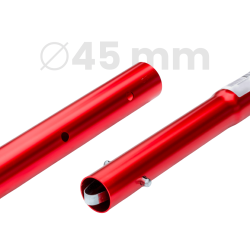
Toolsa Handle Pole For Bull Floats And Vibratory Screeds (45 x 1830 Mm)
- 1830 mm
- 45 mm
zł183.27 149,00 zł net At your place on Monday
This category holds two groups of tools that are easy to confuse although they work at different moments. Screed bars set the level of the slab: drawn along rails or across fresh mix, they take off the surplus. Bull floats come afterwards and close the surface — they remove no material, but smooth it and push the aggregate below the layer of mortar.
12 products
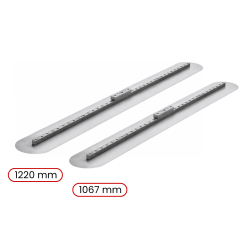
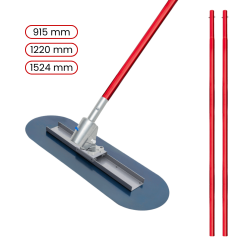
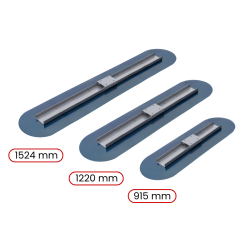
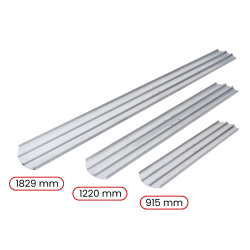
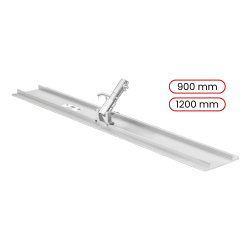
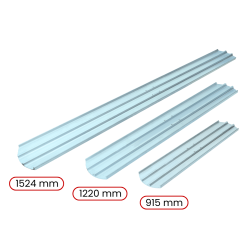
Bull float blades come in three materials. Magnesium does not stick to a wet mix and leaves the surface open, so it works earliest. Aluminium is stiffer and cheaper at the same length. Manganese steel and Big Blue Float hold an edge longer and stand up better to abrasion. Working widths are 915, 1 220, 1 524 and 1 829 mm.
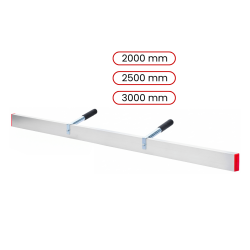
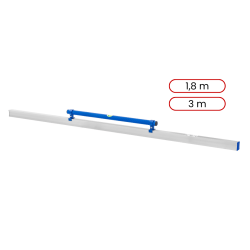
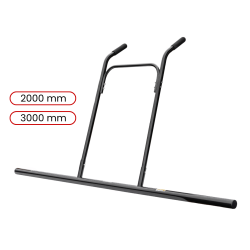
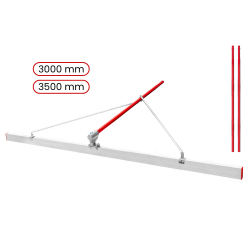
On the screeding side there are magnesium screed bars of 2 000, 2 500 and 3 000 mm with double handles, an aluminium straightedge with a built-in spirit level, and the Bump Cutter — a levelling float of 3 000 and 3 500 mm for cutting down local high spots.
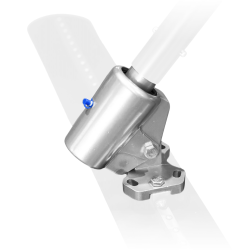
Blades, poles of ⌀45 mm × 1 830 mm and a bracket with angle adjustment are all available separately — because what wears out is the blade, not the pole. The full sequence of stages is in concrete hand tools.
Both tools are long, both are worked on a pole and both get called a float on site. They do different jobs at different moments, and confusing them produces a slab that looks right and does not hold its level.
A screed bar takes off surplus mix and sets the finished level. It is drawn along rails or across compacted concrete in a sawing motion, with material gathering ahead of the blade. Stiffness is what counts at this stage — a bar that sags in the middle transfers that sag straight into the floor.
A bull float follows immediately and removes nothing. Drawing the blade across the surface pushes aggregate below the mortar layer, evens out minor irregularities and brings the fat to the top. It is worked from the edge of the slab, on a pole, without stepping onto the concrete — which is the second reason, after sheer coverage, that the blade sits on a tube.
The practical consequence is that neither substitutes for the other. A bull float will not bring concrete to level, because the blade is too narrow and has nothing to bear on. A screed bar will not close a surface, because its edge gathers mortar instead of spreading it.
| Blade | When it works | What it gives | Widths |
|---|---|---|---|
| magnesium | earliest, concrete still wet | will not stick, leaves pores open | 915 / 1 220 / 1 524 mm |
| aluminium | general purpose | stiffness over long lengths | 915 / 1 220 / 1 829 mm |
| Big Blue Float | where edge life matters | resistance to abrasion | 915 / 1 220 / 1 524 mm |
| manganese steel | finishing, hard concrete | holds an edge longest | replacement blade |
The choice between magnesium and aluminium comes down to timing. Magnesium goes on straight after screeding, while the surface is still wet and anything else would stick to it. Aluminium works a little later and is noticeably stiffer, which matters on the 1 524 and 1 829 mm blades — the longer the blade, the easier it sags in the middle, and that sag prints onto the floor as a hollow.
A wider blade means fewer passes but harder handling. At 915 mm the tool stays flat easily, even for one person; at 1 829 mm a few degrees of tilt has the float digging with one edge. That is why a bracket with angle adjustment is effectively compulsory at the larger widths.
The tool consists of three independent parts: the working blade, a bracket and a pole. What wears is the blade — poles and brackets last for years, so they are bought once.
The range covers complete tools ready to work, blades on their own for replacement (aluminium 1 220 × 203 mm, magnesium, manganese steel and Big Blue Float), and an Economic version with blade and bracket but no poles, for anyone who already has tubes from another tool.
Fittings complete the picture: a ⌀45 mm pole 1 830 mm long, fitting both floats and vibratory screeds, and a bracket with angle adjustment that allows the blade to be tilted mid-pass. Without it, at longer reach the blade holds one fixed angle and one edge takes more than the other. There is also a carry case, which matters for steel blades that do not tolerate being stored damp.
Three tools cover the screeding side, each for a different case. Magnesium screed bars of 2 000, 2 500 and 3 000 mm have double handles and are worked by two people. The aluminium straightedge with a built-in spirit level allows the level to be checked as the work goes on, without putting the tool down to reach for a level. The Bump Cutter at 3 000 and 3 500 mm cuts down local high spots, which usually only show up after the first pass.
The ⌀50,8 mm spreader bar for anhydrite screed is a separate tool altogether. Self-levelling compounds are spread differently from concrete: the material flows out on its own, and the tool's job is to distribute it evenly and release trapped air rather than take off surplus. Hence the round section instead of a flat blade — the bar is worked through the mix in a swaying motion, without gathering material ahead of it.
A bull float is a wide blade on a long pole, used immediately after the concrete has been screeded to level — the first smoothing tool of the pour. Drawing it across the fresh surface pushes aggregate down, evens out minor irregularities and brings a layer of mortar to the top. Typical widths are 915, 1 220 and 1 524 mm. It is worked from the edge of the slab without stepping onto the concrete, which is why the blade sits on a 1 830 mm pole that can be joined for greater reach.
Screed bars run 2 000 to 3 500 mm long, bull floats 915 to 1 829 mm wide — a difference that follows directly from the job. A screed bar removes surplus mix and sets the level of the floor — it is drawn along rails in a sawing motion, with material gathering ahead of the blade. A bull float follows and removes nothing, closing the surface and pushing aggregate below the mortar. Neither replaces the other: a bull float cannot bring concrete to level, because the blade is too narrow and has nothing to bear on, and a screed bar cannot smooth a surface, because its edge gathers mortar instead of spreading it.
A wider blade means fewer passes but harder handling. At 915 mm one person can keep the tool flat through a long session; 1 220 mm is a sensible compromise for a typical floor; 1 524 and 1 829 mm earn their place on large areas but demand practice, since a few degrees of tilt has the blade digging with one edge. At those widths a bracket with angle adjustment stops being an accessory and becomes the condition of even work.
Magnesium goes on earlier, because it does not stick to a wet mix and leaves the surface open so water can still evaporate. Aluminium works slightly later and is noticeably stiffer, which on the 1 524 and 1 829 mm blades decides whether the tool sags in the middle. If the kit is to hold one blade only, magnesium makes more sense on finished floors; aluminium wins on large working areas where stiffness and price matter more.
Replacing the blade alone makes sense whenever the pole and bracket are sound, which is often — the blade works in concrete and wears out far sooner than a tube that only transmits movement. Blades are stocked separately in aluminium 1 220 × 203 mm, magnesium, manganese steel and Big Blue Float. The condition is that the fixing matches the bracket in hand. For anyone who already owns poles there is also the Economic version — blade and bracket, no tubes.
Self-levelling compounds call for the ⌀50,8 mm spreader bar, not a straightedge or a float. Anhydrite screed flows out by itself, so the tool is not there to take off surplus but to distribute the material evenly and release trapped air. The round section lets the bar be worked through the mix in a swaying motion without gathering it ahead — a flat blade in this application would set up waves and leave marks that a self-levelling compound will no longer even out.
The previous stage, spreading the mix, is covered by concrete rakes. On larger areas screeding and compaction pass together to vibratory screeds, and finishing after the initial float is the work of hand trowels. The full order of stages is in concrete hand tools.
Essential cookies keep your cart and login working — the shop will not run without them. The rest let us measure traffic and target our ads, and we switch them on only with your consent. You can change your choice at any time using the “Cookie settings” link in the footer. Cookie policy
Essential
Cart, login, form security and remembering this choice. The shop will not work without them, so they need no consent.
Toolsa
Analytics
We count page views and checkout paths to find what is broken in the shop. We look at the data in aggregate.
Google Analytics · Microsoft Clarity
Marketing
We show our ads outside the shop and check which of them lead to a purchase. Phone callback requests land here too.
Google Ads · OptinMonster · Zadarma