
Lightest TA-ER2C
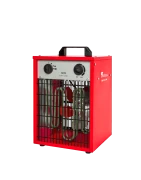
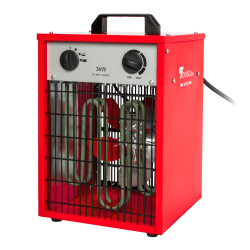
Toolsa TA-ER2C Electric Heater
- 1,5 kg
- 50 Hz
- 218 × 140 × 250 mm
zł147.60 120,00 zł net At your place on Monday
A space heater warms a building where fixed heating is absent or would not pay for itself: a production hall, a warehouse, a marquee, a workshop, a site under finishing works. The working principle is the same in every type — a fan drives air past a heat source and returns it to the room. What separates them is where that heat comes from and what happens to the products of combustion.
5 products
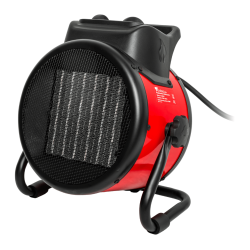
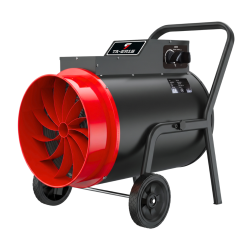
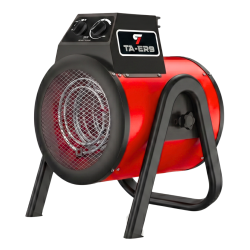
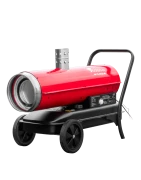
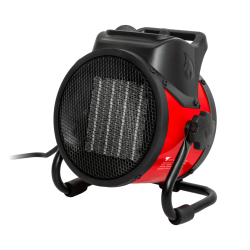
The Toolsa range covers three kinds. Electric heaters from 2 to 15 kW produce no combustion products at all and suit anywhere with a supply of adequate capacity. Direct-fired diesel heaters — 51 and 63 kW — deliver the most heat from a single machine, but discharge combustion products into the heated space and therefore require continuous air exchange. Indirect-fired diesel heaters of 20, 30 and 50 kW have a sealed combustion chamber and a separate flue: the heated air never comes into contact with combustion products.
That distinction governs selection more than output does. An enclosed room, a site office, a marquee with people inside or a unit without mechanical ventilation admits only an electric machine or an indirect-fired one. A direct-fired heater belongs in ventilated spaces — halls with open doors, open structures, buildings still under construction.
Output is matched to volume rather than floor area: a unit 8 m to the roof holds more than three times the air of a 2,5 m room of the same footprint. In practice the working figure is 16 to 20 m³ per kilowatt, assuming the building is closed up.
The full listings are in electric air heaters and oil-fired air heaters, and the ducting used to distribute the warm air is in heater accessories.
Most selections start with output, and output is the second parameter. The first is what the machine does with its combustion products — because that is what settles whether it may be placed in a given building at all. Kilowatts are compared afterwards, within the correct type.
An element converts electricity into heat and a fan distributes it. Nothing is burned, so the machine needs no flue, no ventilation and no fuel. The constraint is the electrical installation: the 2 and 3 kW models run from an ordinary 230 V socket, while 9 and 15 kW require a three-phase 400 V supply. Electric machines are also the smallest in the range — 15 kW is the ceiling, whereas diesel starts in practice at 20 kW and reaches 63 kW.
The burner fires into the open air stream, which then passes straight into the building. All the energy released goes into the heated space, which is how a machine weighing about 22 kg delivers 51 or 63 kW. Combustion products and water vapour travel with that heat. A direct-fired machine therefore works only where air is continuously exchanged: units with open doors, structures enclosed on three sides, buildings still under construction.
The combustion chamber is sealed and separated from the heated air stream, and combustion products leave through a dedicated flue spigot. The air returning to the room never touched them. This is the arrangement used wherever people are present and intensive ventilation cannot be provided — marquees, closed units, rooms under finishing works. The cost is the flue that has to be run outside, and a higher price for the same output. The TA-DV series covers 20, 30 and 50 kW.
The commonest mistake when ordering is to work from square metres of floor. What is heated is air, and how much of it there is depends on height: a unit of 600 m² standing 8 m to the roof contains 4 800 m³, while premises of the same footprint at 3 m hold only 1 800 m³. One machine will fail in the first case and have capacity to spare in the second.
The starting figure is 16–20 m³ per kilowatt with the building closed up and outside temperatures around freezing. The volumes below come from the machines' data sheets and assume exactly those conditions. An open door, uninsulated walls or frost below −10 °C all raise the requirement, and output then has to be chosen with a margin.
| Model | Type | Output | Volume | Supply | Weight |
|---|---|---|---|---|---|
| TA-ER2C | electric | 2 kW | up to 40 m³ | 230 V | 1,5 kg |
| TA-ER3C | electric | 3 kW | up to 60 m³ | 230 V | 2,3 kg |
| TA-ES3 | electric | 3 kW | up to 60 m³ | 230 V | 5 kg |
| TA-ER9 | electric | 9 kW | up to 180 m³ | 400 V | 9,7 kg |
| TA-ER15 | electric | 15 kW | up to 300 m³ | 400 V | 20,1 kg |
| TA-DV20 | indirect diesel | 20 kW | up to 320 m³ | 230 V | 24 kg |
| TA-DV30 | indirect diesel | 30 kW | up to 480 m³ | 230 V | 30,5 kg |
| TA-DV50 | indirect diesel | 50 kW | up to 800 m³ | 230 V | 38,2 kg |
| TA-D175 | direct diesel | 51 kW | up to 1 020 m³ | 230 V | 22,3 kg |
| TA-D215 | direct diesel | 63 kW | up to 1 260 m³ | 230 V | 22,8 kg |
The proportions repay a moment's attention. The largest electric machine covers 300 m³ — a typical workshop, or a small store 4 m high and 75 m² in area. Above that size the answer is diesel, and not because of energy prices: 30 kW of heat simply cannot be drawn through a domestic supply.
This is the most important section on the page, and the only one where a mistake carries consequences beyond a poor purchase. Carbon monoxide has neither smell nor colour and cannot be detected without an alarm — hence the rule that the machine's type decides where it may stand, not an impression that the building "gets a draught through it".
This admits an electric machine or an indirect-fired one — the TA-DV series, with its flue run outside. A direct-fired heater is excluded regardless of how large the space is. The same applies to site cabins, rooms under finishing works, closed units without mechanical ventilation and marquees with guests inside.
Every type works here, including the 51 and 63 kW direct-fired machines — provided air exchange is real, and not merely assumed from the building being draughty. The manufacturer states the required air-change rate in the manual for the specific model, and that figure governs, not a judgement made on site.
The established arrangement is to stand the machine outside and feed the heat in through ducting via an inlet in the side wall. That settles three things at once: safety, noise and fuel odour. For the TA-DV series this means ducting of 250 or 300 mm diameter from heater accessories.
A diesel heater is not started in a cellar, a closed garage or an unventilated room "just for a while, to take the chill off". Nor is it positioned so that the hot air stream plays directly onto polythene, insulation board, tarpaulin or marquee fabric — outlet temperatures are more than sufficient to distort or ignite them. The flue spigot is never replaced with air ducting: these are two separate systems of different diameter and different thermal rating.
The "diesel or electric" question comes down to two figures anyone can check. An electric machine rated 15 kW draws 15 kWh for every hour at full output — the hourly cost is that figure multiplied by your own unit rate. A diesel machine burns between 1,9 and 5,8 l an hour depending on model, so its cost follows the current fuel price.
The other half of the calculation is the tank. Running continuously at full output, fuel lasts:
| Model | Consumption | Tank | Run time per tank |
|---|---|---|---|
| TA-DV20 | 1,9 l/h | 38 l | approx. 20 h |
| TA-DV30 | 2,9 l/h | 50 l | approx. 17 h |
| TA-DV50 | 4,6 l/h | 50 l | approx. 11 h |
| TA-D175 | 4,8 l/h | 50 l | approx. 10 h |
| TA-D215 | 5,8 l/h | 50 l | approx. 9 h |
The practical consequence is about organising work rather than cost alone: a TA-DV20 will cover a full day and night without refuelling, whereas a TA-D215 running without pause needs topping up within an eight-hour shift. The thermostat fitted to the diesel models extends these times appreciably, since the machine holds a set temperature instead of firing continuously.
On the electric side the limit is the supply. 3 kW is about 13 A — the full rating of a standard plug, which is why a second such heater on the same circuit will trip the breaker. The 9 and 15 kW models are three-phase, drawing roughly 13 and 22 A, and need an appropriately rated industrial socket. Both have stepped control and will also run at 4,5 and 7 kW, which allows the load to be matched to what the installation will actually carry.
In industrial buildings the height decides. At 6–8 m the volume grows enough that an electric machine will serve a single workstation rather than the building, and spaces measured in thousands of cubic metres call for the 51 and 63 kW models. A common and sensible approach is to stop heating the whole building and duct the heat into the working area instead: the cost falls several times over, because the air under the roof — usually more than half the volume — is of no use to anyone.
The standard is an indirect-fired machine standing outside, with heat fed in through ducting via a side-wall inlet. Output is chosen with a margin over the bare volume, because marquee fabric insulates barely at all and the entrances are opened continuously: a 10 × 20 m marquee with 3 m side walls comes to roughly 700 m³, which is TA-DV50 territory. Across larger floor areas, two smaller machines at opposite ends give a more even temperature than one of the same total output.
Up to 300 m³ the natural choice is electric: no flue, no fuel, and the machine can be left running unattended. A TA-ER9 will heat a typical 60 m² workshop 3 m high with capacity in hand, while the TA-ER2C, at 1,5 kg, suits a single workstation or a welfare cabin.
In winter, temperature decides whether wet trades can proceed at all — most adhesives, skims and renders have a lower application limit around 5 °C. A heater holds those conditions long enough for the material to set. Drying after a flood or a fresh screed brings in a second mechanism: warm air carries far more moisture than cold, so raising the temperature speeds evaporation. That moisture still needs a way out — in a sealed room the vapour condenses on cold surfaces and the effect works against you.
On a building open to the weather, direct-fired machines are the right tool: air exchange takes care of itself, and 51 or 63 kW brings a large part of the structure up to working temperature. Once the openings are glazed and the doors hung, the position reverses completely — from that point the machine must be indirect-fired or electric.
A heater raises air temperature, and does it quickly, but it does not stand in for fixed heating. The heat goes into the space rather than into the structure: once the machine stops, cold walls and floor absorb it within the hour. In an uninsulated building that means the temperature holds only for as long as the machine runs.
Nor will any machine cope with a space losing heat faster than it is supplied. An open door, a roof not yet covered or frost below −15 °C can defeat even 63 kW — under those conditions the realistic aim is to hold one area above freezing, not to heat the whole building.
A heater is also not a dehumidifier. It increases the air's capacity to carry moisture but removes none of it, and without extracting that damp air the water returns to the surfaces as condensation. Serious dampness calls for a heater working alongside ventilation, or alongside a refrigerant dehumidifier.
Volume and ventilation settle it. At 6–8 m to the roof even a modest footprint gives several thousand cubic metres, so electric machines — 15 kW and 300 m³ at most — will serve a single workstation rather than the building. Heating the whole hall means diesel: 51 or 63 kW where air exchange is assured, or the 50 kW indirect-fired machine where the building is closed and people are working in it. In practice it is often better value to duct heat into the working area than to warm the entire volume, since the air under the roof serves no purpose and typically accounts for over half the space.
The type of machine decides. An indirect-fired heater — in our range the TA-DV series at 20, 30 and 50 kW — has a sealed combustion chamber and a separate flue, and is built for exactly this situation. A direct-fired machine discharges combustion products and water vapour into the heated space and may be used only where air exchange is assured. Carbon monoxide has neither smell nor colour, so the absence of any noticeable effect proves nothing about whether conditions are safe. The required air-change rate is stated in the manual for the specific model, and that is the binding figure.
The starting point is 16–20 m³ per kilowatt with the building closed up and outside temperatures near 0 °C. Volume is floor area multiplied by height — leaving out that second dimension is the usual reason a machine arrives half the size it needed to be. A hall of 300 m² standing 6 m high is 1 800 m³, which puts it in the 63 kW bracket. Three things push the requirement past that rule: uninsulated walls and roof, doors that open, and frost below −10 °C. With any of them present, choose output with a margin — a machine working at its limit never reaches the set temperature.
At small volumes the arithmetic rarely decides, because up to 300 m³ electric wins on convenience: no fuel, no combustion products, no flue and no need to supervise it. Above that size the comparison stops being meaningful for installation reasons — 30 or 60 kW of heat cannot be drawn from an ordinary supply, so diesel is the only option left. The hourly cost itself is straightforward: for an electric machine it is the rating in kilowatts times your unit rate, and for a diesel one it is consumption of 1,9 to 5,8 l/h times the fuel price. To the second figure add the time spent refuelling and getting fuel to site.
The established answer is an indirect-fired machine standing outside the marquee, feeding heat through 250 or 300 mm ducting via an inlet in the side wall. That deals with guest safety, noise and fuel odour together. Output is chosen with a margin over the calculated volume, because the fabric provides almost no insulation and the entrances stay in use throughout: a 10 × 20 m marquee is around 700 m³, putting it in TA-DV50 range. Over large floor areas, two smaller machines placed at opposite ends produce a more even temperature than a single one of equivalent total output.
The 15 kW model needs a three-phase 400 V supply and draws about 22 A, so a single-phase socket is out of the question. From a standard 230 V outlet the ceiling is 3 kW, and even that loads the circuit to roughly 13 A — effectively the full rating of a domestic plug. Two such heaters on one circuit will trip the breaker. The 9 and 15 kW models offer stepped control and also run at 4,5 and 7 kW, but even on a lower step they remain three-phase machines requiring an industrial socket.
Consumption follows output and ranges from 1,9 l/h on the 20 kW model to 5,8 l/h on the 63 kW. The more useful figure is run time per tank: the TA-DV20 with its 38 l tank runs about 20 hours, the TA-DV30 with 50 l about 17 hours, and the largest TA-D215 needs refuelling after roughly 9 hours. These are continuous full-output figures. The thermostat fitted to the diesel models lengthens them noticeably, because once the set temperature is reached the machine stops firing and simply maintains it.
The difference is the path taken by combustion products. In a sealed-chamber machine the fuel burns in a space separated from the heated air stream, and the products leave through a dedicated flue spigot — the air returning to the room never touched them. In a direct-fired heater they travel into the room together with the warm air. That is where the entire difference in application comes from: the first suits enclosed spaces and marquees with people inside, the second only places with assured air exchange. The flue spigot differs from the air outlet in diameter and in thermal rating, and air ducting — 250 or 300 mm, made solely for distributing warm air — must never be connected to it. In the range the distinction also maps onto output: sealed-chamber machines are 20, 30 and 50 kW, direct-fired ones 51 and 63 kW.
A warehouse follows two rules that a production hall does not: it is closed for most of the time, and it holds goods that must not be exposed to combustion products or to a hot air stream. Up to 300 m³ an electric machine is sufficient; above that the answer is an indirect-fired diesel, the TA-DV series. A direct-fired machine is admissible only where genuine air exchange exists — an open loading bay, for example. Position the machine so the stream is not aimed at racking, shrink-wrap or packaging: outlet temperatures are high enough to damage stock standing too close.
Warm air holds many times more moisture than cold: at 20 °C a cubic metre carries around 17 g of water vapour, at 5 °C barely 7 g. Raising the temperature therefore genuinely accelerates evaporation from floors and walls. The condition is that the damp air is taken outside — in a sealed room the vapour condenses on cold surfaces and returns exactly where it evaporated from. The correct arrangement is a heater plus ventilation, or a heater plus a refrigerant dehumidifier. Flood-damaged rooms are usually enclosed, which restricts the choice to electric or indirect-fired machines; a direct-fired heater releases additional water vapour as it burns, so in this application it works against the objective.
The complete range of mains-powered machines is in electric air heaters, and every diesel model — direct-fired and indirect-fired alike — is in oil-fired air heaters. Ducting for distributing heat around a building or feeding it into a marquee is in heater accessories.
Essential cookies keep your cart and login working — the shop will not run without them. The rest let us measure traffic and target our ads, and we switch them on only with your consent. You can change your choice at any time using the “Cookie settings” link in the footer. Cookie policy
Essential
Cart, login, form security and remembering this choice. The shop will not work without them, so they need no consent.
Toolsa
Analytics
We count page views and checkout paths to find what is broken in the shop. We look at the data in aggregate.
Google Analytics · Microsoft Clarity
Marketing
We show our ads outside the shop and check which of them lead to a purchase. Phone callback requests land here too.
Google Ads · OptinMonster · Zadarma